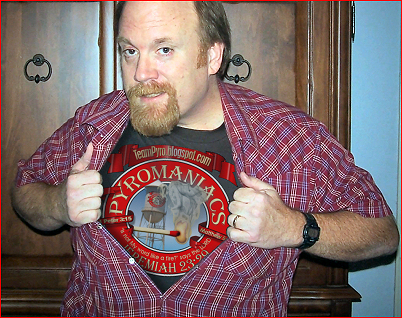
Thursday, April 26, 2007

Hijackers!

Folks who do blogs want readers, and commenters. Duh! Otherwise, why write?

But all of us who have any trafffic whatever have occasionally run into one sort: the thread hijacker.

I was reminded of this at a couple of friends' blogs, a bit ago. This is the sort of person with a giant chip and a giant need, who comes in and slaps down some outrageous comment with one design: to move the focus of the thread onto himself.
First sign: inane comment
Second sign: instant-response interaction with each and every reply
This is, apparently, the whole aim. Whatever the initial post was about is secondary. The primary thing is to lasso the attention of all comers, and Feed the Need.

So what do you do?

I don't know.

I know what I generally do. A response or two to the substance (if any), then ignore. I know, 'tain't elegant.

My model, loosely, is Titus 3:8-11.
The saying is trustworthy, and I want you to insist on these things, so that those who have believed in God may be careful to devote themselves to good works. These things are excellent and profitable for people. 9 But avoid foolish controversies, genealogies, dissensions, and quarrels about the law, for they are unprofitable and worthless. 10 As for a person who stirs up division, after warning him once and then twice, have nothing more to do with him, 11 knowing that such a person is warped and sinful; he is self-condemned.
I have some at some blogs who are already on this list, so I just essentially never respond. I know what will happen if I do, and choose not to feed the pathology.

Given my fallibility, there are two "down"-sides to this:

  1. I might mis-diagnose, and mistake a genuine question for a hijack attempt because it is poorly or emotionally phrased.
  2. Even if the questioner is a self-absorbed vacuum tube, openminded lurkers who don't have the nerve to ask it might benefit from the discussion, even if it itself is pointless.
But here's the thing. I have limited time, resources, and brains. I just have to make choices as to where to spend them. In that, I have no choice!

And given that the hijacker is willing to give all his time to the pursuit of his goal (occupying the center of a thread's universe), I'm simply no match. So, no matter how many times his position has been finally refuted, he'll always have one more comment. It's probably a rewording of his third, refuted comment. But he's never done, because it isn't about the issue, it's about his psychological "itch."

So I just have to decide to give the lion's share to those who are asking genuine questions. I think (= hope) my record shows that the questioner doesn't have to agree with me. I just have to feel there's a point to it.

If I don't... no sale.

Monday, April 23, 2007

Glimpse into the psyche of a half-decent guy (for the ladies)

PREMISE: What follows all depends on whether you can imagine that I'm a half-decent guy. If you can't... well... maybe I'll post something of value to you later on. I move from there; whether you move with me is your call.

NOTE: this was written on April 13.

BACKGROUND: It's been another brain-frazzling week. I think I've managed a couple of posts at the Greek site, one at Pyro, and one here. Something like that.

Last night at Karate I re-injured my knee. I've been limping around since March 19, when I injured it dealing with four "assailants." It's taking me forever to get into the doctor's office. Meanwhile, I've re-injured it three times now, just doing normal things. (What did it last night wasn't actually any Karate move; it was just the reckless, wildeyed, irresponsible act of turning around. Yeah; getting older is great!)

So I'm hobbling around in my house with a cane. My wife very sweetly went out to get me a leg brace. So I go to my pc to check a couple of things, one of them being the Pyro blog. On that blog, I see this sweet post from Phil, wishing Darlene a happy birthday.

I was glad to see it. Usually, Thursday is one of "my" days at Pyro, but I really didn't have anything in my brain worth giving, so I was happy to see Phil posting a couple of times. And I think it's about Frank's turn, perhaps to go on with his promised series on apologetics. So I was a bit relieved — because, as I said, I didn't have anything. Besides, it was about bedtime, and there wouldn't be any time to do anything, anyway. Bedtime for me is a firm time, since I have to get up at 3:30am.

But then I see this:

Ay yi yi.

Oh boy, so what do I do? I had nothing. My brain is an empty coffee can, without the nice aroma.

I looked where I keep my under-development posts. Is anything ready to go, or close to it? Ohh, wonderful. Nope. Nothing.

So what do I do?

Well, I think very highly of Phil. His confidence in me means a lot to me; it matters to me. He's depending on me to come up with something. He's trusting in me to deliver.

So I take a breath, I pray, and I start thinking hard. Then I come up with something, off the cuff, on the spur of the moment. I typed fast and furious last night, then woke up at my usual time, and finished it this morning.

Why? Because Phil expressed confidence in me. That it was so public honestly didn't matter at all. It would have been the same in an email, a phone conversation. He was trusting me to come through for him. He honored me. I had to deliver. (Whether what I came up with is any good is for God and you to decide.)

"And this is 'for the ladies,' how, exactly?" Every woman will have some sort of tension with her man. She'll have some desire to dominate him in some way (Genesis 3:16), to disrespect him. He won't live up to every one of her expectations. He won't conform to her will in every regard.

So, what to do?

I'll put this positively, for whatever degree I'm representative of my species.

What gets the most out of me? Respect. Trust. Confidence. When someone expresses confidence in me, shows trust, shows respect, that is when I feel the most driven to give 110% or more. Both of my bosses at work have done so recently, and it really made me want to justify that confidence. And that's just my bosses. The more a person means to me on a personal level, the greater the effect. It unerringly has that effect when my dear wife gives me a "You'll do great"-type pep-talk, for instance, before a challenging situation. Her confidence and trust mean more to me than any other mortal's.

I think all at-least-half-decent men are basically the same. Trust spurs them to do more. By contrast, expressions of mistrust, disrespect, evil-eyed suspicion are likelier to tear down, dishearten, and crush men. Or if they're absolutely convicted that they're on the right course, they have to dig in their heels and grimly trudge on (to mix metaphors). But they're less likely to be hearing a critic who has already so severely misjudged them.

Isn't this along the lines of what Peter says in 1 Peter 3:1ff.? Remember, he's talking about a situation of actual sin. And in such a situation, he doesn't encourage the wife to tear her husband apart with her sharp tongue, nor to berate him, disrespect him, unman him, rip him to shreds. No, he urges her to shush, and show him quiet, devoted respect. (Read a lot more about that here.)

And that is in cases of sin — which, if we're honest, isn't where most marital friction arises.

For a half-decent man, do what Peter says. Express respect, trust, confidence. As far as you honestly can, cheer, don't boo. Build (Proverbs 14:1), make him feel like a king (Proverbs 12:4). The Proverbs 31 lady's husband didn't end up in the gates with the Big Dogs, by his wife telling him what a loser he was. It was because he could trust her goodwill towards him completely (31:11-12).

Be your husband's cheering section. A half-decent man will knock himself out living up to it.

Friday, April 20, 2007

Meandering mashal musings

[...a title that will only amuse my Hebrew readers. (Mashal is a hamfisted transliteration of the Hebrew word for "proverb," as in mishley shlomoh — "Proverbs of Solomon.")]

Over on Pyro I just reviewed Longman's commentary on Proverbs. Since I didn't want the review to equal the book in length, there were some things I left out, among which are the following:

I really liked Longman's handling of many of the sapiential terms (the Hebrew words behind "wisdom," "discernment," "understanding," "insight"). I will go back and revisit my own translations, and perhaps reconsider some of them.

And while I'm not dead-sure I agree, Longman's wrestling with Proverbs 8, with issues of the afterlife, with gender-issues, was beneficial. One area with which I know I disagree, however: on the one hand, he unapologetically affirms that the supposed audience is male, but says we can just turn around remarks about men or women, genderwise. For instance, things Solomon says about marriage to an argumentative and angry women can simply be flipped to apply to an argumentative and angry man.

Now, in the first place, of course it is true: marriage to an argumentative and angry man has to be nightmarish.

On the other hand: it seems to me that respect for verbal inspiration leads us to wonder why some things are recurrent themes in Proverbs. The argumentative woman, the woman driven to destroy her family (14:1b) and specifically her husband (12:4b); by contrast the excellent woman who makes her husband feel like a king (12:4a), and is so encouraging that he achieves excellence and prominence himself (31:23).

Is it really just a flip of the coin that these are all gender-aimed as they are? I don't think so.

Also, I wish the book had been laid out different. The Theological sections are not well set apart, as far as the printed layout. I wish a smarter "hand" had guided the composition of the book, in terms of typesetting — if that isn't an archaic term.

I was puzzled that Longman didn't interact with Kidner more. On that, Pyro readers may be puzzled that I consider Waltke and Kidner as indispensible. Waltke is about 95,000 pages, and misses nothing; Kidner is about 12 pages, and brief. How can I say that they are both "must-haves"?

That was my initial impression of Kidner as well: too brief! But as the years passed, and my understanding of Proverbs (I hope) deepened, so did my appreciation for Kidner. Kidner is simply a marvel of compression. His style is almost Proverbial in itself. One title, one phrase, will be so well-crafted, so pithy, so memorable, that it will suggest a whole line of thought all its own.

Oh, theologically I'm to the right of Kidner. For that matter, I'm to the right of most writers. But his comments, while brief, expose a depth of thought and reflection, and a mastery of wordcraft, that Longman and I both would do well to pursue, but to which neither of us has attained.

I do read commentaries on Proverbs with some trepidation. It has long been a dream of mine to write a commentary on Proverbs myself. For that matter, it's a dream of mine to be published, period. (I was given hope on that a year or so ago, but it has dwindled.)

But Proverbs has lacked commentaries that are academically and exegetically sound, theologically rich, and both pastorally and homiletically useful. Something like Leupold, only in Proverbs.

So I read each commentary with the thought in the back of my mind: is there still a need for such a commentary?

I read Waltke and think "Yes," because it is almost too deep — though it is certainly excellent. I read Longman and think "Yes," for reasons suggested in the Pyro review.

I'm reading Kitchen now... and it's worrying me.

Thursday, April 19, 2007

"It was twenty years ago today"... yesterday

Our sister Kim the Kanadienne writes a characteristically transparent reflection on the 20th anniversary of her wedding to the infamous Bugblaster. Here's just one chuckalicious excerpt:
When I was a young bride of 22, I had no idea of what it meant to be married. I thought marriage was all about having my needs fulfilled and finally finding that perfect, romantic person to do all the fulfilling for me. I had little understanding about humility, submission, and forgiveness. In the first few months of my marriage, I threw a box of After Eight mints at my husband as he retreated down the hall, anxious to get away from my temper. I am happy to say that I am still very rough around the edges, but I am getting better. And I don't throw things at him anymore ..... much.
Read the whole thing for the smiles and wisdom.

Wednesday, April 18, 2007

What if Joss Whedon directed "House, M.D."?

My wife and I try not to get addicted to more than one TV series at a time — well, two, tops.

At present, our addictions are 24 (of course) and, most recently (thanks to our going-to-be-a-doctor-DV son) House, M.D. We've been watching House each week and, at the same time, catching up on past episodes through the wonder that is Netflix. Since the show's only in its third season, we're almost caught up.

We like the show a lot. It's very intelligent, mostly very well-written, and the actors (particularly Hugh Laurie in the title role) are very good. Actually, Laurie is marvelous, particularly given that he's a Brit acting in a flawless American accent.

House himself is a terrible man, just terrible. Absolutely brilliant doctor, wreck of a human being. I doubt we watch an episode without me turning to Valerie, exclaiming "He's awful!" He's unsympathetic, impatient, never suffers fools (or even non-genuises) gladly, has the bedside manner of Hannibal Lector, and horrendous ethics.

But he's tireless in his pursuit of the cause of each week's disease, he's funny; and often, as he is watching, he has the most haunted look of yearning sadness that the viewer hopes that something is going on inside.

Plus, the episodes often do a surprisingly good job of raising ethical issues, and that in a non-clichéd way. And usually these episodes are kind of like (if you'll pardon the metaphor) a road-kill pizza: a real array of meatiness, yet complex and knotty. For instance SPOILER ALERT ON — there was the episode of the pregnant woman who would die unless she accepted a treatment that would kill her unborn child. But the woman was (to us Christians) unsympathetic in that she was unmarried, and had the child fathered by a homosexual friend's sperm. Yet she was absolutely insistent that the child would live, even if she died. And she insisted on calling it a child, while House insisted in calling it a "fetus." Plus his boss, Dr. Cuddy — whose spirituality and ethics are better than House's, but that's not saying a lot — was pursuing saving child and mother as intensely as House usually pursues his weekly mystery disease.

And then House does surgery on the unborn child -- who reaches out and grasps his finger. He's clearly moved. He calls it a "baby" after that. The last scenes shows him alone in his apartment, looking at the finger the child touched.

Yes, you read me right. That was on network TV. — SPOILER ALERT OFF —

If I had one criticism, it mght be of the fact that every episode we've seen follows exactly the same formula. Opening scene shows some happy soul, who within a minute or two is struck down by The Mystery Disease of the Week. And whatever else happens, it will take the whole episode to figure out what's afflicting this person. Plus, the hospital's tests alone will usually worsen it, as will initial treatment.

Now, if Joss Whedon were directing....

In case you don't know him, Whedon was the genius behind the Buffy, the Vampire Slayer, Angel, and Firefly TV series, as well as the movie Serenity. How would House be different if Whedon were in charge?
  1. He would certainly mess with the formula. It would not be the same from week to week. One week — it might be a musical!
  2. He would have killed some major character by now. Probably either Dr. Cuddy or Wilson; it has to be one everyone loves. I say it'd have been Cuddy, since House needs the counterpoint of Wilson (who plays Dr. Watson to House's Sherlock Holmes).
  3. Religious characters would not have been portrayed so sympathetically. I've often remarked that Joss Whedon (a self-described "angry atheist"), like most Hollywood writers, has evidently never ever known well and liked even one genuine, practicing Christian.
  4. The humor would be as sharp, or sharper.
  5. Sexuality would be about the same (which isn't good), except that one heterosexual character might "go gay" for no apparent reason whatever.
  6. The seasons would have serious plot-arcs. At present, they've had a weak arc here and there, but basically you can jump on this train at any time, and not have missed much.
  7. There would be more character-evolution. As it is, every one of the four major characters is basically exactly the same as when we first met him or her. If Whedon were at the helm, this would not be so.
Your thoughts or additions? I mean, besides how terrible it is that I know either House or Whedon?

Monday, April 16, 2007

Who said that the particular redemption position "heresy"?

That would be Jerry Falwell.

You may recall that I initially thought the same. Evidently the difference is that Dr. Falwell stayed with his first kneejerk impression, rather than thinking it through.

So in Falwellville today, the list of "heretics" has grown to include John Owen, Jonathan Edwards, Charles Spurgeon, J. I. Packer, John MacArthur Jr., Phil Johnson, R. C. Sproul, Al Mohler, Charles Hodge, A. A. Hodge, Wayne Grudem, S. Lewis Johnson....

And, for what it's worth, Dan Phillips.

Sunday, April 15, 2007

Archaeological Study Bible

So Zondervan's put out this Archaeological Study Bible, which looks very cool in ever way except one: it's in the NIV. This is strange, to me. The design in such a Bible would be to get back to the original source, but the NIV (at times) gets about as far away from the original source as you can without being a flat-out paraphrase.

So here's my question: does anyone know of any plans to release this study Bible in a translation? I've read it was originally supposed to be NAS, which would make more sense to me, as would ESV or even NKJ (though the latter would deserve some footnoted beating up over its NT manuscript choices).

I'm reluctant to buy it as-is. Two reasons:
  1. I don't really want another NIV.
  2. I shudder to think of the well-deserved payback-teasing I'd endure at the hands of certain NIV users I know, love, and mercilessly mock.

Friday, April 13, 2007

Proverbs 3:5 "favourite" verse

A British survey found that Proverbs 3:5 was the "favourite" Bible verse of those polled.

But I have to wonder: how many of them actually understand it?

Thursday, April 12, 2007

Would you please turn that thing off?

Kim the Kanadienne writes about people who relate (?) to other people with one I-Pod bud in their ear. She's right, of course, and I think she's handled I-Pods and what they communicate just fine. I'll pile on, and add a pastoral perspective.

Cell phones. I could go on and on about this, and you could as well. Cell phones are a great invention and a great tool, but some people... yikes.

I saw three ladies walking together. Two were talking on their cell phones. Were they talking to each other? About the third?

I saw an older guy riding a bike. He had a cigarette in one hand, a cell phone in another. How did he bike?

More and more, when I see stupid, thoughtless and/or unsafe driving on the freeway, the driver is talking on his/her cell phone. And usually driving a white car, but that's another subject (of which the title would be White Car Drivers: Worst In The World).

It's a particular pet peeve in theaters. My oldest son (Matthew) and I have often been driven nuts by people who accept, and persist in cell phone calls during movies. When they flash the "Please Silence Your Cell Phone" screens before the movie, Matt and I applaud loudly. He'll often say, very loudly, "DAD, DID YOU PUT YOUR CELL ON 'SILENT'?" And I'll loudly say, "HERE, LET ME CHECK," and hold the cell above my head, and silence it.

One recent movie: it's the very dramatic, heartwrenching climax. Some idiot gets a call, AND TAKES IT.

I have often leaned across to such people and said, "Don't you just hate it when the White House keeps bugging you?"

How can these calls be that important? Good heavens, if you knew you'd be called in to brain surgery, don't go to a movie!

I understand parents going to movies, leaving baby sitters, and setting their phones on vibrate. Then you see the call, and you leave the theater, and take it. There are other people in the world, right? At least that's what I hear.

Cell phones, I-Pods... these can all be ways of communicating to the people around you that, to you, they don't exist. Or they're inconsequential. Not very Matthew 7:12 behavior.

Pastoral addendum. So here's a pastoral pet peeve. No, I'll just phrase it as a command:

When the pastor comes over, turn your darned TV off!

For that matter, when anyone comes over, turn the darned TV off.

"So, if you died and stood before God, and He asked you, 'Why should I let you into my Heaven,' what would you say?"

"Oh. Wow. Well, I guess I'd -- oh, wait. It's the Daily Double!"

Right.

Leaving your TV or your radio on when someone is there to see you tacitly says, "I'm pretty sure you're not interesting enough to keep my brain functional, so I need this going in the background, mmkay?"

No, not really "mmkay."

Turn it off, put it down, pull it out of your ear. Be there for and with the people who are there for and with you.

Thursday, April 05, 2007

All right, this is just funny

Sad, but at the same time, funny:
Why is it that all the Dem candidates are still married to their first spouse, while among the current crop of leading GOP contenders, the only guy with just one wife is the Mormon?

Wednesday, April 04, 2007

The Gospel = "Jesus died for you"?

I pretty surely remember when I was first exposed to 5-point Calvinism. It was in the mid-seventies or so, in the book The Forgotten Spurgeon, by Iain Murray.

I was appalled.

Spurgeon had already caught my attention as a wonderful preacher, but I didn't know that about him. Heck, I didn't know that about anybody! To my certain knowledge, the Gospel was defined as telling people "God loves you, and has a wonderful plan for your life. Jesus died for your sins. Accept His sacrifice, and you will be saved. If you don't accept it, you will be like the criminal who does not accept his pardon, and must serve out your term, because God has done all He can."

So here's this guy saying that God doesn't wait for our permission to save us anymore than a lifeguard waits for permission to save a drowning man. It doesn't depend on "free will."

What? I had thought everybody believed in free will. But this guy didn't.

Next I remember reading from that perspective was John Murray's Redemption: Accomplished and Applied. At this point, I'd gone a bit further in my own studies, and I was less appalled.

But somewhere around there, I'd started re-thinking. I was a fuzzy Amyraldian, though there were all these weird verses about sovereign predestination, election (Ephesians 1:3ff), sovereign and irresistible drawing (John 6), and all. They were hard to fit in, and just sort of "sat there" in my thinking.

One thing that opened my mind was revisiting the actual evangelism of the apostles. If anyone knew how to evangelize, it was these guys. So how essential did they find saying "God loves you, Jesus died for your sins" in Gospel preaching?

So essential that they never said it, at least not on-record.

Nothing changed in the epistles. They regularly talked about God's love and Christ's death for "us" and "you" (Christians), and for the church — but more general expressions of God's distinguishing love and Christ's effectual redemption were few and at best ambiguous.

I thought of this again a couple of days when Dr. S. Lewis Johnson mentioned it to me.

Dr. Johnson has gone to be with the Lord, but he being dead yet speaketh, thanks to modern technology. Believers Chapel provides a real gold mine of Johnson's sermons and lessons, which I am grateful to have on i-pod, or IPod, or iPod, or however you spell that. So I take Dr. Johnson on a lunchtime power-walk with me everyday, or ask him to keep me company as I cook burgers for my family if none of them want to have anything to do with me.

I was listening to The Design of the Atonement: For Whom Did Christ Die? - V, in which Dr. Johnson responds to objections raised against the particular redemption view. Among others, he raises the objection, "But that would mean that you can't tell people you evangelize that Christ died for them."

What would he say? Many Calvinists I respect argue for saying this (as well as "God loves you") in evangelism. Johnson was hard to pin down into any one category completely. Where would he come down on this?

"That's right," was his answer.

He went on to say (I paraphrase) that apostolic preaching and Christ's own words authorize us to say that we are all sinners under the wrath of God; that God loves sinners, and sent Christ Jesus into the world to save sinners; and that any and every sinner who repents and believes in Jesus Christ will certainly be saved. Further, any who wished to, may and is commanded to come.

This, to my mind is apostolic preaching. It really tells the sinner everything he needs to know, without either (A) making unsubstantiable statements about the eternal counsels of the Trinity, or (B) giving false grounds of confidence to the sinner.

On that last note: perhaps I was an exception. But before Christ, as a hard, Christ-rejecting sinner, if you'd told me "God loves you," I'd have said "Great. I believe that, too." If you'd told me, "Jesus loves you," I'd have said, "Whatever." And if you'd said, "Jesus died for your sins," I'd probably have said something like, "I don't believe I have any sins; but if I do, sounds like I'm covered."

Which isn't what we want to communicate, and isn't what the apostles did communicate.

Final note of unnecessary emphasis. Am I revoking the Calvin-card of anyone who differs from me on this issue? Merciful heavens, no. I don't control club membership; it's others who think they do. And I know that none of those who see this differently would communicate any of those false ideas (i.e. everything's okay for the lost, they don't really need to repent).

It's just how one muzzy-headed young man's mind was opened to Biblical Calvinism.

Monday, April 02, 2007

Where I Am Right Now® (mostly-personal blah-blah-blah)

Posting has been light, here, recently. Some things have been going on keeping me busy and middle. Here are the ones I'll tell you about:

New laptop.
I just upgraded my old Toshiba Portege 3505 for a Gateway CX210S. Both are convertibles, which is to say that you can use it either as a laptop or a tablet. The monitor twists around, and you can write on it with a stylus. It's really cool: I've used it for classes, it comes with me on retreats or trips, and I take notes on it during sermons. I can have half a screen with BibleWorks 7, and half with Windows Journal. The older Toshiba had no internal optical driver. I had to plug in an external CD drive. But it was light and cool. The Gateway has a faster, dual-core CPU, twice the HD size, 1GB of memory, an internal DVD-RW drive, and a larger, very clear screen. I also got a 12-cell battery, so it could go a lot longer between charges. It is a lot heavier, though, but that's not a real problem.

What was a problem was that the cursor displayed as a big, black box instead of a dot. It took Gateway almost 2 weeks to hook me up with a driver upgrade that resolved the issue. Otherwise, getting a new pc is like moving into a new home. You have to install all your programs, copy all your files; and you have to uninstall the unwanted garbage that comes with the pc. (Gateway is not nearly as bad as Dell in that regard.)

Here's a funny thing: I got this great laptop for just over one-third of what the Toshiba cost some 5 years ago.

New Operating System. The laptop came loaded with Windows Vista Home Premium. This is my first experience with Vista, and danged if they didn't move everything around! So that's taken some getting used to. Thus far, I like it. It's definitely pretty! But I had to retrain myself on how to do some common tasks.

Microsoft OneNote. I gather that Windows Journal (which I'm used to) is to OneNote as Wordpad is to Microsoft Word. But OneNote is really taking some getting used to, and I'm still not comfortable with it. OneNote doesn't actually save discrete files; it auto saves whatever you're working on. I've watched a number of training videos and read some documents, but still really don't get how to organize what I'm creating. All those tabs... I just don't get it. I bet someone has a good page or post on it, but I've Googled in vain so far.

Scholar's Library: Silver - Logos Bible Software 3. I'm reviewing a new Bible Study(and more) program, and it's really taking some getting used to. It's massively powerful and very impressive, but even starting to use all its assets is (to me) not intuitive. There's just a lot to learn, but it's clearly worth it. Logos helpfully provides a lot of tutorial videos, and I've been working my way through them.

Hot times at Pyro. You can read all about it in this post, if you haven't already. Some brave anonymous professor writes about hearing God's voice and writing a book under divine inspiration. I had a few warm words to share. I thought I was probably going to be under heavy fire, but the comment thread seemed to be tapering off at 30-40 comments. Then boom! it took off, before coming to rest (so far) at 169. It never makes me happy when people get mad at me. However, some of the angry people were really kind of funny, if you look at it from the right angle.

It's what happens when you do write pointedly, and don't write anonymously.

Preaching. Some of the happiest times in my life are when I get to preach, and I just did. Read about it here, if you like.

Ouch. About two weeks ago in karate, we had one of those exercises I really enjoy. One student was surrounded by four others, each of whom was to attack with one strike, followed by the others in rapid succession. The person in the middle had to block that strike and respond quickly with at least three strikes of his own. It's a great workout; one of the students is a really excellent (and aggressive) black belt. Every encounter with him is educational. Often painful (and bruising!), but always educational.

Well, I was very winded, but doing all right for an old fossil — blocking, striking, pivoting, shoving my opponents into the others. But I have a kind of tricky right knee. A few times, I've done something and it has yelped at me to stop. So far, I've always stopped short of really injuring it.

But not that night. I probably pivoted clumsily, but all of a sudden my knee was out of it; and it was kind of hard to carry on without that knee. Sort of attached to it.

So I limped like Walter Brennan for quite some time, with a very sore knee. It still hurts. Unfortunately, I didn't injure my appetite. So I've been unable to do my hour-long lunchtime "power walks"... but I've been able to eat just fine. Clothes tighten, muscle tone declines....

Ah well, life of an old man taking karate with a bunch of younguns. Not likely to get much better.

Reading. I've also finished reading Tremper Longman (The Third, if you please)'s new commentary on Proverbs. I plan to do a review over at Pyro. Stay tuned.

Greeking — in public! Plus I've had a pretty steady output over at my Greekblog. I have really appreciated the folks who come regularly and interact betimes. I do hope the readership builds, and particularly among pastors. If your pastor isn't going there regularly, tell him about it!