Showing posts with label World-tilting Gospel. Show all posts

Friday, May 24, 2013

From 1990: Second-Hand Values or Can Conservatism Save America?

I wrote this in 1990. It was, I think, published in a local newspaper. See what applying Biblical logic (rather than listening for holy mumbling) can do for anyone. Sure worked for Machen, whose writings from the 20s and 30s are chillingly current.

I post this without editing, overuse of parentheses and all.


It is disappointing when a plant dies. It is even more frustrating when a plant blooms, shows apparent health — and then keels over, limp and dead. What happened? Could be shallow soil, could be lack of nourishment, could be hungry bugs…. Regardless, the plant is gone.

Conservative values seem to be "blossoming" in a number of ways. We have a professedly conservative President [George Bush, at the time of writing]. Ads for William F. Buckley's stimulating National Review are hard to miss, on radio and television. Everyone and his brother is a Rush Limbaugh "ditto-head," and can quote the deservedly well-known (and notorious) talk-show host on many given subjects. Surely anyone who holds conservative values (as I do) would be beside himself with glee and optimism.

But I'm not. Not yet. Here's why:

Once upon a time there was a generation of Israelites who were delivered by God from Egypt. They turned out to be a terrible disappointment: whiners, rebels, closet idolaters almost to the last man. So God sentenced them to a few "laps" in the desert: forty years' worth.

The next generation showed more promise. Apparently humbled by their parents' bad example, they pledged and displayed loyalty to God's appointed leader (Joshua 1:16-18). This devotion even surpassed the "inconvenience barrier," as the males all submitted to the at-best painful rite of circumcision (Josh. 5:2ff.). With a few inevitable glitches, that generation basically performed adequately. As the inspired historian tells us, "the people were serving Yahweh all the days of Joshua, and all the days of the elders who prolonged their days after Joshua, who had seen all the great work of Yahweh which He did for Israel" (Josh. 2:7).

So far, so good. Then what? Then Joshua and his generation died, and "a different generation arose after them, which did not know Yahweh, nor even the work which He had done for Israel" (Judges 2:10b) This generation had second-hand divine viewpoint values. And "second-hand" proved to be not good enough, as these folks proceeded to get involved in compromise, spiritual and moral gutlessness, idolatry, and the inescapable consequence: divine judgment (cf. Judges 2:10-15).

Now, none of this was necessary. God never promised to give "command-performances" of His miracles in the desert. These miracles, and what they taught of God's character and ways, were not to be re-produced, as the modern "signs and wonders" crowd mistakenly imagines. No, their lesson was to be transmitted through teaching from parent-to-child, parent-to-child (Exodus 12:26, 27; Deuteronomy 6:4-9; 32:7ff., etc.) Future generations would internalize the same truth of God by the Word of God, and by faith in that Word (Ps. 78:3, 4).

The problem: though God's Word provided the answer, Israel did not accept that answer. The nation did not obey God. The result was that devotion to the truth perished with the first beneficiaries. And so the outward trappings of religion can survive the death of the inward reality, resulting in external religious form without internal power and conviction (cf. 2 Timothy 3:5). In short, we end up with people who hold a few selected religious values, without knowing why, and without an overall, deeply-rooted rationale and game-plan.

I think that this is what we see today. The "plant" appears to be blooming —— and understandably so, given the manifest bankruptcy of liberalism across the board. But modern "conservatives" are rootless, and the prognosis is not particularly good. What symptoms are manifesting themselves? Take a recent issue of National Review (July 9, 1990). It contains a letter from a Mr. Liebman, who counts arch-conservative Buckley as his "best friend" (p. 16). Liebman says that he has been a Roman Catholic for ten years, an active conservative for over three decades, and a homosexual. Buckley's response (p. 18) is vague, tepid, and affectionate. Although he expresses misgivings about homosexuality, Buckley fondly embraces Liebman as a fellow-conservative, calling him his "dear friend" and "brother in combat" (p. 18).

Similarly, Rush Limbaugh has said in effect "I don't care who sleeps with whom," and makes it clear that he is bothered by organized homosexual politics and rowdiness, rather than by homosexual orientation and behavior per se. He has received and welcomed politically conservative "gay" callers. By contrast, Limbaugh angrily dismissed a caller who dared to suggest that "sodomite" would be a more fitting appellative than "gay." It seems that bad taste bothers Limbaugh more than questions of bad morality.

And so, on what basis can either of these public figures, or any others, register complaints about organized "gay" activities? To my knowledge, neither clearly appeals to any objective, unchanging, absolute standard; such an appeal might backfire. Neither clearly says, for instance, "My personal feelings in the matter are irrelevant. I am bound by Biblical revelation, which records God's attitude towards homosexual practices." Accordingly, the publicly "conservative line" concerning homosexuality appears to boil down to personal bias — which plays right into homosexuals' common counter-complaints of "hate" and "homophobia."

Other examples could easily be multiplied. Just think of the ever-waffling Republican party (pro-life...pro-choice...pro-life...pro-choice — "What do the polls say I should be today, honey?"). "Conservative" becomes more and more difficult to define; and "conservatives" in power are desperate to distance themselves from religion or religious people — except so far as to garner their votes. Overlap between "conservative" values and (say) Biblical teachings is fortuitous, but sheerly eclectic and coincidental. Therefore, a "conservative" today ends up being in effect someone with certain ideas about economics, politics, and morality, but no deep diagnosis of the cause of man's problem, no unchanging basis for his own values, and therefore no rationale as to why anybody else should embrace those values.

This is a prescription for long-term failure. It will result in a "plant" which may bloom brilliantly for awhile, but which is doomed to die for want of soil, roots, and nourishment.

The Bible provides what "conservatism" lacks, and what men and women desperately need. It gives an absolute, objective, revelatory basis for thought and life. (The phrase "Thus says the Lord" alone occurs in some 416 verses in the New American Standard Bible). It diagnoses man's problem as being twofold: his legal standing before God ("through one man [Adam] sin entered into the world, and through sin death, and thus death came through to all men, because all sinned"; Romans 5:12), and his nature ("the mind-set of the flesh is hostility towards God, for it does not subject itself to the law of God, for it is not even able to do so"; Romans 8:7). Too, the Bible puts man's crisis in its proper perspective: it is not the deficit nor the Dow, but "the wrath of God...against all ungodliness and unrighteousness of men who suppress the truth in unrighteousness" (Romans 1:18).

The Bible also prescribes the only solution which will abundantly address our fundamental problem: the person and work of the Lord Jesus Christ. He takes care of believers' legal standing before God ("being declared righteous as a gift by His own grace through the redemption which is in Christ Jesus"; Romans 3:24), and He changes believers' hearts ("if one is in Christ, he is a new creation: the old things passed away; see, new things have come into existence"; 2 Corinthians 5:17).

As long as "conservatism" imagines itself as containing within itself the ultimate answers to man's dilemma, it is doomed to die like our "plant." But the man who trusts in Christ, and learns and obeys His word, has hope, has direction, and ultimately has the answers that this tired old world needs: "Jesus Christ...the same yesterday and today and forever" (Hebrews 13:8), and "the living and abiding word of God" (1 Peter 1:23).

If only we would listen.

So you see, it was evident in 1990 that the only real solution was the world-tilting Gospel of Christ.

This is all the more evident, today.

Tuesday, January 22, 2013

The dark side of guns

First, let me say what regular readers, Twitter followers and Facebook friends already know: when it comes to Second Amendment rights for Americans, I'm well-nigh libertarian. I think not only is gun ownership a right, it's a darned good idea. I'm often heard to say "When seconds count, the police are minutes away." As a Christian, while I accept the urge to turn my cheek to the insulting blows of enemies, I also accept the Bible's pro-life ethic in affirming the use of whatever force necessary to protect life, including deadly force.

More, I find the gun-control lobby's arguments to be puerile, asinine, superficial, absurd, and often hypocritical. They're easily dismantled, and often have been. Rightly so.

What is more, "Guns don't kill people, people kill people" is absolutely correct, as stated. People were killing people long before guns were even dreamt of. Ask Abel's grieving parents.

Having said all that...

The one thing all of us Second-Amendment pro-gun types need to deal with is the fact that guns do pose their own unique risk. I have in mind something other than the specter of youngsters getting a hold of a handgun, and killing themselves and others. That nightmare is easily remedied by gun safes or other similar measures.

What I have in mind is the ability of a firearm to deal death (A) in an instant, (B) from a distance, and (C) with no recourse. If the weapon is a fist, a knife, a rock, a brick, it can still be deadly. But not as quickly, and not as irremediably. There are self-defense measures available to give folks a chance in a hand-to-hand encounter. There are no self-defense classes for being shot at, from close range. Only guys in movies can knock bullets aside with swords.

A man cannot stand across a room and strangle a woman. But a woman can stand across a room and murder a man with a single, well-aimed shot.

A gun can turn a momentary rage into murder. Fly into a rage, pick up a gun, pull a trigger, the person's dead, the rage subsides — the person's still dead.

For instance, take two stories I saw the day I wrote this. A man went to his estranged wife's house for a 16th birthday party; the couple argued; he shot her and himself dead. Bang, over.

Elsewhere, a fifteen-year-old boy apparently shot both of his parents and his three siblings dead. Pubescent rage? Maybe. Whatever it was, when it subsided, they were all dead. Any chance he could have beaten them all to death, or knifed them all to death? Not likely.

Now at this point a gun-grabber might be thinking, "You're so close! Give in to the dark side." Yeah, on that: not a chance.

The simple and decisive counter is that there IS no law, and there CAN BE no law, that would have prevented either incident — unless it be a law authorizing the confiscation of every last firearm in possession. And that idea is sheer idiocy. First, it couldn't be done. More, it shouldn't be done. It would leave yet more innocent, law-abiding citizens vulnerable to criminals...and to governmental stormtroopers. So that's a non-starter.

All this brings us back to this: once again, the problem is human nature. And that's a problem that no law can remedy.

What America needs is what Britain needs, which is what Israel needs, which is what Switzerland needs, which is what South Africa needs, which is what every tribe and nation and people needs. We need something that will transform our natures, that will take a violent woman or man who is bent on conquest and theft, and will transform him or her into one who loves and gives.

What we all need is to know God. What we need is the world-tilting good news of Jesus Christ. Only Jesus Christ can redeem a lawless man or woman, make him right with God, and transform his nature (Titus 2:11-15; 3:4-7).

So here's the irony. That is what we need; and that is what is opposed by most American gun-grabbers, and increasingly suppressed by most office-holding gun-grabbers.

Unbelief always is, in the final analysis, suicidal.

But then that's hardly breaking news. Read Genesis 3.

Wednesday, January 16, 2013

Doc Martin and redemption

As a result of suggestions made by you, Dear Readers, Valerie and I are watching the British TV series Doc Martin on Netflix.  We just finished the third episode of season 4, and don't want spoilers, thank you very much.

The premise of the series is that Dr. Martin Ellingham, accomplished surgeon, is suddenly seized by hematophobia. Accordingly, he leaves surgery (hard to do the slicing without some splashing), and ends up as the GP in a beautiful bayside town called Portwenn. The latter is played by Port Isaac in North Cornwall, England.

The basic format is that of a medical mystery / romantic comedy. Locals persist in calling Ellingham "Doc Martin," against his frequent but now-fading corrections. He is himself a surly, rude man, bereft of the least whiff of tact, and proud of it. He calls tact and sensitivity "rubbish" (which is a modern Britishism for "humbug"), and he'll have none of it.

But Ellingham is medically well-nigh brilliant, and eventually sees through everything sent his way. And while he virtually never shows the least bit of kindness or compassion per se, one of the most recurrent sites is of him running at full speed to some medical emergency.


As you're probably already thinking, it is impossible not to make comparisons to the American series House, MD, which started the same year. Both men are rude and churlish, both men have handicaps that irritate them, both men are medically brilliant, neither man rests until he figures out the medical mystery.

But there are major differences. One dissimilarity is that there's little real malice in Doc Martin. He's guileless. For the most part, Ellingham isn't trying to be mean; he just IS mean because he doesn't care what people think about him or what they make of what he says. Occasionally he effects a puzzled look indicating that doesn't seem to understand what others' problem is — if he even takes note of their reaction.

House, by contrast, was deliberately cruel, setting out to make fools and liars of people and expose their (assumed) hypocrisy. The least flicker of virtue in others constituted a glowing target for House, compelling him to search for a pathology of some sort.

And yet here also is a place where early House was superior to anything we've yet seen in Doc Martin. As I discussed elsewhere, in the early years Dr. House was longing and searching desperately for redemption. He knew he was a broken man, sometimes admitting his need for help; and he hated the horrid place the world was. House longed for something transcendent to cling to, something to give him hope; yet he had the settled conviction that there was no such thing. So House's compulsion to "expose" people who did have hope and transcendent values was driven by a bitter certainty that no real hope existed, a fury at that fact, impelled by a remaining flicker of hope that he'd find something he couldn't deconstruct.

There's nothing of that in Doc Martin. Ellingham's only discomfort is with his hematophobia, and that only because it keeps him in that dreary little village with those dreary little people. He neither longs nor searches for redemption of any sort. When he thinks of it at all, he thinks the rest of the world is off-kilter, addicted as it is to "rubbish" like tact and kindness and compassion. They should all be like him. Or not. He just doesn't care.

One's view of Ellingham is ameliorated a bit by glimpses of his upbringing. He alludes (admiringly) to severe and unloving discipline as a child. More becomes clear when we meet Ellingham's parents. Horrible people, sneering and loveless. Ellingham's father has few or no redeeming traits; and his ice-cold mother tells him, in so many words, that his birth and very existence ruined her life. She was happy before Ellingham as born; then, with his arrival, her life was rubbished. It hurts more to see Ellingham take abuse from both parents with no sign that he thinks them out of line, that he sees what a wretched, inexcusable cruelty it is. This is what has formed him.

Yet the humanist's version of redemption does nibble at Ellingham, in the form of a pretty little teacher named Louisa Glasson. For reasons which baffle and elude any viewer not schooled in abnormal psychology, Louisa is attracted to Ellingham early on, and he to her. Their conversations are really funny, in that every slight encounter turns into an argument. The first time they kiss, he instantly — without a pause — launches into speculation as to the medical causes of her bad breath. The second time they kiss, he speculates that a bad menstrual period explains her being over-emotional. Yes, it's that bad. He's that bad.

SPOILER ALERT ON

Then, in a careening plot line, Louisa finally shows some sense, and breaks up with Ellingham. He is utterly miserable. They happen to encounter each other, and he... proposes marriage. And she accepts! Yes, they literally have not put together two consecutive happy days together, let alone two consecutive happy hours, but they're about to marry.

But even that is doomed. They end up leaving each other at the altar.

In this sequence, both are revealed as selfish people, though Louisa less so. That is, they both primarily want to be made happy by someone. She doesn't want to take Ellingham on as a project, and I daresay anyone who cared a whit for her would agree. He won't make her happy, and she won't make him happy, so they leave each other.


SPOILER ALERT OFF

Valerie and I continued watching because the locations are lovely. The cameraman only seemed to notice that fact with the beginning of the third season, and we started being treated to more artistic views. Also, the people are quaint and quirky, rather like the characters in the All Creatures Great and Small series.


Yet, as my dear wife has observed, it's only rather like. Something keeps the series from being fun. The writers seem to hold all their characters in contempt. The series has a negative attitude towards almost everyone in it. Every last person is unhappy and/or broken in some way. There are no exceptions.

And they're not "quirky-but." Some are insane, most are stupid and self-destructive and mean, none of them really seems to care for anyone other than himself, with the sole exceptions of Ellingham's aunt (who cares for him), a rotund father (who cares for his son), and a "chemist" (who adulterously lusts for Ellingham).

For instance, there's a ranger who's insane and has come close to killing several characters. Funny? Not a lot. Then there was the episode where a 15 year old girl was eager to lose her virginity, and overdosed on drugs because she was stung by her girlfriends' relentless ridicule over the size of her breasts. The happy ending? Ellingham gave her a placebo, and she viciously mocked one of those friends for the shape of her ears. She "won," you see, by getting the last hateful word in.

Like House, there's no redemption for Ellingham thus far. Unlike House, there's no longing for it. You watch a series like this, hoping for some epiphany to hit Ellingham, but so far none has so much as tugged on his sleeve. One religious character had an ongoing presence, yet his religion was shapeless and powerless, and both it and he were ultimately mocked and waved aside dismissively.

Only two even semi-hopes came by. One was a psychologist who immediately diagnosed Ellingham as having Asperger's, which at least would have explained his rudeness pathologically. The other hope of course is Louisa. Ellingham adopts a softer tone around her, and looks rather twitterpated. His voice becomes softer, and he looks like a big puppy, when she's around. Until they start arguing. Which they usually do.

But to date, they've not put themselves together, and in the real world (A) Louisa wouldn't even be available in the first place, and (B) this link-up never would have happened. Barring a sad, sad self-destructive pathology on Louisa's part.

And where does that leave Ellingham? He cared for Louisa as much as he cared for anyone other than himself and, to a lesser degree, his aunt. Nothing else calls to him but a return to his career as a surgeon, if he can just overcome this pesky phobia.

This is where modern screenwriters dip into a dry inkwell. How can they not? They live in a dry inkwell. All mankind is still banished from Eden, still longs for a way back, but still is unwilling to admit either the real cause of the problem or confront the real and only hope for a cure. So we wander on with Cain as strangers in the land of wanderers, complaining about the severity of our punishment but not owning up to our guilt. This is why all long for redemption, and this is why the best storytelling always contains an element of redemption.

But modern Brits, like modern Americans, have no redemption to offer. Amusement, anesthesia, diversion, yes. Mockery and derision of our supposed inferiors, yes.

Redemption, no.

So we watch broken characters like Dr. House and Doc Martin, longing to see them find the redemption we ourselves hope for. But the writers of House ran dry long before the series closed, and gave up all hope of the theme. So they resorted to the formula of House being monstrously cruel and hateful and brilliant. They had nothing more to offer. And so far, while their protagonist isn't the monster House become, neither do the writers of Doc Martin.

Because the only genuine hope for redemption is in the Redeemer... and facing up to that reality would entirely jostle their very world in a way which they are still denying and still fighting with all they've got.

Which is, ultimately, very sad.

ADDENDUM: SPOILERS

Valerie and I have now finished watching the entire series. There is no need to revise anything I wrote above. We enjoyed many things about it. The actors are excellent, the writing is clever, the characters are sad. Bert Large runs his business deep into debt, takes money from a loan-shark, and then won't pay the interest. (Point: the loan-shark didn't specify the interest at the outset; Counterpoint: if Bert is so dim-witted as to think the money was a gift, it's hard to his credit.) His son helps him... by stealing from his aged employer, taking advantage of her trust and affection for him. Nice. All the more so because she's not much more a "people" person than Ellingham, but she likes Al... who takes advantage of her, and barely apologizes. (He had to, you see.)

The poor messed-up constable is fleetingly reconciled to the estranged wife he adores, and loses her, humiliating himself all over again. The poor adulterously love-struck chemist abuses drugs and has a psychotic break. Louisa's long-estranged mother returns, all coos and kisses, only to endanger Louisa's baby and continue the same appalling behavior that shattered her relationship with Louisa in the first place.

Life at Portwenn, in other words, continues as usual.

Meanwhile, Dr. Ellingham and Louisa come to live together, courteously. Martin tries to try to try, Louisa is very patient...in some ways. Ultimately, she has her fill of Ellingham being who he is, and leaves him. Again.

But at the end of the final episode, there's a sweet reunion that does give some horizontal hope to both of them. Ellingham tells Louisa that he loves her, and it looks as if they have a future. More hopefully, Ellingham says he's not going to be a father like his own wretched father, and he doesn't want their son to grow up to be like him. All viewers will cheer both resolutions.

Commenting on this paused story, then, such redemption as we now see serves to glorify God's greater redemption in Christ, by contrast.

Louisa is Martin's only horizontal hope. His aunt Joan, who tried feebly to be an influence, has died. Her death saddened Ellingham, but seemed to provoke no great reflection or introspection. Instead, he used the funeral to blame her for her own death and to lecture everyone about their obesity.

Only Louisa softens him, reaches him, touches him, humanizes him. His voice is always softer in talking to her (until they start arguing, which is usually the case), and his face always takes on a puppylike look.

At the same time, while she shows him a lot of patience, it is limited and aimless — except insofar as it is selfish. Louisa puts up with a lot from Martin... but not so that she can help him grow or change. Nor has he indicated (until the end of the last episode) that he feels the need for any change. Indeed, it is the world that should change. It should become more like him.

Louisa appears to want only to change Martin to make him into someone more suitable for her. And who could blame her? What is more, if he did learn to suit her better, Ellingham would probably become a better person in the bargain.

But Louisa shows no sign of knowing God, so she has no Christ-centered goal for herself or for Martin, and thus doesn't have any idea what either he or she should become. She doesn't have it, so she can't give it.

Christ, by contrast, is hard at work in the lives of His people to conform them to the image of their Creator (Col. 3:10; Titus 2:11-14). To do this, Jesus Christ must be the epitome of long-suffering patience in His dealing with us (1 Tim. 1:16). Unlike Louisa, He will never under any circumstances leave His people (Heb. 13:5-6), and will save us not just part-way, but all the way (Heb. 7:25), and will never, every put us out (Jn. 6:37). His love for His people is unfailing, sovereign, invincible (Rom. 8:35-39).

You see, that's real redemption. That's what it is to know God. It is a redemption that finds us as ruined and with nothing whatever to offer (Eph. 2:1ff.). It finds us not even as "fixer-uppers," but as hopeless wrecks. Yet there is hope for the hopeless, and that only because the Redeemer Himself brings it (Eph. 2:4-10). It is a redemption that begins with us in the very worst condition, and never rests in the good and joy and blessing and recovery that it brings us, not even to the endless ages of eternity.

Now, that is a redemption. Unfortunately, like Louisa, today's authors and screenwriters as a rule do not have that redemption themselves.

And so, like Louisa, they cannot offer what they do not possess.

Friday, April 06, 2012

"It is finished"

...before He died, Jesus cried, ―It is finished‖ (John 19:30). These three English words translate one Greek word: tetelestai (teh-TELL-ess-tie). With this marvelous word, Christ says, "It stands accomplished." Everything that needed to be done has been done; every bit of the mission the Father gave Him for His glory, the redemption of His people, the defeat of Satan, and the reclamation of the planet, has been brought to completion.

Jesus is saying that everything necessary for the completion of God‘s saving plan has been accomplished. At that moment, the great curtain that separated the Holy Place from the Most Holy Place tore in two, from top to bottom (Matt. 27:51; these compartments were discussed in chapter 4). This was an act of God, trumpeting that the way into the Holiest Place had been thrown open by the sacrifice of Jesus (cf. Heb. 9:8; 10:19–20).

The reality that all the sacrifices had foreshadowed throughout the many centuries of OT history now had come to fulfillment. The picture gave way to the reality, the shadow to the body, the promissory note to the full payment. God‘s very presence was open to sinful man through the substitutionary atoning death of the Son of God. 
(from The World-Tilting Gospel, 128)

Wednesday, October 19, 2011

Two TWTG items: first picture from a Men's Bible Study, and a neat review

The day started rough. I usually wake up before my alarm, but today it dragged me to consciousness. I was clumsy and off-game, and a bunch of little dumb things went wrong. Shirt-buttoning, no remote to listen to news as I shod myself, knocked box of Atkins bars onto floor (upside-down, duh), and so forth.

But one happy thing was that I knew I had this to share with you:

Last night Pastor Andy Chulka of Hope Bible Church in O'Fallon, Missouri Tweeted me this picture:


And here's the accompanying Tweet:


Even on my iPhone, I could make out all those little green books the smiling folks are holding up (there are a couple of Kindles as well, I believe). Gave me a happy chuckle; I hope it does you.

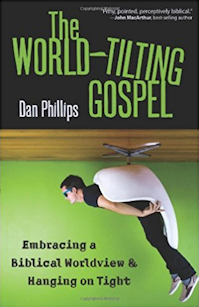
The folks at Kregel and I hashed out exactly what to title the book, and then which of several covers to pick. I'm really glad we settled on what we picked both, since both are distinctive. Google "world-tilting," and you mostly only find one target. Plus, who can miss that green cover in a bookstore?

Andy's picture thrills and warms my heart, as you can easily imagine. I have prayed that God will use The World-Tilting Gospel to instruct, help, encourage and edify individuals. Scores have written, Tweeted, and blogged that God has blessed it to just that effect, and I am very grateful.

But I also hope and pray to see it used to a great degree in church fellowships. I believe that pastors of like faith in the Gospel will be able to use the book as an extension of their ministries, as a way to frame discipleship. It can be the in-depth talk/study that each would like to have with every person in their church, if only there were enough hours in the day. It can supplement and frame their one-on-one discipleship.

If only the word would get out.

God grant that the Scriptural tour these folks at Hope Bible Church are undertaking will instruct, bless and encourage the brothers at Hope Bible Church, and exalt Christ  and His great work of salvation in their hearts and lives.

Now, the second happy thing, from someone doing her best to get the word out: Jaci Greggs, queen of the blog Me and My SoldierMan, has published her review of The World-Tilting Gospel.  It's thoughtful, warm, and very enthusiastic.  She begins:
If you are a Christian looking to grow in your faith and biblical maturity, this book is for you. If you are a new believer trying to figure out what to do next, this book is for you. If you are just curious about what Christianity is really all about, this book is for you.
...and then she concludes:
I could go on and on, but I'll finish by saying I cannot recommend TWTG highly enough. It will make you think, make you laugh, make you cry (or maybe that's just me), and goad you to a deeper understanding of who God is and what He wants for your life and this world. I can see TWTG being on my regular reading rotation for a while.
Thanks, Jaci. That does not harsh my mellow.

(Maybe you and Reformed Redhead can start a club?)

Wednesday, August 17, 2011

Guest reviewer: eight-year-old Michael S. Dickey reviews The World-Tilting Gospel

When one is in the stage of "selling" a book to a prospective publisher, one of the questions they ask is "What is this book's audience? Who would read it?" Prospective authors have to come up with intelligible answers.

In my submission of The World-Tilting Gospel to Kregel, back in January of 2010, I wrote that the book "speaks to Christians of all walks in life, from late teens [NB] and up. Pastors will use it, and give or recommend it to church officers and members. The format of headings and subheadings, plus the wealth of Bible-references, are designed for use in study-groups or discipleship classes for a wide age-range, as well as in individual reading." Now, of course, this reflected my intent and expectation. I didn't do a test-audience on it (as I later did do with God's Wisdom in Proverbs).

So when folks later read it, of course I was grateful and encouraged to have a brother like John MacArthur commend it, and it was delightful to have PhDs like Ligon Duncan and Jim Hamilton join in, as well as the rest. And while I watch for reviews, it has been terrifically encouraging for all sorts of folks (moms, dads, pastors, students, and so on) to report finding the book a blessing and a help.

But, friends and neighbors, brothers and sisters, you are about to read a review of TWTG that pasted a grin on my face that has not gone away, and won't for a good while. It was completely unexpected, and I frankly would not have guessed nor even hoped that the reach of the book would go this far.

It is from eight-year old Michael Dickey, the son of Mike Dickey who comments under the screen name VcdeChagn. He actually finished the book before his dad, and did a book report on it, which he wanted his dad to share with me. I have Mike's permission to share it with you — and I think you'll be glad of it.

Now young Michael is clearly, as his dad said, a "voracious reader," so I wouldn't necessarily recommend that Kregel do a campaign to offer the book to the single-digit set, and we parents shouldn't look too askance at our kids who might not be up to Michael's reading level. But he's a remarkable young gent, and it's my delight to share his review (book report) with you, as one of the very, very few guest-writers at this blog:


Transcribed (as-is):

by Michael S. Dickey
  1. Dan Philips wrote the book as a sort of every day helper. Dan gave four points in the introduction that divides true Christians from the bad Christians. Reference for parable is Matthew 13:3-9. Take the book anywhere you can evangelize, even your church. Don't forget to hang on tight.
  2. Dan writes in Chapter 1 about who comes first God or us. Dan gives three beautiful examples of false believers. Dan also gives us an illustration to give in to Christ. He tells us what we need: a Whole-Bible view. Read more to find more.
  3. Dan deals with two towering truths in chapters 7+8. These two truths are how God deals with our bad record and our bad nature. In chapter 7 he gives a fiery example of repentance. Eventually you will reach the point where you are a world tilter unless you are not preordained. So our conclusion is that means pass the towering truths and you are a buster. (Margin: special effects by me)
  4. Dan surprised us with a few more "bullets" in the after word. He gives us a "Mystery passage" which sums up the whole book. That Mystery passage is I Corinthians 15:1-11 if you wish to look it up. his conclusion = there are two types of Christians. Read it to find even more.
  5. I think he gave us a good book worth reading. Thank you Dan for a good book. I recommend this book widely. Take it where ever you go. I think Dan is a good writer.

That's it. My day's made. Thanks Mike, and thanks, Michael. I think you are a good writer, too.

Thursday, August 11, 2011

Jay Adams and "Gospel Only"ism: an exercise for World-Tilting Gospel readers (and others)

Brother Chris recently called attention to a Jay Adams essay titled Preaching the Gospel to Yourself. It's a brief essay, and characteristically pointed. Give it a read.

Adams' point is that many Christians are stressing the Gospel to the exclusion of other truths relevant to

Christian living. Here are some quotations from Adams' article to set us up:
Doubtless, this idea seems strange to many Christians today, yet it is the rage in some circles. Such ideas as going deeper into the Gospel and that the Gospel is the means of sanctification, all bundled up together with a half dozen other such statements can be found—not in some backward-thinking, offbeat fundamentalist weirdo church—but in the preaching and writings of a number of big guns as well!

It seems as if one writer is attempting to outdo the next in getting in his licks on the subject... When asked about the matter of biblical obedience, we are told such things as “Oh, it’s hard work getting into the Gospel more deeply.” Such “hard work” replaces biblical obedience to Scriptural commands.

There is a kind of Monkish mysticism in this idea. Think of all that Jesus did for you on the cross—over and over (“Preach the Gospel to yourself every day”)– and somehow or other you will be sanctified thereby. Sanctification no longer is a matter of becoming more and more like Christ by putting off sinful ways and replacing them with biblical ones. Though most mysticism is difficult to articulate, it seems that what is being said is that Gospel immersion automatically makes you a better Christian without learning and doing what God commands by His Spirit’s wisdom and power.
I know for a fact that Adams is considering a very real problem, so let's us discuss it a bit ourselves — but with a twist.

I know that The World-Tilting Gospel has only been available a few weeks, but I also know that a number of you have already read it. (Hey, even in Honduras!) The Scripture studied and expanded on in WTG will fully-equip any reader to respond to what Adams is talking about.

So I am focusing on you who have read the book: how would you respond to Adams' concerns? Some would respond by saying that he is downplaying the Gospel, it really is central and all-sufficient in the sense that sanctification will come almost automatically as we simply preach the Gospel to ourselves and meditate on Christ and His salvation. Others might say no, the Gospel tells us how to become Christians. Then we shift our attention to God's commands, and to obedience. That is sanctification and discipleship, and it has no relation to the Gospel, which is introductory doctrine.

WTG fully equips readers to evaluate and respond. How would you? Feel free to quote or cite.

(Others can chip in too, of course, but I'm really encouraging WTG-alumni to start using what they've learned.)

Wednesday, August 10, 2011

Male sexuality and marriage-onlyism — or, actually...

OUR DEAL, and I've made this one before: it's a brief post. Don't read any of it unless you commit to read all of it. Okay? Here we go:
Anyone thinking the ‘male sexuality’ battle is over & done, we still have a long way to go. Marriage-onlyism, even when delivered with trendy clothes & a cool haircut, is still merely the oppression of men. My heart aches to see younger men grow up free from this teaching, so they don’t have to doubt their sexual gifting, their equality in the Body of Christ, or their equality within society.
Pause. Sound of dropping jaws, swallowed gum, across globe

Okay, regular readers will guess that either I have completely lost my mind, or am up to something. Selection B would be your safer bet in this case.

That paragraph was a Danitized version of the following original text:
“Anyone thinking the ‘women in ministry’ battle is over & done, we still have a long way to go. Complementarianism, even when delivered with trendy clothes & a cool haircut, is still merely the oppression of women. My heart aches to see younger women grow up free from this teaching, so they don’t have to doubt their leadership gifting, their equality in the Body of Christ, or their equality within marriage.”
That quotation is lifted from Denny Burke, quoting a Christian singerwoman. Denny then gives her a respectful, gentle response. Nobody should read what follows as in any way critical of his fine post.

However, I'm not inclined to respond to this oft-heard complaint gently or respectfully. Surprise!

First, I recall the pastor who told the singer before the service, "Let's have a deal: you don't preach, and I won't sing." That would have been good, here.

Second, why do women-who-don't-like-what-the-Bible-says-about-women and homosexuals-who-don't-like-what-the-Bible-says-about-homosexuals so often seem to expect and receive such dainty treatment, as if they were Special Cases with a note from Mom or their doctor? The notion seems to be that if we really-really-really want something in our hearts, and if it feels right to us... well, it just can't be wrong. Can it?

Fellow-redeemed-sinner, all of us find things in the Bible that run contrary to our flesh. I can't imagine anyone posing as a Bible-believing Christian arguing that men whose sexual drives don't run to monogamy shouldn't be "oppressed" and "in bondage" to expectations of sexuality-within-marriage-only.

Yet is the Bible any less clear about male sexuality than it is about homosexuality or wifely submission, or women being barred from leadership over men in the church?

That our flesh wants things that are wrong — even really-really-really wants them — should be Breaking News to no Christian.

Hmm, flesh, flesh, flesh... does the Bible say anything about it, what it is, whether we're supposed to coddle it or flatter it or accomodate it or, oh, I don't know, mortify its deeds?

Dang, I really should have written a chapter in a book on that very subject.

Oh wait. I did.

Instances such as this, very seriously, to my mind reflect an incomplete grasp of what conversion really means and involves. And it was with that exact problem in mind that I wrote WTG.

Thursday, July 28, 2011

An endorser re-endorses WTG, suggests it's a solid inoculation for Emerg*** ism

Brian and Janet Rickett were kind enough to be among the endorsers for The World-Tilting Gospel. On Wednesday, Brian posted this on his Facebook page:


Meanwhile, Amazon got some more copies in, then sold them out and dropped the price a bit further. I hope that's good! Now the price is so low, I'm tempted to get a few copies, myself.

Very tangential and sad aside: I just read of the apostasy of a man whose name I know from enjoying many, many Adventures in Odyssey. The tale of his slide from being a Baptist, to being Anglican, to defecting all the way to Rome, is chilling and tragic. It really has me feeling low, honestly. I may devote a post to it. But if I may say so, candidly: this sad story underscores to me the vital and absolute necessity of a Biblical grasp of all that the Gospel entails. It was toward that very end that I wrote WTG.

Back to a happier note, so you're not as low as I feel at the moment: So far, I've gotten encouraging feedback on WTG from folks in five countries. To that, all one can say is...

Monday, July 18, 2011

Book giveaway contest closed; results

I have my winner; my problem is I'm not sure what to do.

I thought I'd closed every loophole, not having done this before. But I have a bunch of emails with a screen shot of 1000000 on it, and I trust the senders to be honest.

So obviously there's some oddness about the counter, or about browsers, or something.

Given that I did say several times that I would be giving away one copy to one entrant, I am thinking that no one would expect me to do other than send that copy to the first person to email me a 1000000th visitor screenshot.

UPDATE: the winner's name is Ben Thompson. Congratulations, Ben!

Sunday, July 17, 2011

The World-Tilting Gospel available for Kindle download now

To my surprise, I learn that Amazon is offering my literary maiden voyage The World-Tilting Gospel for Kindle downloads right now, about two weeks ahead of the official release date. None was more surprised than I!

(It may also be that they are shipping the hard-copies as well; I just learned that publishers will normally simply ship preordered books when they receive them, irrespective of formal release-dates.)

Two of my Twitter friends have Tweeted kind things about the book on the basis of reading the first half.

If you're a Kindler and interested, check it out.

And don't forget the giveaway. The magic number draweth nigh.

PS: for those who have asked, no, I haven't yet figured out how to autograph Kindle editions.