Showing posts with label Hollywood. Show all posts

Wednesday, April 13, 2011

Hollywood and Jesus, part 3248598: "Soul Surfer"

I've often remarked about the scarcity of portrayals of real-live, identifiable, genuine, 3-D Christians in the movies.

Leaving aside even questions of truth — there are, well, let's see: dozens of Christians in America. Hundreds. Thousands. Tens of thousands. Heck, maybe even millions!

But in movies and TV? Not so much. Nary a one. Quick: name one major ongoing TV show with a continuing, positive character who is openly and verbally and consistently a Biblically-faithful Christian. Just one.

On the other hand, name a TV show with a sympathetic homosexual character. Ooh, you could do that one. Now, which is the higher percentage of the American population? In other words, which are you likelier to find in any random lassoing of a group of Americans? Homosexuals, or Christians?

Do the same exercise for TV or movies for a character who is an amoral person, an atheist, an agnostic, a humanist, a Muslim, a Wiccan, a non-practicing Roman Catholic, a political liberal. Easy, isn't it? But Christians? Ah, again, not so much.

One of my favorite creative minds in Hollywood, Joss Whedon, can write credible monsters, murderers, nutcases, humanistic nihilists... but either can't or has no desire to create one identifiably Christian character. (I wrote more fully on that here, in case you're interested.)

If you do see any religion of even distantly-Christian caste, one or more of these will obtain:
  1. It will be Roman Catholic. Or, if not...
  2. If he is a hearty believer, he will be insane, a murderer, a hypocrite, or all three.
  3. If he is a good guy, he will be losing or seriously questioning his faith — or hopelessly vague about it.
  4. If he's a good guy and a sincere believer, he will be unable to give any rationale for his faith, and will lose every argument or debate, no matter how kindergartenish.
  5. If he prays, he will keep his eyes open, as if to signal that he isn't really talking to God.
Why is it so? Obviously, part of it is simply that Hollywood blends well with the world-system, and the world hates the real Jesus and His people, period (cf. John 7:7; 15:18; 17:14; 1 John 2:15-17; 3:13).

More charitably, I've simply wondered whether none of the big wigs and creative minds knows any actual practicing, card-carrying Christians. Maybe there isn't that presence simply because there just isn't that influence. That's my nicest thought.

So with all that, it's interesting to read this back-story about the making of the movie Soul Surfer. Evidently there were a number of fights during the filming, attempts to bar precisely those elements I single out above. Maybe the actors can be allowed to say "God," but they may not say "Jesus"; maybe they may quote from the Bible, but they may not say from where; and so on.

So you can't say Hollywood didn't want the story, and you can't say that Hollywood didn't have any direct, in-person Christian input. It was all there.

Hollywood just didn't want it.

Now, if it had been about some homosexual girl whose arm had been bitten off by a shark, how do you think her perversion would have been treated? It isn't a sure thing, but lesbianism is kind of "hot" today. Or if she'd been an abortion-clinic volunteer? Or Muslim? I think that would all have been different.

Meanwhile, I haven't seen the movie. It will probably be a Burger Night movie; Anna Sophia Robb is an incandescent actress, and the movie is doing well.

Have you seen it?

Michael Medved liked it... but, as Christian-friendly as he is, one of the things he liked about it was that the Christianity wasn't "in your face" (or some such expression).

Sigh.

Wednesday, July 01, 2009

Film ratings and selections

The Washington Times did an article about how meaningless PG-13 can be. We've obviously noticed it as well. Some movies with that rating really should be "R," while others could just as well have been PG. We refer to "hard" and "soft" examples.

When I'm trying to make a decision, I'll look to Screenit. It is the most comprehensive, detailed and explicit, going as far as actually counting and detailing cusswords and problematic imagery. The drawback is that you have to pay to see reviews of brand-new movies when they come out; otherwise, you have to wait around three days after they hit the theaters.

I also use Christian Spotlight, but with a grain of salt. Their reviewers are just people who get into the movies then write. They aren't given reviewer passes, so reviews won't be out until the movies have been in the theaters. Also, reviewers are of widely varying quality. I've thought some reviewers absolutely clueless. Yet they always give the movies artistic rating and moral ratings, and usually comment on the movie's suitability for kids. Plus, they print positive, negative, and neutral comments from folks who have gone, giving their ages. Sometimes those are more useful than the reviews.

Besides reading major reviews such as Ebert (good writer, usually fun to read even if I don't agree — but morally largely unconcerned) and trying to hear or see if Michael Medved reviews a movie, those are my main resources.

What do you use?

Monday, June 29, 2009

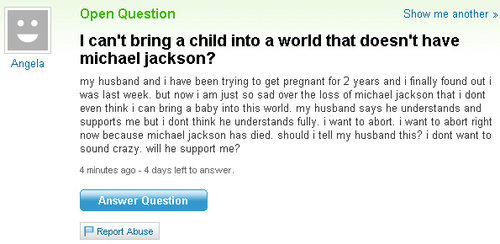
Michael Jackson's mourners: grieving as those who have no hope

According to this report, twelve grieving Michael Jackson fans have committed suicide in the wake of his death.

Think of that. Michael Jackson was a gifted, talented individual. He was also a famously and deeply troubled man, wounded and wounding. At worse, he was also a perpetrator of the worst sort. Now, we will likely never know the true sum of it.

There is no harm in appreciating a person's gifts and enjoying his art. But — again, I stress if the report is accurate — here are people so bound up with this broken shell of a man that their life loses meaning when he dies.

Contrast that will my brother and friend Phil Johnson's moving tribute to a dear friend and coworker. His title is "At Home with the Lord (2 Cor. 5:8)."

It is clear that Phil, and many others, are shocked and saddened at Mike Taylor's passing. Taylor didn't perform to sold-out arenas nor get his picture plastered over magazines and posters and billboards. He never had a video on MTV. He wasn't known for bizarre eccentricities. What he was known for was an infectious and hearty laugh, and for his love for Jesus Christ and for people.

The legacy Taylor leaves is lives touched for the Gospel, made better by encouragement and instruction in the Word, better-prepared for eternity. Jackson leaves people with nothing, except (in the case of the alleged twelve) a feeling that with him gone, they're empty, and life is too painful. (For some, it's even worse than that, if this isn't a pathetic joke.)

Taylor's parting saddens all who knew and loved them, but they have a hope that can't be shaken. Taylor's passing actually sweetens their appreciate of what he believed, taught, and lived for: which is to say the Gospel.

It all brings to mind this poignant passage from the apostle Paul:
But we do not want you to be uninformed, brothers, about those who are asleep, that you may not grieve as others do who have no hope. 14 For since we believe that Jesus died and rose again, even so, through Jesus, God will bring with him those who have fallen asleep. 15 For this we declare to you by a word from the Lord, that we who are alive, who are left until the coming of the Lord, will not precede those who have fallen asleep. 16 For the Lord himself will descend from heaven with a cry of command, with the voice of an archangel, and with the sound of the trumpet of God. And the dead in Christ will rise first. 17 Then we who are alive, who are left, will be caught up together with them in the clouds to meet the Lord in the air, and so we will always be with the Lord. 18 Therefore encourage one another with these words. (1 Thessalonians 4:13-18)
Christians do grieve. We are sad. We weep. We miss the sweet fellowship of our brothers and sisters, friends, spouses, children, who die in the Lord. But we do not mourn as having no hope.

Nor is it a wispy hope, as pagans have. I am constantly saddened to read unbelieving or superstitious conservatives over at FreeRepublic. When someone whom they like (i.e. Farrah Fawcett, recently) dies, they immediately proclaim the person as "in a better place." Why? On what basis?

On no basis whatever, with no authority and on no solid grounds.

Yet Christians have the objective historical fact of Jesus' bodily resurrection, and of the whole mass of His teachings which that resurrection confirms. Our hope is solid, and grounded.

If you don't have that hope for yourself, do not have reason to believe on God's own authority that you have a real involvement with Jesus Christ, then you must seek Him. Now is only opportunity you're sure of.

You have no greater priority.

ADDENDUM: Pastor Chris Anderson comments on a report that Jackson prayed with Andre Crouch shortly before his death. As is always the case with Chris, his thoughts are pointed and solid.

Wednesday, June 10, 2009

Hollywood in wartime: another lament

I've remarked in the past how starkly different Hollywood in the 1940s was from Hollywood in our day.

In the 1940s America was engaged in World War II. Hollywood put out scores of movies sharing the function of uniting us as a country in the conflict, extolling our troops' bravery and heroics, identifying the enemy as an enemy. This was after 2403 people died in an attack on American soil, on Pearl Harbor — itself the subject of a number of movies.

In our day, after 2985 people died in an attack on American soil, on 9/11/01. America went to war against terrorism. It was necessarily a very different and more difficult war, in that "terrorism" is not a country. Rather, terrorists use host-countries as bases of operation.

In the ~8 years of the prosecution of this war, Hollywood produced nothing along the lines of the WWII movies. A good movie on the WTC, another good one on Flight 93... and that's about it. Nothing positive about the conflict, the troops, the conduct of the war.

Think about that. Afghanistan? "Foolish! Nobody can win there! The Russians had to admit defeat and withdraw!" Bush sends the troops in, they fight with honor, bam! initial objective achieved.

Worth a movie?

Apparently not.

Iraq? "O noes! Elite Republican Guard! Saddam will fight like a madman! Can't be done! We're all going to die!" Bush sends the troops in, they fight with honor, bam! initial objective achieved. People liberated from a tyrant, another democracy planted in the Middle East, free votes, purple fingers.

Worth a movie?

Apparently not.

Both conflicts filled with stories of troops serving with great honor and distinction and heroism, every bit on a level with our fathers and grandfathers at Normandy.

Worth a movie?

Apparently not.

In fact, Hollywood positively backed away from anything that might remotely be construed as supportive. When the TV series 24 featured terrorists, it also put out an announcement in effect apologizing for the fact. Movie plots were changed so as not to feature the sorts who actually carried out the September 11 attacks.

The difference?

Hollywood has become rabidly liberal, which is to say anti-American. This war was prosecuted by (some kind of) a Christian, pro-life, (at-least nominally) conservative Republican president. He didn't fit Hollywood's marriage to the Democratic Party and cocktail-party liberalism. So, troops fought, bled, died without the Hollywood film factory's support. (Though individual stars such as Gary Sinise did do their part and more to support the troops.)

What brought that up?

Well, eight years of heroics and battles and stirring successes were not worth a movie.

But now, Hollywood is instantly planning a movie about the heroics of one man, Captain Richard Phillips. Instantly, within weeks of the incident — which was, indeed, heroic; and almost surely does, indeed, rate a movie retelling.

Gee, but why now?

Simple. You all know the answer.

Their man is president now — a radically-liberal pro-abort extremist. He's like Hollywood. He affirms Hollywood. He shares their arrogance and contempt for America. And he looks good in this event. Now it's okay to do a positive movie about something American.

Contemptible.

Wednesday, December 24, 2008

That "bold" and "daring" Hollywood

I skimmed through a featurette on a movie called The Reader. As I haven't seen it, this won't be about the movie — it will be about about the movie.

With its very capable actors, The Reader (I gather) tells the story of a young man who has a sexual affair with a considerably older woman who turns out to have worked for the Nazis during WWII. Listening to the creative minds behind the story and the film, part of their intent is to blur moral judgment — how do you judge people when lives and situations are so complex? Regular people did atrocious things in WWII. How do you judge them, how do they judge themselves?

Springboarding off of this, I thought (not for the first time) about what makes the film industry see itself as bold, daring, courageous. This would be such a movie. The boy is 15, the woman is more than twice that. Were the sexes reversed, the relationship would be seen as statutory rape or child molesting, in America. See? "Daring." And humanizing someone who contributed to atrocities against Jews, blurring moral judgment (as I gather the movie does, from the doco) — bold, daring.

That's what's bold and daring in Hollywood. Humanizing murderers, rapists, homosexuals, pedophiles, adulterers, nihilists, and various forms of immoral and anti-social behavior. Not for the purpose of clarifying moral judgment, but for the purpose (as the doco states) of blurring the lines.

Now, my point isn't what you may assume it is. Obviously I can't fully judge a movie I've not seen. What I'm judging is Hollywood's narcissistic self-congratulation. It loves to tear down Christian values any way it can — though, paradoxically, it needs those values. Without at least ghosts and echoes of Biblical values, it can have no sympathetic characters, no uplifting message, no structure. But at the same time, it despises those values and wants to silence its own throbbing, guilty conscience by dismantling them - as well as anyone who affirms and tries to live by them.

It's Post-modernism on film. It's Romans 1:18-32, over and over and over again, in living color and CGI.

It's common for the artistic geniuses to "cover" themselves by saying, "I am not saying that [insert immoral/anti-social behavior here] is a good thing, but...."

Okay, fine. Let's accept the statement at face value.

So what would be a truly "daring, bold" film today?

How about a futuristic drama about post-abortion America, in which some pol or doctor or nurse or advocate is coming to grips with the bloody, human slaughter that (s)he'd enabled?

How about a drama about a couple in a sexual relationship, in which one converts to genuine Christian faith, and what follows — told from a perspective sympathetic to the convert?

How about a drama about a Christian family in which a member "comes out" as deciding to act on homosexual passions — told symphathetically from the perspective of family, opening up their self-reproach, doubt, fear; their struggling to understand how to keep God as God, and show love, grace and truth to the child who embarks on this path of repulsive self-destruction? How about portraying the "deeply religious fundamentalists" as compassionate, genuine 3D people?

You could suggest others, I'm sure.

But if the folks behind the last forty years of "bold, daring" movies truly aren't advocating and enabling and rationalizing the behavior they portray so symphathetically — then what could possibly prevent them from making movies such as these?

Except that they're not so bold and daring after all. And they really are advocates.

And they can't see it otherwise (Ephesians 4:17-19).

Wednesday, February 21, 2007

The Bridge to Terabithia: spoiler-heavy review/reflection

Pre-spoiler part: on the strength of the trailers and glowing reviews, I planned to take my two younger children Jonathan (7) and Josiah (11) to see this. It looked like a lot of fun.

Then I saw a thread on FreeRepublic titled "Bridge to Terabithia" PARENTAL WARNING! SPOILERS! (And do be warned: it's a very spoilery thread.)

Now, I have a very strong opinion about spoilers. I think delilberately springing uninvited spoilers on someone is immoral. I think it is wrong to "spoil" something for someone else. It's like theft: it steals the pleasure of discovery, surprise, delight that they would have had.

It also is a form of theft of the artist. I remember a short story I wrote once with a surprise twist at the end. I gave it to a friend to read. He turned immediately to the last page, and read the last line aloud. I wanted to strangle him. Why had I bothered to craft that whole story, to do the intricate buildup, only to have some _____ short-circuit it all?

Like I said. "A very strong opinion."

But on the other hand, when it comes to my kids, I will sometimes expose myself, if it means taking a "hit" so they don't. So when I saw this, I very reluctantly read; and I'm glad I did.

This is like "Million Dollar Baby" all over again, in that it is advertised as one kind of movie, but actually is a very different movie.

So, be warned, after this there be spoilers.

Spoiler-ridden review

The movie is based on a book I have not read. It stars AnnaSophia Robb and some guy.

AnnaSophia Robb is a lovely young actress with a 100-gigawatt smile and eyes like saucers. She was winsome in "Because of Winn-Dixie," and she's terrific in this. She plays Leslie Burke, who's new in town and friendless. Not for long. She befriends a repressed underdog named Jessie Aarons, and they forge a warm and fun friendship.

The "some guy" who plays Jesse is Josh Hutcherson. His character calls for him to be largely inward, subdued, smoldering, subdermal; and he's certainly all of that. Jesse loves to draw, and his hardware-store dad does not "get" him. He's got like forty-seven sisters, all of whom seem always to be angry at each other except his little sister, who's a cutie.

Leslie and Jesse both run afoul of bullies both male and female, and they band together and bully back. Jesse also has a crush on his music teacher, played by Zooey Deschanel.

"Okay," you're asking, if you've only seen the trailers and the poster. "So when do they enter this magical kingdom and have wonderful, heartlifting adventures like in The Lion, the Witch, and the Wardrobe?"

Never.

Oh, they do use their imagination, and their imaginations are given CGI life. Those scenes are fun, they're well-done, and they're relatively fleeting.

"Fleeting?" you say. "But this is an adventure-fantasy movie! I saw the trailers!"

Yeah, except no. It isn't an adventure-fantasy movie at all. It's sort of a coming-of-age drama and tragedy.

"Tragedy?" you gulp. "I was going to take my kids."

Yeah, I know. A lot of parents took their kids for a fun, escapist afternoon at the movies, drawn in by Disney's very deceptive ad campaign. I heard those parents audibly gasp when Jesse's father tells him that his friend is dead, that she died trying to swing across on the rope they used to get into their imaginary kingdom together. The rope broke, she may have struck her head. She drowned. Dead, for keeps.

"Wait. You heard them gasp? You mean, you took your kids anyway?"

Yes, I did. I read more about the movie, and decided to handle it differently than usual. I talked to my two boys and, for the first time in their lives, spoiled a movie for them. I told them:
  1. We get to know two kids, a boy and a girl, and the girl dies very sadly.
  2. We get to know two families, one Christian and one not Christian, and the Christian family is made to look bad.
I swore them not to breathe a word about this in the theater (no spoilers!), and said we'd talk afterwards.

How did it go?

First, it is a very good movie. Apart from the fact that pretty girls aren't generally friendless for long in schools, their friendship is credible and involving. The movie puts up a complex patchwork of personalities and issues, not too heavy, but not too formulaic. The viewer is definitely drawn in.

And "the sad part" (as we called it) is very sad. I don't mind telling you that the handkerchief came out twice. Mine, not the boys'. Tears were rolling freely down my cheeks for about the last fifteen minutes. Maybe I'm getting soft in my old age, but there it is.

Forewarned, the boys were not traumatized nor depressed, and we had a good talk afterwards. Josiah couldn't believe how deceptive the ads were.

Within the movie, though, here's what bothered me the most.

The Christian family was portrayed as bickering, loveless, and borderline dysfunctional. Except for a little secular "redemption" at the end, the father was a boilerplate neglectful, distant, clueless, angry dad. There wasn't a wiff of Gospel about the family either collectively or individually.

Leslie invites herself to church with Jesse (he doesn't broach the subject to her). They talk on the way back. Jesse is unable to tell her much of anything about Christianity, and the little girl basically tells Leslie that she's going to Hell. Then after Leslie dies, Jesse sobbingly asks his dad if Leslie has gone to Hell.

Dad (who now is showing his decent side) says something like: "I don't know much about all this, but I can't imagine God sending a sweet little girl like that to Hell."

And there you go. The father has nothing to give but sentimental guesswork. He can't reassure his son that God is holy and merciful, that He will certainly do the right thing. He can't point Jesse to Christ, can't say that this reminds us how short life is, how dear Christ must be, how earnest we must be about telling others of His love. He can't give it, because he doesn't have it to give. He's a Hollywood-approved "Christian" dad.

So here is yet another professedly Christian family, broken and clueless; another non-Christian family, warm and loving and open. The movie's "Hollywood-gospel" call is given by Leslie, and echoed by Jesse at the end: "Keep your mind wide open."

"He wasn't a very good friend to her," I told my boys. "She was asking questions about God and the Bible, and he didn't have any answers for her." He couldn't tell her how she could know God, or didn't care to.

Jesse didn't, Jesse's dad didn't, I guess his mom and shallow older sisters didn't. It's just another "Christian" Gospel-free family, brought to us by Hollywood. I think back on "A River Runs Through It." Gorgeous movie, interesting story, well-acted, drove me nuts. About a pastor and his two sons. Pastor-dad doesn't even so much as mention the Gospel, even in passing, ever, that I recall. Reads poetry from his pulpit. Poetry! Boys don't even bother to indicate that they've rejected anything, because nothing is presented to reject.

The author of The Bridge to Terabithia is Katherine Paterson, who professes Christian faith. She says,
I wrote Bridge because our son David's best friend, an eight-year-old named Lisa Hill, was struck and killed by lightning. I wrote the book to try to make sense out of a tragedy that seemed senseless.
I can't possibly judge the book by the movie. A parent who was there remarked that the last twenty minutes were exactly like the book.

I don't know what "sense" the movie makes of Leslie's sad, sad death. Christian Dad says it makes no sense. Someone (I think the music teacher) tells Jess to keep Leslie alive in his memories. He then revisits his imaginary kingdom, this time with his little sister. He envisions all sorts of fantastic beings in Terabithia.

Leslie is not among them.

I'll just say that, if the movie is true to the book, the author portrayed the kind of Christian family Hollywood is comfortable with: dysfunctional, with no credible nor compelling—nor threatening—Christian witness.

So there it is. I loved the actors, I liked the movie, I hated the ad campaign, and I hate Hollywood's general inability (or unwillingness) to find screenwriters who can write a genuine, credible Christian character. These families represent Hollywood's view of Christians, and of themselves. I can understand that. I saw things that way once myself. But that all changed.

POSTSCRIPT: to be very clear, I am not saying that all Christian families are loving and speak in Bible verses, nor am I saying that all non-Christian families are horrid and hateful. But can't some Christian families make it to the movies with their Christian faith intact, identifiable, and on-display?