Showing posts with label book review. Show all posts

Wednesday, January 25, 2012

Very briefly noted: Proverbs, by Andrew E. Steinmann

Probably every nonfiction author has been bitten this way: you work hard to consult the best and most current works you can get your hands on, you try to send off your manuscript as up-to-date as you can... and immediately afterwards, some pertinent book is either published or discovered.

That's the case with me and Andrew E. Steinmann's Concordia Commentary entry on the book of Proverbs.  The book is a 719-page tour-de-force, written from the perspective of believing Lutheranism. I wish I had had it in preparing my book of Proverbs studies. In writing that book, I had opportunity to refer to some valuable research by Steinmann in journal articles... but only after the manuscript was completed did I discover this volume.

It is a pity, too. The book was already in print (2009), but Steinmann's confessional Lutheranism and "my" circles often don't overlap. So I never even saw a hint of this book until it was too late. I contacted Concordia and was sent a review copy, which I've been using for several months now.

I haven't read most of the book, but I did want to let you know about it. Steinmann's approach to authorship is not my own, but it is another conservative and faithful view. He believes in the text as the Word of God, and closely examines the Hebrew text. Each section receives his own translation, a section of notes on the Hebrew wording, and then a commentary. The commentary is readable, practical, and warmly Christ-centered and Gospel-centered.

In years past I read H. C. Leupold's volumes on Genesis and Daniel with profit, but always wished he'd done Proverbs. This is similar to that — but I think better than anything Leupold could have done. My impression is that Steinmann has produced a volume which will serve Christ's church for a great many years, as have works by other Biblically-faithful Lutherans such as Keil, Delitzsch, Hengstenburg and others. Steinmann deserves to be numbered with them, from what I have seen.

When I have read the whole book I plan to give a full review. But I can already recommend it to anyone wanting a close, detailed commentary on the entire book.

Tuesday, November 08, 2011

Book review: Waking Hours, by Lis Wiehl, with Pete Nelson

Waking Hours, by Lis Wiehl (with Pete Nelson)
Nashville: Thomas Nelson, 2011

Genre. Waking Hours is a murder mystery with overtones of supernatural horror. The supernatural elements are distinct yet understated, so do not think Ted Dekker or Frank Peretti. However the murder aspects are fairly explicit, making this not family or youth reading. If that genre offends or doesn't interest you, this isn't your book or review.

However, if it does, Dear Reader...

Writing. As I read Waking Hours, I kept thinking of my painful review of Litfin's The Gift. There, I was forced to say that the narrative and, more, the dialogue was often regrettably stilted, unnatural and awkward. Thankfully, in this case the comparison is by way of contrast.

The writing in Waking Hours is far more natural, and the dialogue moves beyond adequate to delightful. The different characters speak in different voices, and are natural, fun, and often laugh-out-loud humorous. There are very few missteps, such as that when a male character refers to a childhood incident of lighting his "bangs" on fire (81) — bangs not a "guy" term of self-reference. This, however, is by far the exception in a book brimming with dialogue that makes the characters vivid and likable. This includes both external and internal dialogue.

For instance, Dani Harris, the main female character, has just re-met former NFL hero Tommy Gunderson, for whom she had briefly had feelings in high school.
"I apologize if I smell bad," he said. "When Liam called, I rushed here without grabbing a shower."

"You smell fine," she said.

Why were they talking about how he smelled? When had she ever talked to anybody about how they smelled? (31)
Their initial awkwardness and internal tension goes both ways, as we see in this interchange, where Tommy obviously doesn't know how to respond to a compliment from Dani, and comes out with
"Did you know that the animal that has the most dreams is the platypus?" he told her.

"How did you know that?"

"How do you not know that?" he said. "It's common knowledge. I read it somewhere."

"What do platypuses dream of?"

"Probably about being anything other than a platypus." He'd also read somewhere that trying to impress a girl with random facts was something only morons did. (123-124)
Cops sound like cops, older people sound like older people, and kids sound like kids. Take this teen, who finds himself a possible suspect in a gruesome murder:
"Hi, Liam," Dani said. "How are you doing?" 
"Okay," Liam said, drying his eyes with a tissue and then dabbing at his nose. "I mean, not  really. But I'm okay. I guess." (45)
You can hear a teen saying that.

It is well that the dialogue is so effective, because there is more of it than there is action. In fact, the narrative often felt a bit rushed, as if the author were in a hurry to move along. For the most part this is used to good effect, as one never feels the story lagging; yet for a rarity, I found myself wanting a bit more exposition, a bit more grace in some transitions. I wrote "abrupt" in my margin at several transitions.

However, the book opens with an effective, eerie scene, which is the first of several. One feels the author eager to move on rather than (as some) describing each branch and pebble along the way. Overall this factor is a strength, though one feels it at the fore in some sequences.

At times, the dialogue switches from blow-by-blow to summary, and one wonders at the variance. For instance:
His aunt sighed. She explained that Abbie had once been a vital life force in the town, active in the church, an avid letter writer to the local paper, a favorite dinner guest, and a the town historian a tireless chronicler of the town's narrative and chairman of the East Salem Historical Society. She'd been outgoing and extroverted until her health began to fail. (104)
Given the writers' gift for dialogue, this would better have been conveyed as such: "When I was a girl, nothing ever happened but that Abbie Gardener was at the heart of it. If the church had a pot luck, Abbie organized it, and believe you me, her pot lucks were legendary." And so forth.

It is a compliment to the writers of a 300+ page book that one wishes it had been longer, and in this case, I think I do. Yet I'd rather be there than buried under reams of needless exposition, as sometimes happens (for instance) with Tad Williams and Stephen Donaldson.

Story. Waking Hours starts off with a tense, creepy, portentous scene, then dives into the discovery of a grisly murder. The main characters, former football star-turned-private-eye Tommy Gunderson and forensic psychiatrist Dani Harris, are introduced with narrative that gradually informs without heavyhanded exposition. The two knew each other years earlier, but it is this case and a mutual connection with some of the kids who come under suspicion that throws them back into each other's lives.

Other "real"-feeling characters are introduced, such as detective Casey, whose initial disrespect for Dani is decisively overcome. On first meeting Casey's first words, in a meeting with fellow-professionals, are "How old are you?" Dani shoots back, "Twenty-nine. What do you weigh?" (36) After one more clash, Casey apologizes, and they're on good footing for the duration.

We also meet Tommy's older Christian friend Carl, who provides more theological and scholarly religious input, as well as the teens themselves. Tommy joins Dani as an unofficial assistant investing the case, and both become personally involved with the case, and with each other.

The best part of the story is the dialogue, but the plot continues to develop and unfold steadily, building tension and directing suspicion first here, then there. Behind it all are recurring eerie "coincidences" and occurrences. A reader unfamiliar with Wiehl's work (as I was) has no idea where events are leading.

The climax makes sense, yet feels also a bit abrupt and incomplete — but then subsequent events (which I'll neither disclose nor hint at) makes sense of that, as well.

Theology and morality. Secular horror stories (Stephen King, Clive Barker, etc.) tend to be filled both with immoral sex and with bucket-loads of profanity. Waking Hours hasn't a drop of either, which is refreshing. One need not read in a constant state of cringe.

It is apparent that Tommy is some kind of Christian, as is his friend Carl. Dani is less outward, but seems at least to be in the ballpark. Scripture comes in prominently here and there, but the book is neither a tract nor a work in systematics. The demonic comes in, and there is where I think we may be further into speculative ground — yet it is as speculation, so nothing that doctrinally brought slammed brakes or flashing red lights.

One has the feeling that subsequent books will introduce more of both elements.

Recommendation. I really enjoyed the book, and found myself looking forward to getting back into it. It is reportedly the first The East Salem Trilogy, and I want to be there for the subsequent volumes.

I was glad Nelson sent me a review copy. If this is a genre you enjoy, I recommend Waking Hours as an engaging and fun read.

Well, "fun" except for the gory parts.

And some of you will want to leave the lights up.

Wednesday, August 17, 2011

Guest reviewer: eight-year-old Michael S. Dickey reviews The World-Tilting Gospel

When one is in the stage of "selling" a book to a prospective publisher, one of the questions they ask is "What is this book's audience? Who would read it?" Prospective authors have to come up with intelligible answers.

In my submission of The World-Tilting Gospel to Kregel, back in January of 2010, I wrote that the book "speaks to Christians of all walks in life, from late teens [NB] and up. Pastors will use it, and give or recommend it to church officers and members. The format of headings and subheadings, plus the wealth of Bible-references, are designed for use in study-groups or discipleship classes for a wide age-range, as well as in individual reading." Now, of course, this reflected my intent and expectation. I didn't do a test-audience on it (as I later did do with God's Wisdom in Proverbs).

So when folks later read it, of course I was grateful and encouraged to have a brother like John MacArthur commend it, and it was delightful to have PhDs like Ligon Duncan and Jim Hamilton join in, as well as the rest. And while I watch for reviews, it has been terrifically encouraging for all sorts of folks (moms, dads, pastors, students, and so on) to report finding the book a blessing and a help.

But, friends and neighbors, brothers and sisters, you are about to read a review of TWTG that pasted a grin on my face that has not gone away, and won't for a good while. It was completely unexpected, and I frankly would not have guessed nor even hoped that the reach of the book would go this far.

It is from eight-year old Michael Dickey, the son of Mike Dickey who comments under the screen name VcdeChagn. He actually finished the book before his dad, and did a book report on it, which he wanted his dad to share with me. I have Mike's permission to share it with you — and I think you'll be glad of it.

Now young Michael is clearly, as his dad said, a "voracious reader," so I wouldn't necessarily recommend that Kregel do a campaign to offer the book to the single-digit set, and we parents shouldn't look too askance at our kids who might not be up to Michael's reading level. But he's a remarkable young gent, and it's my delight to share his review (book report) with you, as one of the very, very few guest-writers at this blog:


Transcribed (as-is):

by Michael S. Dickey
  1. Dan Philips wrote the book as a sort of every day helper. Dan gave four points in the introduction that divides true Christians from the bad Christians. Reference for parable is Matthew 13:3-9. Take the book anywhere you can evangelize, even your church. Don't forget to hang on tight.
  2. Dan writes in Chapter 1 about who comes first God or us. Dan gives three beautiful examples of false believers. Dan also gives us an illustration to give in to Christ. He tells us what we need: a Whole-Bible view. Read more to find more.
  3. Dan deals with two towering truths in chapters 7+8. These two truths are how God deals with our bad record and our bad nature. In chapter 7 he gives a fiery example of repentance. Eventually you will reach the point where you are a world tilter unless you are not preordained. So our conclusion is that means pass the towering truths and you are a buster. (Margin: special effects by me)
  4. Dan surprised us with a few more "bullets" in the after word. He gives us a "Mystery passage" which sums up the whole book. That Mystery passage is I Corinthians 15:1-11 if you wish to look it up. his conclusion = there are two types of Christians. Read it to find even more.
  5. I think he gave us a good book worth reading. Thank you Dan for a good book. I recommend this book widely. Take it where ever you go. I think Dan is a good writer.

That's it. My day's made. Thanks Mike, and thanks, Michael. I think you are a good writer, too.

Tuesday, June 07, 2011

Book review: The Gift, by Bryan M. Litfin

The Gift, by Bryan M. Litfin
 Wheaton: Crossway, 2011

Last year, Crossway debuted The Sword as the first book in The Chiveis Trilogy. The Sword posited a post-apocalyptic world in which a dreadful disease had prompted nuclear devastation, in effect bombing humanity back to the Middle Ages. Among the casualties was knowledge of the true God, kept alive among a tiny remnant, and nurtured by virtually no written Scripture whatever.

In my review, I recommended the first book as having an intriguing premise and an involving narrative. I expressed eagerness for the second volume. Now that The Gift, volume 2 in The Chiveis Trilogy, has arrived, does it carry on the vision of the first and create further yearning for a climactic conclusion?


Necessary (if ominous) aside. Candidly, whether you believe me or not, with virtually no exceptions, I hate to give negative reviews. Always have. Now, I anticipate reviews of my first and second books in just a few months (Lord willing), I become still more and more sensitive in that way, and more reluctant to write a negative or critical review.

Yet I owe it to God, you, and the authors to be just as honest as I try to be charitable.

Verdict? That being so, I am forced to render a mixed verdict in this case. I feel that the quality of writing has sagged, as has the plot's urgency and freshness. I still am interested to see the fruition of the story in the third book, and still look forward to reading it. But I feel as if this second installment is not a great deal more than a placeholder on the way.

I will of course elaborate.

The art of dialogue is exceedingly difficult. When an author is adept, it seems effortless and almost escapes notice. Think of Tolkien, for instance. Treebeard always talks like Treebeard, Sam like Sam, Gandalf (both Grey and White) like Gandalf, and Gollum like Gollum — to say nothing of Tom Bombadil, Gaffer Gamgee, Pippin, Aragorn and the rest. These are memorable, highly distinctive characters with their own unique ways of expressing themselves.

Or to take a very different author, Stephen King is uneven. His adults are memorable, but many of them talk just like each other from book to book, and virtually all of them have filthy mouths. King's child-characters virtually always sound ten years older than they are supposed to be. But some snatches of dialogue are very authentic and real.

Or, finally, think of Father Mapple's sermon in Moby Dick, brimming with nautical allusions appropriate to the character and setting; or even J. K. Rowling's singular creations of Hermione, Hagrid, Dumbledore, and the other distinctive characters dotting her stories.

By contrast, Litfin's dialogue in this book was often painful reading to me. His characters show little distinctness, and often speak in painfully stilted ways. As I've been helped with my own failings by my pre-readers and editors, I'm more conscious of their role. I think that perhaps the process failed Litfin in not catching "I shall motivation soon enough" (330). But that's simply a typo; other problems called for an early reader/editor's challenge and help, and a lot more work.

For instance, typo's don't explain:
Teo: "You're a fiend. A monster" (239, to a major antagonist)

Ana: "You are defeated" (277, after killing someone)

A captain: "Alright, what do you want, landlubber? ...You're dead, landlubber!" (308, 309)

Ana: "I became arrogant and sensual and...immodest!" (318)

A major antagonist: "I will have to pour out my anger on your woman instead" (349)

Teo (in reply): "Your pride will be your downfall, lord of darkness. Come! Test your strength against a servant of the living God" (ibid.)

Same antagonist (in response): "'Gladly,' he snarled" (ibid.)
There are more, but both in dialogue and in narrative, I found that I kept wincing. The villains tend to be cartoonish, like pagans in a Chick tract. This excerpt from a courtroom scene gives unhappy examples of both awkward dialogue and shallow characterization:
Ana lifted her chin. "Your courtroom is already a mockery. Your justice is a sham. I will never sign."

The judge went berserk. Through gnashing teeth he screamed, "Then I sentence you to death and condemn you to hell!" His unruly hair stood up like the mane of some crazed monster.
Ouch.

The feel of the book is no longer so much that of a fantasy/adventure as that of a florid gothic romance.The characters shift definition, as we have a series of situations in which Teo rescues Ana again and again.

This is a declension from the first book, in which we are introduced to Anastasia as a confident, competent woman who knows her own mind. In this book, by contrast, she is weak and inconstant; she falters and strays. Of course, that happens in real life, but here it doesn't feel real or true to character. She basically shrugs off Teo for a time and is caught up in Litfin's version of Vanity Fair (a character is even unsubtly named "Vanita"), during which she buckles to peer-pressure and goes topless in one scene.

As with the first book, there are "adult" elements which are surprising and sometimes do not seem fully-integrated. We are told several times that Ana has sexual thoughts and feelings. Odder, we are introduced to a character who is homosexual, who snuggles up at night to another auxiliary male character. What is that about, and where is it going? Anywhere? By book's end, we do not know.

Also odd: we are introduced to the leader of the "Christiani." He's in Rome. He's called "Papa," and he pretty much tells everyone else what to do. Huh? Where are we going with this?

As with the first book, there is a female conversion from hearty antipathy to a sort of faith and, as in the first book, it seems a bit sudden.

So the game-pieces in the overall plot arc are moved forward for what I hope is a satisfying resolution in the third book, but it does feel a bit as if we're killing time. Still, nobody in all of humanity has a copy of the New Testament? Old, but not New? And only traditional vaporous vestiges survive? One thinks of the days of Josiah; then one remembers the printing press, and the reality of millions of copies as opposed to dozens or hundreds.

By the way, this does continue to be an ongoing intriguing element of the overall arc: what faith would people come up with if they had only an Old Testament, no New Testament, and no Calvin or anyone to help in any way? Even so, one wonders if they would be so free from any interest in locating Israel as a place or nation, or would formulate faith as these characters do, neither expecting miracles nor direct revelation (though there is some of this in the first book), nor wondering whether they should offer animal sacrifice and keep to a special diet, and so forth. They are more or less living like NT Christians without a NT.

In sum, I truly am sorry to say this volume has the feel of a cut of steak that needed to marinate a few hours longer. It feels like a first or second draft, in need of work, tautening, deepening, and more intricate coloring.

If you adjust your expectations, I'd still recommend following the story. I still cherish hopes for the dénouement. If you like florid gothic romances, you're in luck, no adjustment needed. But while some authors' styles droop considerably from book to book, others clearly work at their craft and bring up their game; J. K. Rowling comes to mind as an example of the latter.

I hope the same for Litfin, who has an intriguing tale to bring home in the final volume.

Tuesday, March 01, 2011

Book review: Street Player: My Chicago Story, by Danny Seraphine

Street Player: My Chicago Story, by Danny Seraphine (with Adam Mitchell)
Nashville: Wiley, 2010

The times. In 1969 I turned fourteen. According to various websites, gas was 35 cents a gallon, you could buy a nice new car for under $2000, and a new house for $15,000 - $16,000. There were protests of the Vietnam war, man walked on the moon, and a woman named Golda Meir became Prime Minister of Israel.

The music. I liked listening to the Beach Boys, the Beatles, Blood, Sweat & Tears, some by The Who, Janis Joplin, Santana, and other artists. I did not notice the arrival of a double-record album called Chicago Transit Authority, with its nondescript black and blue cover and its too-long-for-AM-radio songs.

This band. But somewhere around this time my beloved sister Maryly was blown away by this new band playing the Whiskey A Go Go on Sunset Boulevard, and she bought their albums. Visiting her apartment, I heard this different style of music, with its evocative mix of jazz and rock, its complex, layered songs, its turn-by-turn interplay of top-notch musicians. It stuck in my mind, and in short order I became a fan.

This was after, by the way, my dear sister kindly took me to a concert at the Hollywood Bowl. I was not a fan at that point. We sat in the nosebleed section, and could barely see the little figures on the stage. Only the closed-circuit screens brought them out. What really stood out to me was the funny-looking cigarettes people brought out, and the gut-churning clouds of stink they produced. "They aren't cigarettes," Maryly informed me. But I digress.

This drummer. As I say, all the musicians were excellent, but the single member who hooked me was their crazy drummer. This cat had a sound like no one else I'd ever heard. I almost immediately thought of it as loose-tight. Most rock drummers were straight-ahead, like machine guns, rat-a-tat-tat. Even The Who's frenetic drummer was pretty vanilla in his timing and punctuation.

Not this fellow. He had a slinky, sharp, creative groove that was all his own. It was impossible to hear and not respond, not to nod or tap or move. It was worth listening to the songs just to pick out his beat and catch his fills.

The man's name was Danny Seraphine. Hearing (and, later, watching) him was so fun that I decided to try it myself. Got a set of drums, and went at it. On my best day I was miles and miles away from Seraphine's worst day, but the pursuit was fun.


And now finally, some forty years after I started listening to Chicago, Seraphine has written an autobiography titled Street Player: My Chicago Story.

I've followed Chicago at varying distances since the 1970s, attending well over a dozen concerts, buying all their albums, participating in fan discussions in the 90s — even arranging an after-concert meeting with one of the members (bass player Jason Scheff) after a concert for my DAOD's twelfth birthday.

But always they were by design a faceless band. Prior to the 80s, no individual stood out as the public face of Chicago. They were intentionally about the music, not the personalities. Algore hadn't invented the internet yet, so information was not widely available, and all we had was the songs. So Seraphine's book offered a fun opportunity to be able to peek inside the life of a favorite founding member, and I appreciate Wiley publishers providing me with a review copy.

Disclaimer: as I will explain, this book is not at all the typical BibChr readering material. There are quite a few obscenities. There are also tales of drug use and immorality, though the former ends up strongly cautionary and the latter stops well short of lurid detail. It is a very engaging read, but definitely not for everyone. More, later.

Beginnings. The book starts, arrestingly, with Danny at the house where friend and fellow band-member Terry Kath had just accidentally shot and killed himself. Danny numbly watches Kath's body being carted off by the coroner, too tall to fit into the body-bag. From that attention-grabbing intro, Danny turns back to his own childhood.

Danny grew up in the rough streets of Chicago, running with gangs just a few removes from the Chicago Mafia. He was a high-spirited kid, never one to walk away from a fight or a challenge. This meant trouble around home, and major problems at school.

But Danny discovered as a young child that he loved banging on his mother's pots and pans. His father was a more distant figure, but his mother doted on him, and she got him a drum kit and lessons. Danny took after drumming with real fire, developing his chops by playing in various bands. He details the move from group to group playing in small venues.

One group was Jimmy Ford and the Executives, with whom he was paid the princely sum of $50 a show. Among the band, Seraphine met sax player Walter Parazaider and bass payer (!) Terry Kath. Danny clicked with those two... but the three of them were let go, in a sudden personnel change. Some time later, inspiration struck Danny. Why not put together a band comprised of the most talented players in Chicago? He looked up his former band-mates Parazaider and Kath. They talked and worked at it, and brought in Lee Loughnane on trumpet, Jimmy Pankow on trombone, and Bobby Lamm on the keyboard. Lamm would play bass on organ pedals, and Kath would switch from bass to guitar.

This was the core group of what was eventually to be known as Chicago. They got together and jammed in Walt's mother's basement, and realized they had something special going. Gathered afterwards, Danny said to his new bandmates:
"Everyone has been involved in bands that have gone nowhere and had to deal with being treated like [garbage] by other members on a regular basis. We've seen big egos take over and ruin groups. Well, this band isn't about any of that; it's about the music. Everything will be done by a democratic vote. I say we make a pact right now that no one is ever going to be fired from this group. You either quit or you die" (52-53)
Walt was on the same page, and everyone agreed. This is an ominous bit of foreshadowing of what was to come later.

Before long, bass player Peter Cetera (who had studied to be a priest, in seminary!) was added, completing the seven core members who alone powered the first five albums, and — apart from Terry Kath's death — stayed together for seventeen albums

From there the book traces Danny's life and career as Chicago struggles its way into the limelight and transitions from barely being able to fill small venues, to playing massive sold-out stadiums and pressing multiple-platinum albums.

What is interesting.  If you're a fan, you'll learn a great deal of interesting back-story. You'll learn of their encounters with Jimi Hendrix, Janis Joplin, Chuck Berry, Bill Cosby and others. You'll learn as well of Terry Kath's increasingly troubled life, and his tragic, pointless death. You'll learn of the first post-Kath guitarist, Donnie Dacus, and why he was eventually let go. You'll learn about rumors of mob-involvement with Chicago, through (of all things) a Wall Street Journal piece. You'll learn a lot more about Pete Cetera's voluntary departure, and then finally about Danny's own involuntary dismissal from the band (more on that, later). Also, you'll learn the stories behind songs like "Little One," "Greatest Love on Earth," and of course the titular "Street Player."

What is sad. While much of the book is fun and interesting. a lot is sad as well, from several angles.

Right away one sees Seraphine's father as a somewhat remote figure. What is worse, neither parent seems to have pointed Danny to the gospel of Jesus — so what follows is as predictable as it is sad. Danny hooks up with the wrong kind of male figures as a youth (cf. Proverbs 1:10-19), makes bad associations and bad choices. He starts having sex at age 14 and becomes a father at 15... then has no involvement (beyond paying support) for years. The guilt from this comes back to haunt him.

What "redeems" Danny is strictly horizontal. Young Danny reaches a point where he realizes that his life-path is going in a direction he doesn't want to go, and music becomes his positive outlet. This eventually leads to his involvement in Chicago. Older Danny returns to his music, helped by a solid marriage.

The saddest complex of events in the whole saga is Seraphine's ejection from the band he helped found.

As I mentioned above, the founding members were agreed: nobody would be fired from the band, period. Over the years, Danny shows himself true to his word. When success and drugs literally drive saxophonist Walter Parazaider into a mental hospital, some in the band suggested firing him. Seraphine will hear nothing of it, and says he'll walk out if Parazaider is fired. When cocaine so ruins Bobby Lamm that his performances are wrecked, Danny confronts him, Lamm goes into extensive rehab, and rejoins the band as "Robert" (198-202). He similarly stuck by Pankow and Loughnane through rough periods. Firing founding members is not an option to Seraphine, period.

However the 90s form of the band, with relative newbies Jason Scheff (bass, vocals) and Bill Champlin (keyboard, vocals, everything), get antsy about their commercial profitability. Danny is having a rough stretch, due in part to the advent of electronic drumming and a hit to his self-confidence. Parazaider assures him he's not going to be let go, no matter what. However, they hold secret meetings behind Danny's back, and they fire him. Boom.

As Danny tells it, it is just that callous, just that treacherous, just that brutal and cold. His loyalty is repaid by cold shoulders, whispered conversations, covert meetings, and then a quick shove out of the door. Seraphine attends the next band business meeting, and confronts each of them (except no-show Pankow) eye to eye — but they lamely make excuses and stand by their verdict.

The band's story at the time is that Danny's playing was off, and he'd lost focus. I can only tell you a fan's perspective. I noticed the drumming in his later albums to become very un-Danny-like — which the book explains. But in concert, I never saw Seraphine do a solo that wasn't a show-stopper. (Here is a solo from that period; in it I notice one false stroke, which is fewer than the other musicians average.) It's forty years after I first started listening to Chicago, and I've seen some phenomenal drummers since that time. But Danny Seraphine is one of a kind, and the band really lost something when it flaked on him.

Seraphine's heartbroken, shattered. He quits drumming entirely. It takes a long time for him to get himself back together, rejoin the music industry, and eventually form a new band. His attempts to be reconciled with the band on a personal level are only partly successful; his former bandmates do not come off admirably.

The saddest. Saddest of all is the fact that there isn't even a passing appearance by anyone who knows Christ in the entire saga. There is vaguely religious language here and there, and Seraphine in the Acknowledgments starts with this:
First and foremost, to My Sweet Lord—who has given me such an incredible and interesting life. You have always taken care of me, no matter what.
But there's no context for that in the entire book, and the only religion that appears (and only very faintly so) is Roman Catholic.

If Seraphine and the band ever met a genuine Christian believer, that person does not appear as such in the book. If anyone has ever in his life told Danny Seraphine how he could know God, it isn't mentioned.

Seraphine comes off ultimately as a likable, goodhearted (as we say) guy. He pulls no punches in criticizing himself, and expressing guilt and regret for many of his decisions and actions. It actually reads like an extended testimonial in an Alcoholics Anonymous meeting. And it is all horizontal. That is, he is sorry for betraying his wives, he is sorry for handling Pete Cetera and Bobby Lamm wrong. But none of these actions or attitudes is viewed in relation to God as holy judge. For instance:
Women had become a destructive vice and I could not overcome the temptation. I tried to justify my behavior in my mind, but I was only lying to myself (121)
There is candor there, yet the wrong perspective. If Danny is judge, he must save himself. Such redemption as there is can have nothing to do with the person and work of Christ, who came to save sinners (1 Timothy 1:15) — not merely from lying to ourselves, but from our offenses against a holy God.

I write this sadly, not as a scold. Danny Seraphine's music has brought a lot of pleasure to me, for decades. But lost people act like lost people. I did. You did. How could they not?

So I think, Really? All the traveling and shmoozing that Seraphine has done over the last decades, and no Christian ever crossed Danny Seraphine's path and saw him as other than a tremendous talent and a celebrity? Did no Christian ever take the time to get to know him, show him love, and tell him what he most needs to hear?

AN ASIDE: in the course of looking for videos, I found that apparently Danny Seraphine made an appearance at Drummers for Jesus. No idea what that was about. I'm following up.


What is instructive. Anyone who views sex, drugs and rock and roll as an inseparable troika would read this book, snap it shut and announce "Case closed." With no relationship with Christ, and no external moral standard, Seraphine dives right in. He unstintingly (though without details) tells of numberless groupies, girls who give themselves sexually to anyone and everyone to "get at" the guys in the band. He "cheated" (his word) on his wives repeatedly, leading to broken marriages, regrets, and a guilty conscience.

Though cocaine's effects alarm and repel the younger Seraphine, he does other drugs extensively, as do his band mates. But drug use ruins them — and, arguably, contributes to Terry Kath's tragic death — and by the end of the book most or all have been through rehab and are apparently "clean." Danny also is in a marriage to which he's devoted, and he has given himself to being the best father he knows how to be to all his children by his marriages, as well as the girl he fathered out of wedlock.

What is missing (in terms of the narrative). I was a little puzzled that Danny did not mention the circumstances behind the release of lightning-fast guitarist Chris Pinnick, who was with the band from 1980-1985, nor the tenure of guitarist Dawayne Bailey. Danny was let go in 1990, and Dawayne's tenure with the band was 1986-1995, so they did overlap. Is it a loud silence, or just a silence?

Also, Seraphine never mentions the drummer who replaced him, Tris Imboden. Perhaps too painful a subject?


In sum. The book is a fast and interesting read. I had trouble putting it down. Seraphine is very engaging, and tells his story in rapid succession. Some of it is pretty funny, such as the story of the toupe that saved Danny's life.

Seraphine is not easy on himself, or on the excesses of the rock-star lifestyle. In fact, in this age of mealy-mouthed politicians (and fallen "evangelical" "leaders"), his candor is refreshing. Take one example:
Rose [his wife] and my daughters deserved much better treatment from me. I had failed miserably as a husband to her and as a father to my two little girls. I was devastated at the thought that they would have to grow up without a full-time father in their lives. But I only had myself to blame. Nobody had forced me to do the things I had done. I repeatedly gave in to the temptations of the rock-star lifestyle and I alone was responsible for my awful behavior (148)
Honestly, couldn't some fallen "Christian" "leaders" learn something from a confession like this?

But once again, be warned: there are many obscenities in the book. Danny also alludes to a lot of sexual immorality, though that part of the narrative is never detailed or lurid — again, in contrast to the supposed "confessions" of so-called Christian leaders.

I was interested in hearing Danny's story. Now I'm glad I heard it. Seraphine's given interested fans a fast-moving, involving, good read.

Wednesday, December 29, 2010

Book review: Has the Church Replaced Israel?, by Michael J. Vlach

Has the Church Replaced Israel?, by Michael J. Vlach
Nashville: B&H Academic: 2010

Readers with eidetic memories will recall my earlier review of Vlach's earlier book, Dispensationalism: Essential Beliefs and Common Myths, wherein I wished for another book that "makes the robust, positive, aggressive Biblical case that dispensationalism deserves." Is this that book?


Vlach divides his 210-page presentation, of which B&H Academic provided me a review copy, into four parts:
Part 1: Introduction to Supersessionism (9-23)
Part 2: Superessionism in Church History (27-76)
Part 3: Supesessionism and Hermeneutics (79-120)
Part 4: Supersessionism and Theological Arguments (123-210)
Supersessionism? "You keep using that word," observes Inigo Montoya. Vlach uses the word as equivalent to replacement theology, while noting proponents' objections to the terms (which they use, themselves; cf. 9-11). He defines it as "the view that the NT Church is the new and/or true Israel that has forever superseded the nation Israel as the people of God," a view which sees the church as "the sole inheritor of God's covenant blessings originally promised to national Israel," and which "rules out a future restoration of the nation Israel with a unique identity, role, and purpose" (12, emphases original). That question is the book's main issue (5), with the attending focus on the question of "whether the nation Israel will experience a national salvation and restoration" (5).

A great portion of Vlach's book is expository or defensive, from a nonsupersessionistic viewpoint. That is, he is at great pains fairly to represent the varying forms of supersessionism, along both explanation and positive argument. Therefore, nonsupersessionism first appears in the book in Vlach's responses to the positive case for supersessionism. More on that, later.

The first part (9-23) is devoted to analyzing the forms of supersessionism, and setting forth and analyzing its historical roots. Vlach singles out the forms of punitive supersessionism (Israel displaced as a judgment for its sin; 13-14), economic supersessionism (the transfer from ethnic Israel to the universal church is the next phase in God's plan; 14-16), and structural supersessionism (such a stress on the NT as consummation that most of the OT effectively disappears into blurry background scenery; 16-17).

In turning to the question of the future of Israel, Vlach isolates strands of different approaches as subsets of supersessionism. While agreeing that the church is the new or spiritual Israel, these views differ as to the thought of any future for Israel. The widely-held moderate supersessionism, for instance, holds that there is some kind of future for Israel, involving its spiritual conversion and addition to the church (20-23), as opposed to a stronger form that sees no special future for Israel at all (23).

Then Vlach traces the historical development of supersessionism, from the fathers to the present day (27-76). This is an interesting journey that begins with such a Jewish presence in the church that Eusebius traced 15 Jewish bishops in Jerusalem (29), to the complete absence of Jews at Nicea (30). As allegorical interpretation and philosophical influences pair to affect and redirect hermeneutics, and as the gulf between apostate Jews and Gentile Christians increases, the notion of the church as replacing Israel becomes the established position. Still, it is striking to note Vlach's documentation again and again of belief in some sort of future for Israel as the people of God, though it involves incorporation into the church rather than a distinctive national role.

The real surprise for me in this section was how many post-Holocaust denominational statements explicitly disown supersessionism  (69-72). Good as the outcome seems, I wonder what the motivation is, whether Biblical or cultural. Vlach observes that "supersessionism's grip on the Christian church as a whole has been lessened significantly," and may no longer be the dominant view (72). Vlach also (of course) brings in dispensationalism's affirmation of Scripture's insistence on the perpetuity of Israel's distinctive place in God's plan (72-73), as well as the realization among historical-Jesus researchers that Jesus affirmed the hope for ethnic Jewish restoration (74).

Then Vlach tackles the hermeneutics (interpretive principles) of supersessionism (79ff.), which he identifies as:
  1. Belief in the interpretive priority of the NT over the OT
  2. Belief in nonliteral fulfillments of OT texts regarding Israel, and
  3. Belief in national Israel as a type of the NT church (79).
Vlach notes the range from the subtler textual massaging on the part of some, to the up-front, blatant assertion that NT writers reinterpret, change, and alter the original meaning of the OT texts in ways that do not derive from the source texts themselves (80-81). In the course of this discussion Vlach covers the use supersessionists make of Acts 2:16-21; 15:18-18; and Romans 9:24-26.

Then (finally) the nonsupersessionist response begins more heartily to make its appearance on pp. 91ff. as Vlach evaluates these hermeneutics one by one. While acknowledging the authority of the NT and Christ's right to change or cancel OT commands (as in Mark 7:19; 93), Vlach points out the difference between adding referents such as Gentiles on the one hand, and blurring categories, on the other (93-94). He shows that Scripture relates the New Covenant both to Israel and to the church, without identifying the two (94).

Further, Vlach sounds the alarm against effectively robbing 2/3 of the Bible of its authority by refusing to locate the meaning in those texts, and insisting that the OT itself does not speak for itself (94-95). Vlach observes that no explicit NT assertion warrants this overriding of the OT text, or presents the writer as claiming that his new interpretation cancels out the meaning of the OT text. This is a telling point.

Vlach also correctly notes that this approach "defangs" the OT, and impugns its integrity, as it raises legitimate questions as to whether "OT revelations were actually revelations in good faith to the original readers of the promises" (96). The OT clearly insists on the perpetuity of Israel as a nation (Jeremiah 31:35-37; 98), and the NT affirms this expectation (ibid).

Finally Vlach begins presenting the positive case for nonsupersessionism in chapter 10 (109ff.), as he develops four beliefs:
  1. The starting point for understanding any Biblical passage (including OT passages) is the passage itself
  2. Progressive revelation reveals new information without canceling unconditional promises to Israel
  3. National Israel is not a type that is transcended by the church
  4. OT promises may have double application or fulfillment with both Israel and the church (109)
Each of these points is unfolded, illustrated, and defended in the following pages.

But then in Chapter 11, we're back to presenting supersessionism's position in its own terms, including permanent rejection of Israel as the people of God (based in part on Matthew 21:43), application of OT Israel-language to the church (i.e. Galatians 6:16; Romans 2:28-29), unity of Jews and Gentiles (i.e. Ephesians 2:11-22), the church's lone possession of OT covenants, and supposed NT silence on the restoration of Israel to the land. He devotes an entire chapter to supersessionist understanding of Romans 11:26 ("and thus all Israel will be saved"), before finally turning to an evaluation of these arguments.

In his evaluation (141-164), Vlach takes supersessionists' claims one by one and verse by verse. I appreciate the breadth of Vlach's reading, and his willingness to defend less-popular views if he finds the evidence convincing. For instance, he notes the view of many that Matthew 21:43 refers to the leaders, a view strengthened by v. 45, but then explains his preference for the interpretation that the "nation" referred to is that (future Jewish) generation which will acknowledge Jesus as Messiah, in line with vv. 37-39 (142-143). Or in 1 Peter 2:9-10, Vlach defends the view that Peter's addressees are Jews (147-149). In both cases, he offers alternative responses in case his specific position is not convincing.

Then two chapters are devoted to making the case for the future restoration of national Israel (177-201), built on seven positive declarations, including the specific promises and affirmations in both OT and NT. This is followed by a chapter on God's future plan for nations (165-176), in which Vlach notes two basic eschatological models: the Spiritual Vision model, influenced by Platonism and relegating anything physical to a lower and less-worthy plane, and the New Creation model, which affirms all of creation as under God's Lordship, and sees eternal life as embodied life on Earth. Vlach correctly affirms the latter as the Biblical model, and Biblically develops its implications for the existence and ministry of Israel and the nations in the eschaton.

In the Conclusion (203-206) Vlach sums up his reasons for concluding "that supersessionism is not a biblical doctrine" (203). He notes that a strong case for national Israel's salvation and restoration can be made Biblically, as well as a strong counter to supersessionism, and very briefly recaps the book's argument. A single appendix deals with the Biblical teaching concerning the origin of the church, followed by a Bibliography and Indices.

So... what'd I think? I enjoyed the book, learned from it, read it twice, marked it thoroughly, and recommend it. I expect to use it in the future. It's certainly a calm, irenic, well-reasoned book. Vlach's position and rationale is clear, but he is never belittling of his doctrinal opponents, and seems to work hard to present their views in their words. In other words, he doesn't write as I probably would, on this subject.

In fact, a great portion of the book is devoted to tracing and explaining supersessionism — at great length. This makes sense, given the dominance that this position unfortunately came to have for a time (and still has in some circles). Though I'm sure the opposition will complain that they weren't presented fully enough, it will be a hard case to establish.

This very feature made me a bit impatient. I found every bit of Vlach's book informative and helpful, but I was (and remain) still hoping for a more aggressive presentation of a positive case for the Biblical affirmation of God's faithfulness to all of His promises.  Vlach's mode of argument doesn't come across with quite the urgency and insistence that I'd give it. Yet Vlach says a great deal of what I'd say (and a lot more besides), but says it more kindly and gently and ambient-temperaturedly than I would. I don't doubt that, in the long run, that's a good thing, and while a more aggressive book would light up my lights, it would have a narrower appeal and usefulness.

So, I could have wished for more space and depth devoted to developing the Biblical position, along with its history and advocates.

Also, I wish Vlach did more direct work in the text, himself. He tends to quote really excellent sources, and let them make his case. This is useful, but it reads more like something intermediate between a term paper and a book. Few will be quoting Vlach per se, because he in turn devotes a great deal of space to quoting others, and the strongest and most memorable statements trace to Fruchtenbaum, Horner, Saucy, Blaising, Bock, Kaiser, Feinberg, and others.

This is clearly an area of great interest to Vlach. He knows his stuff, he has academic training, and he cares about it. Also, he occupies a (sadly) unique niche in that he affirms both the Biblical teaching concerning the sovereignty of God and the full implications of inerrancy and perspicuity.

That is, he's a Calvinist and a dispensationalist.

So this makes me hope that Vlach will go on to produce a persuasive, charitably-aggressive work with other scholars more quoted in the footnotes, and the Bible more deeply dealt with by Vlach in the text. When that happens, you'll hear me singing its praises all over.

In sum: I'm still waiting for that book that, with spiritual fervor and academic depth, "makes the robust, positive, aggressive Biblical case that dispensationalism deserves." This isn't it — nor does Vlach aim to make it so. This book is devoted to one question: does the Bible teach that the church has displaced Israel, or does it affirm a spiritual and national future for ethnic Israel? Vlach treats and answers that question helpfully and usefully and, I hope, persuasively.

Leaving my longed-for tour de force still to be written.

Tuesday, December 14, 2010

Book notice: Collected Writings on Scripture, by D. A. Carson

Collected Writings on Scripture, by D. A. Carson; compiled by Andrew David Naselli
Wheaton: Crossway: 2010

Weighing in at 335 pages (including indices), this book is a collection of essays and articles by D. A. Carson from various sources, all relating to Scripture in some way. I was provided a review copy by Crossway.

From the title alone, someone might hope that this book includes earlier books such as Exegetical Fallacies or The King James Version Debate. It does not. Rather, the sources range from chapters in published books (Festschriften, anthologies) to journal articles.

There are ten chapters, divided into Essays (nine of them, pages 19-193), and Reviews (five of them, pages 197-319). Finally we have Subject, Name, and Scripture indices.

The reading-level ranges from moderate to academic. As an example of the former, "Approaching the Bible" (chapter one) is an overall introduction to the inspiration, authority, canonicity and interpretation of Scripture. It sweeps along complex subjects adeptly, even touching on literary forms (inclusio, chiasm) and the contribution of archaeology to interpretation. As to the latter, the appeal of the ending Reviews will be more narrow.

In my scan of the book, a few things stood out to me. The chapter titled "Recent Developments in the Doctrine of Scripture" is from 1986. It interested me because I had to tussle with Rogers and McKim, and other dodges that Carson deals with. I was surprised, however, at how easy Carson went on Robert Gundry, a supposed evangelical who saw the Gospel of Matthew as riddled with historical (and other) errors.

One feels that some of the chapters will appeal more to academics, simply because of their date. Chapter Four deals with redaction criticism, and comes from 1983; chapter 6 reviews three books on the Bible which were published in 1980-1983. But the next chapter takes on three more books about the Bible, including Peter Enns and N. T. Wright, both 2005.

One notes some typos, such as the reference to Ollenburger's "Pursing [sic; "Pursuing"] the Truth of Scripture" (309), "diversity" for "diverse" (308). Also, given the relocation of the articles, some statements no longer work and remain unedited, such as the reference to "The kind of argument developed by Grudem in chapter 1 of this volume" (175), which "this volume" is not that volume, but the original volume. (A similar "oops" is in footnote 21, p. 62.)

Scan the table of contents, see if it is what you are looking for. The indices and footnotes adorn the volume, and Carson's steady, thorough approach is felt throughout. Given that it's from Carson, you know it will have value.

Tuesday, November 16, 2010

Guest review: Fix-It and Forget-It Christmas Cookbook, by Phyllis Pellman Good (reviewed by Valerie Phillips)

Fix-It and Forget-It Christmas Cookbook, by Phyllis Pellman Good
Good Books: 2010

Guest reviewer: Valerie Phillips

Crock pots and busy moms go together like peanut butter and jelly, so I was happy when the publisher offered Dan a review copy of Phyllis Pellman Good’s new slow cooker cookbook called Fix-It and Forget-It Christmas Cookbook.  Over the past few weeks we have enjoyed sampling several of the 600 recipes.

If you are familiar with Ms. Good’s other crock pot cookbooks, you already know what to expect from this addition in the series.  It is a compilation of recipes from cooks all over the country.  There are several recipes for chili; multiple recipes for vegetable beef soup;  and an entire section on turkey!  It’s very handy when you are short on ingredients – just read over the next column or two and you’re bound to find a similar recipe that fits the contents of your pantry. Recipes are laid out in a columnar fashion with three to a page.  Titles are in bright Christmas-y red with little green slow cookers above. Many pages have holiday anecdotes or tips from contributors.


The book’s categories are:  Appetizers, Snacks and Spreads;  Breakfast and Brunch Dishes;  Soups, Stews and Chilis;  Beef Main Dishes;  Pork Main Dishes;  Chicken Main Dishes;  Turkey Main Dishes;  Meat and Bean Main Dishes;  Other Main Dishes;  Vegetables;  Beverages;  and Desserts and Sweets.

Something I especially liked in this cookbook was the addition of the “Ideal slow cooker size” to each recipe.  Having inherited 2, 4 and 6 qt. crocks, it helps me know which one to pull out of the cupboard.  My 1st edition Fix and Forget-It didn’t have that information or the general guide to slow cooker cookery that opens the book.

While this is called a “Christmas Cookbook”, the majority of the recipes are suitable for everyday sorts of meals.  The book has recipes for wassails, sweet potato casseroles, artichoke dip, stuffing, “Christmas smells,” and other holiday favorites.  The section on Breakfast is disappointing for a Christmas cookbook.  I was expecting breakfast casseroles that I could assemble the night before and serve Christmas morning.  It does have a few recipes of this sort, but mostly recipes for oatmeal, whole wheat, grits, applesauce, etc.

We sampled Salsa Chuck Roast, White Chili, Ham n’ Cabbage Stew, Hamburger/Green Bean Dish, Apple Chicken Stew, Scalloped Pineapple and Caramel Peanut Butter Dip.  Now before I tell you what we thought, I should tell you that my boys (yep, that includes the big one) are not big stew/soup fans and amongst them it can be tricky to put dinner on the table.  Cooked carrots, cabbage prepared any way, potato chunks, mushrooms, tomatoes, and more do not belong in any kind of dish I put before them.

But guess what? All these ingredients were found in my test recipes.  The boys thought I was going to poison them with the Ham n’ Cabbage Stew the other night, but in the end everybody thought it tasted much better than it was making the house smell.  Not a one ran gagging from the room. That’s a high endorsement!

I assembled the recipes per the instructions and didn’t add or subtract, in order to get a true idea of their yummyness.  OK, I did add cheese to the top of the mashed potatoes in the Hamburger/Green Bean Dish and I didn’t have apple juice, so I substituted chicken broth in the Apple Chicken Stew.  The consensus was that the recipes ranged from good to scrumptious.  The one I least liked, my DAOD loved.  Dan, the boys and I all raved about the Salsa Chuck roast, the Scalloped Pineapple, and the Caramel dip for apples.

Having one of Ms.Good’s slow cooker cookbooks, I’m not sure if I would have purchased this, but it is definitely a wonderful resource and the recipes are tasty.  If you need a crockpot cookbook, this is an excellent compilation.  Buy, eat, enjoy!

Tuesday, October 12, 2010

Guest review: The Twelve Blessings of Christmas, by T. J. Mills (reviewed by Valerie Phillips)

The Twelve Blessings of Christmas, by T. J. Mills; illustrated by Joy Marie Dock
Nashville: Thomas Nelson, 2010

Guest reviewer: Valerie Phillips


Okay, I know this is trite and probably untrue, but I am Christmas’ Biggest Fan! The smell of cookies, scraping Fantasy Fudge out of the pan, Christmas carols, all the memories stored away with the Christmas ornaments, the Christmas Eve candlelight service, the store clerk who breaks out in a big smile when you wish her a “Merry Christmas” after she said, “Happy Holidays,” and on and on!

If you have read this blog for long, you know the Phillipses have lots of Christmas traditions, and we are constantly on the look-out for ways to honor Jesus more, to celebrate Him more, to turn our hearts and minds to Him more. So when Dan was offered a review copy of The Twleve Blessings of Christmas, by T.J. Mills and illustrated by Joy Marie Dock, I jumped up and down (figuratively), and said, “Oh yes, please get that!”

Published by Thomas Nelson, this hardbound 7” x 7” book, approximately 150-page book is filled with gift ideas, poems, decoration suggestions and recipes arranged around the Twelve Blessings: warmth, greetings, music, kindness, memories, faith, beauty, friends, love, giving, family, and hope.

What struck me first about this book are the heart-warming illustrations. They remind me of artwork you would see in Gooseberry Patch publications: blues, greens, golds and reds that have been washed with a brown tint, giving that antique heritage look to gingerbread boys, snowmen, a church, a nativity scene. The illustrations are delightful, and I might have bought the book just for them.


For those starting on the path of developing Christmas traditions, this book will get you going with many tried and true ideas: recipes for sugar cookies and caramel corn; gift basket ideas; pomander ornaments (you know, those oranges you stuck with cloves as a kid); providing transportation for the elderly; a birthday cake for Jesus — and more.

Throughout the book, the author shares her poems and musings on the Twelve Blessings. And this is where the book loses me. “Glory to God – And let peace guide the way to the love and celebration of a joyous Christmas day.” What does Ms. Mills mean? How can peace lead the way? Rather, Let God’s promise fulfilled of a Savior guide the way. . . or Let the peace that comes through Jesus’ sacrifice lead the way. . . .

Another: “. . .activities that reflect the spirit of our deep faith in this celebration of God’s love for us.” Do we have deep faith in the celebration, or in God’s love?

Or how about “Let the peace and tranquility of this holy night, be an everlasting source of inner light”; or “As you celebrate the birth of Jesus, celebrate the blessing of your own life and lives of your loved one.”

While there are many sweet, sentimental writings, these examples from the book elicit cringes from me. I’m all for the sentimental, heart-warming, sweet family times of Christmas. But anything that blurs the beginnings of the Gospel message troubles me. Maybe it is because of those times where at Christmas pageants the pastor won’t give a clear Gospel message; or the office Christmas parties becoming Holiday parties; or the “Jesus is what I do for health and wealth and to feel good about myself” that permeates so many pulpits and Christians. I’m bothered whenever the Christmas and Gospel message are toned down.


Should you buy The Twleve Blessings of Christmas? It is a lovely book intended for gift giving, featuring a to/from page in the front. It might be worth it just for the illustrations. You might appreciate it as a beginning book on Christmas traditions, activities, recipes. Maybe you shake your head and wonder why I cringe over the sort of writing I mentioned previously. In that case buy, enjoy, give.

And if you are our way during December, drop us a line. There’s usually cookies and coffee and tea, a warm welcome, a messy house — and LOTS of cat fur!

Tuesday, June 29, 2010

Book review: The Sword, by Bryan M. Litfin

The Sword, by Bryan M. Litfin
Wheaton: Crossway, 2010

I dug into The Sword eagerly, the day my review copy arrived. The genre seemed to be Christian fantasy/adventure, framed in an archaic future, and it was from Crossway: all promising factors.

"Promising," I say, but not completely reassuring. I'd gotten a copy of Beyond the Summerland from another beloved publisher (P + R), and had finally had to bail out from sheer boredom. Would this be another disappointment?

The premise was intriguing. Since it's laid out in the first few pages, I won't feel guilty about summarizing it. Our story is set in the 25th century. As a briskly-narrated backdrop, Litfin envisions a devastating, Ebola-type plague breaking out in 2042 and laying waste to humanity. During the resulting maelstrom, nuclear war breaks out, sending the human race back to the Middle Ages. Few survive the disease, war, famines, and climactic upheavals. In the centuries that follow, among other things, knowledge of Christ and of the Bible virtually vanishes.

I don't find the premise to be a stretch at all. The fabric of technology is pretty thin and dependent. It's a commonplace among Christians who are uncomfortable with Biblical prophecy to mock "literalists" on the issue of the presence of swords and archery and horses in prophetic passages. While I think taking the weapons detailed emblematically both makes sense and preserves a respectful (i.e. "literal") approach to the text, I'd not rule out the possibility that we will return to arrows and spears by the time the days of fulfillment finally arrive.

It is a bit harder to make the leap that God would permit all knowledge of Christ to vanish as utterly as this novel assumes thus far. Christianity is not dependent on any particular advanced level of technology or even civilization. But I can grant the premise, given that the focus is local, and the story just gets going in this book.

So this is in effect an ancient society cast centuries in the future. The book cover nicely catches it: glance at it, and you have the impression of a typical fantasy cast in the past. Look more closely: that's a modern building, and a modern car carcase in the foreground.

What you're wondering is, Is it a good book? Is it fun? Is it well-written? Or is this yet another embarrassing, over-ambitious attempt by a Tolkien/Lewis wannabe, such as only Christians would forgive?

Basically yes, yes, basically yes, and (thank God) no, respectively.

Litfin is an apt storyteller, and he solidly held my interest and curiosity from the first page to the last. He introduces his two main characters in the opening pages of the narrative, Anastasia ("Resurrection," get it?) and Teofilo ("God-lover," get it?). They're both interesting folks, only about 2-5% larger than life, and good, likable focii for what follows.

Well, what does follow? I enjoyed encountering some surprises in the story structure. Because of the genre, you go in thinking "There's going to have to be a Quest. I'll bet it's ____." And then, sure enough, you think, "Here it is." But no; that one's begun and resolved. Hunh! Then another crops up, and you think "Yes, here we go" -- but no, we don't. It also resolves. Hunh! This actually happens several times.

As I say, I like that. I like not being sure where I'm going, as long as I can hope I'm going somewhere. (The movie "District 9" -- definitely not for everyone -- affected me that same way.) Such is the course in this novel. Litfin spends the novel introducing us to the Chiveis world, the society, and the main characters. Then he leaves the novel in tension, pointing forward to Book II.

In fact, I'm really not certain what is going to be the specific focus of the trilogy, in terms of plot-specifics. I don't want to be spoilery, but I'll say that the major tension is between a remnant who has discovered a portion of Scripture, and the dominant polytheistic culture and power-complex. It is interesting to see folks who are reading Scripture for the first time constructing their view of the Bible's God purely de novo, with nothing but a portion of Scripture itself as their referent. (Unexplained: why don't all the males decide they need to be circumcised?)

I never had a "Should I bail?" moment, and that's good. In fact, I was always wanting to get back to the book, and sometimes stayed in it longer than I should have. Also good.

I'd rate it PG; there are some very mild sexual allusions, which surprised me. However, they're subtle enough to sail safely over younger heads.

The Sword is unlikely to be either deathless literature, nor epochal in any Tolkienic sense. One finds instances of overwriting, such as when a character is introduced as wearing "a beard, whose smattering of gray spoke more of wisdom than of feebleness." This sent me to the mirror, wondering what the smattering of gray in my goatee bespeaks. I think it bespeaks that I'm at the age where I get some gray hairs. But thankfully, such instances are relatively few and far between.

I recommend it, I"ll pass it around my family of readers, and I'm looking forward to Book Two.

Thursday, May 06, 2010

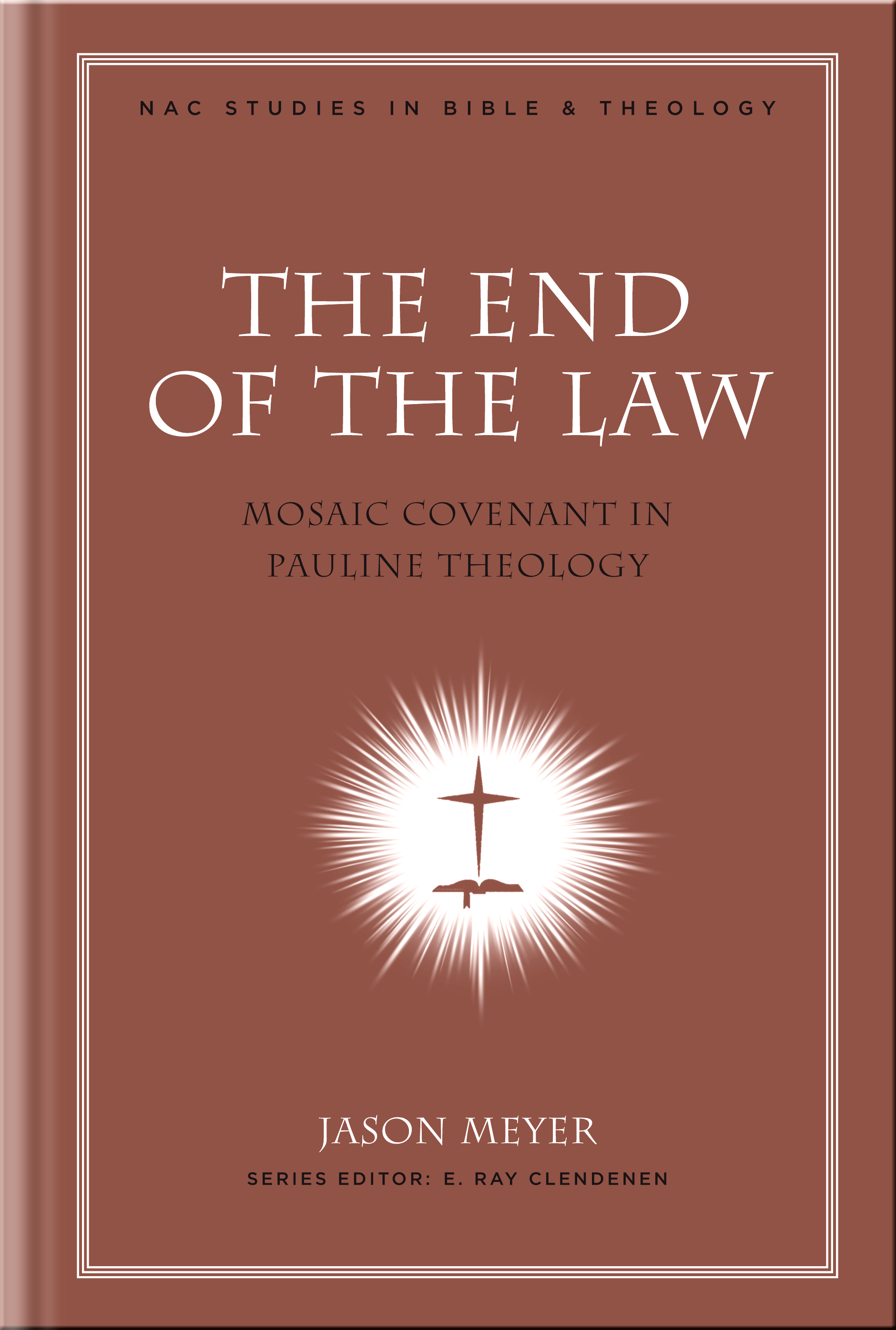
Book review: The End of the Law, by Jason C. Meyer

The End of the Law: Mosaic Covenant in Pauline Theology, by Jason C. Meyer
Nashville: B and H Academic: 2009

Largely because I was looking for the wrong thing, I was disappointed — and that's mostly my fault. If you know what to expect, and are looking for what The End of the Law delivers, you'll be glad.

Let me explain.

The issue of the relationship of the OT and NT is a large matter, looking over many subsidiarly concerns. It affects hermeneutics theology, preaching, and practice.

From the title, I had hoped that this book would delve in systematically and address that issue. I had expected help on the role of the law in Romans 7, the thorny issues related to that passage, and other related matters. I was disappointed.

Instead, what this reads like is a very detailed doctoral dissertation on a series of individual trees, with a brief overview of the forest at the end.

Meyer's "central question" is identified thus: "What is the character of the Mosaic covenant in the theology of Paul?" (268; cf. 1). His thesis is
Paul conceives of the Mosaic (old) covenant as fundamentally non-eschatological in contrast to the eschatologicalnature of the new covenant. Paul declares that the Mosaic covenant is now old because it belongs to the old age, whereas the new covenant is new because it belongs to the new eschatological age. ...The old age is transitory and impotent, and therefore the Mosaic covenant is both transitory and ineffectual. The new covenant is both eternal and effectual because it belongs to the new age and partakes of the power of the new age, the Holy Spirit. (1-2)
Meyer's procedure is painstakingly detailed and primarily exegetical. He spells out alternatives, and closely reasons his way to his conclusion, always with thorough documentation.

The first three chapters are introductory, setting the stage in scholarship and identifying the questions. Then in chapters 4-6, Meyer takes a microscope to passages in 2 Corinthians 3—4, Galatians 3—4, and Romans 9—11. It is easy, in this section (to return to my analogy) to feel as if a guide has you by the hand and is pulling you up sharply to touch your nose to a tree, which he then describes; followed by a second tree, and a third, and a fourth... and pretty soon, you're lost.

My interests were better addressed in chapters 7 and 8, which returned to more synthesis (particularly in the latter). Meyer stresses his observation that the OT calls for what it does not produce, while the NT provides what it calls for through the Spirit's ministry. He does this in part by focusing on the OT themes of circumcision (of flesh and heart), and of rebellion. This is a helpful discussion, as is the final chapter's summary and synthesis. I would have liked to see this chapter expanded, and/or its elements spread more prominently throughout the book.

Summary: this is probably largely a reader-fail on my part. Meyer cannot be blamed for my mistaken expectations. I think he did what he set out to do. If that is what you are looking for, you'll find it a solid and helpful guide and instructor.

B and H provided me with this review copy.

Tuesday, March 16, 2010

Book review: The Dispensational-Covenantal Rift The Fissuring of American Evangelical Theology from 1936 to 1944, by R. Todd Mangum

The Dispensational-Covenantal Rift 
The Fissuring of American Evangelical Theology from 1936 to 1944
by R. Todd Mangum
(2007: Wipf and Stock; 346 pages)

Did you know that, at one time, Dallas Theological Seminary had a huge Presbyterian presence, both on staff and among the student body? Did you know that Lewis Sperry Chafer and many other leading dispensationalists such as J. Oliver Buswell, S. Lewis Johnson, and A. A. Macrae, were Presbyterians?

Yet today, you can't serve as a Presbyterian elder or pastor if you are a dispensationalist. Many (not all) Presbyterians regard dispensationalism with suspicion and/or contempt, and treat it as either a heresy, or as heresy's dim-witted, bucktoothed cousin. Reformed sites and writers come up with "reasons" (including really lame ones) for not allowing dispensationalists a seat at the table.

What happened?

Todd Mangum's book takes a stab at part of the answer. He focuses on events leading up to the findings of Presbyterian study committees in the 1940s, which explain the rift that arose between two schools that were, and should have remained, mutual co-combatants in the struggle against unbelief and compromise.

This is Mangum's doctoral dissertation, so it is extremely detailed and closely-documented. It is readable, but it does read like a dissertation. Mangum gets into the original documents at length, and couples it with interviews with men then-living who had been involved in the actual events and known the principle actors (i.e. the late Drs. Walvoord, Macrae, and Johnson, among others).

Mangum argues that the split arose for a number of reasons, ranging from the regional to the political. A few critical errors in judgment and procedure created a rift which has yet to be fully healed. Chafer (of Dallas) drew some unnecessary lines in the sand very dogmatically; the Presbyterians of the board of inquisition would not allow him to address them in person, and narrowed their inquiry primarily to Chafer and a couple of other sources. Therefore, though not in fact representing all dispensational thought, Chafer was made to speak for all dispensationalists. When his positions were rejected, all dispensationalists were rejected.

The results were a far greater isolation and ossification. Presbyterian and Reformed presence at Dallas plummeted, and (of course) dispensational representation in Presbyterian circles fell to nil.

The result is as we see it today. Many dispensationalists resent and reject the doctrines of grace reflexively (having been rejected by their Presbyterian representatives in the 40s), and many Reformed folks view dispensationalists with suspicion at best, and hostility at worst. Two groups who should be battling unbelief side by side, and growing in their grasp of Biblical truths, remain isolated into warring camps.

At some points, one almost wishes one could be snapped back in time, to plead with one on this side or that to re-think, reconsider, re-examine, re-approach, modify... and sometimes just to chill out. But what's done is done, and that sometimes makes for sad reading.

My thoughts. As has been pointed out more than once, dispensationalists really should be Calvinists, and Calvinists really should be dispensationalists. The former believe at least in election and sovereign grace in the case of the yet-to-be-converted generation of Jews; the latter believe in God's sovereignty and faithfulness to His promises, and (at least formally) in the principle of grammatico-historical exegesis.

Yet, rather than admit and (hello?) reform this inconsistency, the latter re-define grammatico-historical exegesis to protect their un-reformed position, and the former ignorantly echo the shallower dodges of famous "Calminian" dispensationalists, past and present. The resulting stalemate is to no one's benefit.

Among his concluding observations, Mangum offers this:
We may wonder whether such dialogue [as has recently begun more in earnest] (and such modifications on both sides) might not have taken place sooner had the discussion not been marred from the beginning with such misunderstandings as we have explored in this study. Our wonder only grows when we consider that there might have been a latent form of "progressive dispensationalism" always present in the dispensationalist constituency from the beginning. (210)
[Update/aside: it occurred to me that news of dispensationalism's welcome back at the table apparently has not reached Minneapolis.]


In sum. Want to see how the rift started, in great and scholarly detail? I don't know a better source than Mangum.

(For a more learned review from a different perspective, see this from Dr. Kenneth J. Stewart)