As I wrote over at Pyro today, hope is as necessary to the human being as food and drink. You can't really live without it.
I started to write "to the Christian," but that isn't true. Everyone needs hope, and everyone has it. The unredeemed man has his own hope, but it is a doomed illusion. Eve and Adam hoped to have God-like knowledge and freedom and autonomy. They acted in hope. But because they did not act in faith, which is to say according to truth, what they attained instead was guilt and shame and wrath and misery and death. And so is the lot of every child of theirs who follows in their footsteps. I wrote a lot more about that somewhere, and it isn't my focus here today.
Here I focus on the Christian and hope.
I lived for years without (or with very little) hope, as a Christian. It was a dark, horrid time. With the occasional clarity of retrospect, I see that the real lack was a lack of faith.
Don't love that phrase much because it's overused and abused, but it's the truth. Understand, though: by "lack of faith" I do not mean "lack of orthodoxy." I was perfectly orthodox. That's not a self-congratulatory statement; it's categorical. I affirmed the verbal, plenary inerrancy of Scripture, the truth of the Trinity, the truth of penal substitutionary atonement, and on and on. Affirmed them with all my heart, internally and with my mouth and fingertips.
The trouble was that I did not embrace for myself the sweetness that comes from those truths to believers. Here we camp a moment on Ephesians 6:16 — "In all circumstances take up the shield of faith, with which you can extinguish all the flaming darts of the evil one." I see the shield as a bit different from the rest of the armor. "The faith" probably does refer to the revealed body of truth. However, excepting the only the sword, all the other items of armor just stay on, once donned. Put on the helmet and leave it; strap on the sandals, and leave them; belt on the belt, etc.
But the shield doesn't do you a bit of good if you don't hold it tight and hold it close. Possessing a shield alone is of little practical value. The only way you can extinguish all the flaming darts of the evil one is if you hold the shield and hold it tight and hold it close.
So for that period, I bristled with flaming darts and little hope, because I possessed the shield, but I didn't hold it close. John Piper's Future Grace helped me see that, and it combined with other facets of the Lord's patient dealing with me to turn me from despair to hope.
So hope comes from personal, appropriating, clinging, living faith, and that faith must come from revealed truth.
We need to have it, live it, speak it. Joni — who has known daily suffering for decades, to a degree few of us can imagine — speaks passionately, eloquently and movingly on the importance of hope. Parents need it, spouses need it, singles need it; all of us need it.
Worldlings have to make it up or materialize it. All of their hopes either are based on lies and illusions, or deal with things that thieves, moths and rust can destroy. They amount to a chimera. Barring repentance and saving faith in Christ, all their hopes are in the final analysis utterly and completely doomed. However good things are now, one day they will turn for the unimaginable worse, and will never improve.
The Christian's case is the precise and exact opposite.
Pastors should cling to and preach more hope. I've known pastors who show little hope; I've been a pastor who showed little. Pastors (most pastors, anyway, superstars aside) are exposed to such disappointment and sorrow and heartbreak. People fail, fall, betray, deceive, slander, malign, are ungrateful. Churches stubbornly refuse to grow. The hardened stay hard. Miracles are few and far, far between.
And you as a pastor may care more intensely than anyone else. Others drop by, go home, flick on the TV, and they're done. The pastor lives and dies with the church. He needs to have a hope that goes beyond how the church is doing this week, or how it's likely to do next week.
And more, the pastor really needs to hold it and preach Biblical hope. As I said, I've known pastors who've been so beaten-up by the church that the whole service has a doomed, gloomy feel. I'm not saying this either in harsh judgment (believe me!) or in lofty disdain (believe me!). I'm just saying it because it's true. My heart bleeds both for them and the church.
Those pastors need to find a hope that will lift their spirits and give them joy regardless of how faithful or faithless or feckless people are. They need that to lift them, and they need that hope to fill their preaching.
Yes, absolutely, preach the holiness of God and the fearful terrors of sin. But also and with equal passion (like Isaiah! like Jeremiah! like Ezekiel! like Paul! like Peter!) preach the sweetness and glories of the Gospel and its hope and promises.
I say this to you, and I say this to me.
Amen.
Showing posts with label hope. Show all posts
Tuesday, November 01, 2011
Monday, June 29, 2009
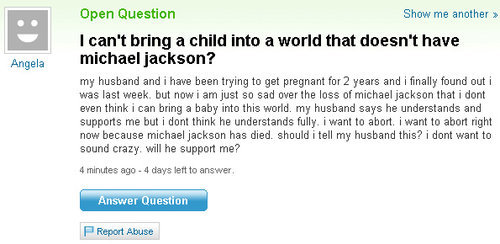
Michael Jackson's mourners: grieving as those who have no hope
According to this report, twelve grieving Michael Jackson fans have committed suicide in the wake of his death.
Think of that. Michael Jackson was a gifted, talented individual. He
was also a famously and deeply troubled man, wounded and wounding. At worse, he was also a perpetrator of the worst sort. Now, we will likely never know the true sum of it.
There is no harm in appreciating a person's gifts and enjoying his art. But — again, I stress if the report is accurate — here are people so bound up with this broken shell of a man that their life loses meaning when he dies.
Contrast that will my brother and friend Phil Johnson's moving tribute to a dear friend and coworker. His title is "At Home with the Lord (2 Cor. 5:8)."
It is clear that Phil, and many others, are shocked and saddened at Mike Taylor's passing. Taylor didn't perform to sold-out arenas nor get his picture plastered over magazines and posters and
billboards. He never had a video on MTV. He wasn't known for bizarre eccentricities. What he was known for was an infectious and hearty laugh, and for his love for Jesus Christ and for people.
The legacy Taylor leaves is lives touched for the Gospel, made better by encouragement and instruction in the Word, better-prepared for eternity. Jackson leaves people with nothing, except (in the case of the alleged twelve) a feeling that with him gone, they're empty, and life is too painful. (For some, it's even worse than that, if this isn't a pathetic joke.)
Taylor's parting saddens all who knew and loved them, but they have a hope that can't be shaken. Taylor's passing actually sweetens their appreciate of what he believed, taught, and lived for: which is to say the Gospel.
It all brings to mind this poignant passage from the apostle Paul:
Nor is it a wispy hope, as pagans have. I am constantly saddened to read unbelieving or superstitious conservatives over at FreeRepublic. When someone whom they like (i.e. Farrah Fawcett, recently) dies, they immediately proclaim the person as "in a better place." Why? On what basis?
On no basis whatever, with no authority and on no solid grounds.
Yet Christians have the objective historical fact of Jesus' bodily resurrection, and of the whole mass of His teachings which that resurrection confirms. Our hope is solid, and grounded.
If you don't have that hope for yourself, do not have reason to believe on God's own authority that you have a real involvement with Jesus Christ, then you must seek Him. Now is only opportunity you're sure of.
You have no greater priority.
ADDENDUM: Pastor Chris Anderson comments on a report that Jackson prayed with Andre Crouch shortly before his death. As is always the case with Chris, his thoughts are pointed and solid.
Think of that. Michael Jackson was a gifted, talented individual. He
was also a famously and deeply troubled man, wounded and wounding. At worse, he was also a perpetrator of the worst sort. Now, we will likely never know the true sum of it.There is no harm in appreciating a person's gifts and enjoying his art. But — again, I stress if the report is accurate — here are people so bound up with this broken shell of a man that their life loses meaning when he dies.
Contrast that will my brother and friend Phil Johnson's moving tribute to a dear friend and coworker. His title is "At Home with the Lord (2 Cor. 5:8)."
It is clear that Phil, and many others, are shocked and saddened at Mike Taylor's passing. Taylor didn't perform to sold-out arenas nor get his picture plastered over magazines and posters and
billboards. He never had a video on MTV. He wasn't known for bizarre eccentricities. What he was known for was an infectious and hearty laugh, and for his love for Jesus Christ and for people.The legacy Taylor leaves is lives touched for the Gospel, made better by encouragement and instruction in the Word, better-prepared for eternity. Jackson leaves people with nothing, except (in the case of the alleged twelve) a feeling that with him gone, they're empty, and life is too painful. (For some, it's even worse than that, if this isn't a pathetic joke.)
Taylor's parting saddens all who knew and loved them, but they have a hope that can't be shaken. Taylor's passing actually sweetens their appreciate of what he believed, taught, and lived for: which is to say the Gospel.
It all brings to mind this poignant passage from the apostle Paul:
But we do not want you to be uninformed, brothers, about those who are asleep, that you may not grieve as others do who have no hope. 14 For since we believe that Jesus died and rose again, even so, through Jesus, God will bring with him those who have fallen asleep. 15 For this we declare to you by a word from the Lord, that we who are alive, who are left until the coming of the Lord, will not precede those who have fallen asleep. 16 For the Lord himself will descend from heaven with a cry of command, with the voice of an archangel, and with the sound of the trumpet of God. And the dead in Christ will rise first. 17 Then we who are alive, who are left, will be caught up together with them in the clouds to meet the Lord in the air, and so we will always be with the Lord. 18 Therefore encourage one another with these words. (1 Thessalonians 4:13-18)Christians do grieve. We are sad. We weep. We miss the sweet fellowship of our brothers and sisters, friends, spouses, children, who die in the Lord. But we do not mourn as having no hope.
Nor is it a wispy hope, as pagans have. I am constantly saddened to read unbelieving or superstitious conservatives over at FreeRepublic. When someone whom they like (i.e. Farrah Fawcett, recently) dies, they immediately proclaim the person as "in a better place." Why? On what basis?
On no basis whatever, with no authority and on no solid grounds.
Yet Christians have the objective historical fact of Jesus' bodily resurrection, and of the whole mass of His teachings which that resurrection confirms. Our hope is solid, and grounded.
If you don't have that hope for yourself, do not have reason to believe on God's own authority that you have a real involvement with Jesus Christ, then you must seek Him. Now is only opportunity you're sure of.
You have no greater priority.
ADDENDUM: Pastor Chris Anderson comments on a report that Jackson prayed with Andre Crouch shortly before his death. As is always the case with Chris, his thoughts are pointed and solid.
Wednesday, April 01, 2009
Pathetic, but (thank God) not forever
Somewhere around Sunday, the local Sacramento winds kicked up some diabolical allergen, or horde of allergens, of the genus Killus Danielphillipus. They've just been kicking my... my self, ever since.

I sit here semi-listless, after another not-great sleep, sinuses packed as with cement (sneezing and dripping should return later), eyes hurting, head throbbing. That's just my body, though, right? My spiritual nature is another thing.
Yes, it's another thing, but it's in my body. God made Adam's flesh, breathed into it the spirit of life, and he became a living soul (Genesis 2:7). I am one person, comprised of body, soul, and spirit. The elements may be distinct, but they're related.
And so I did my Bible reading, but it wasn't terribly rewarding. I tried to pray on the way to work, but it wasn't much. I don't think Heaven got excited. And here I sit, not quite zombielike, but... well, not much
.
And this is nothing, absolutely nothing. Other people have real issues they're dealing with. Joni wakes up today, still a paraplegic, after decades of paraplegia. My brother David Wayne (keep praying for him) is still dealing with that damnable monster cancer. I know specifically some of you, my dear readers, are dealing with physical issues that make my silly, passing allergies embarrassingly trivial.
Physical issues, mental issues, temperamental issues, moral issues. This one brother is a terrific writer, but brittle and fragile. This other one is boastful and crass and taints the way he expresses his love for Jesus with self-defeating crudity. That woman has a sharp tongue she hasn't gotten to the root of; this fellow hasn't bridled his thought-life as he should; that one has desires that must be brought to the Cross....
On and on it goes. That's this life, for the Christian. The phrases I think of to express it are all so over-used that I don't even want to type them — but they're true. That's why they're over-used.
We are broken people who are in-process. That's just as true of a John MacArthur, with his very different construction, as it is of me. After years of being saved, of growth in sanctification, of
fruitful service, Paul could still use the present tense and the mildly emphatic pronoun (εἰμι ἐγώ) in saying that "Christ Jesus came into the world sinners to save, among whom I am first" (1 Timothy 1:15).
And while I think the already is over-stressed in some systems, it is true that we live in an already/not-yet tension. Already we who've placed repentant faith in the Lord Jesus Christ are saved, justified, forgiven, sanctified, adopted, baptized, indwelt, loved, blessed, seated, adopted, owned by God — Paul can even use the past tense "glorified," so sure is the eventuality (Romans 8:30).
But there is so much not-yet. We still struggle with our flesh (Romans 7:14-25), we still await deliverance from the body of this death (Romans 7:24). And then there's John's great "not-yet":
That's our hope, Christian. Let us hang on, and purify ourselves by it.

I sit here semi-listless, after another not-great sleep, sinuses packed as with cement (sneezing and dripping should return later), eyes hurting, head throbbing. That's just my body, though, right? My spiritual nature is another thing.
Yes, it's another thing, but it's in my body. God made Adam's flesh, breathed into it the spirit of life, and he became a living soul (Genesis 2:7). I am one person, comprised of body, soul, and spirit. The elements may be distinct, but they're related.
And so I did my Bible reading, but it wasn't terribly rewarding. I tried to pray on the way to work, but it wasn't much. I don't think Heaven got excited. And here I sit, not quite zombielike, but... well, not much
.And this is nothing, absolutely nothing. Other people have real issues they're dealing with. Joni wakes up today, still a paraplegic, after decades of paraplegia. My brother David Wayne (keep praying for him) is still dealing with that damnable monster cancer. I know specifically some of you, my dear readers, are dealing with physical issues that make my silly, passing allergies embarrassingly trivial.
Physical issues, mental issues, temperamental issues, moral issues. This one brother is a terrific writer, but brittle and fragile. This other one is boastful and crass and taints the way he expresses his love for Jesus with self-defeating crudity. That woman has a sharp tongue she hasn't gotten to the root of; this fellow hasn't bridled his thought-life as he should; that one has desires that must be brought to the Cross....
On and on it goes. That's this life, for the Christian. The phrases I think of to express it are all so over-used that I don't even want to type them — but they're true. That's why they're over-used.
We are broken people who are in-process. That's just as true of a John MacArthur, with his very different construction, as it is of me. After years of being saved, of growth in sanctification, of
fruitful service, Paul could still use the present tense and the mildly emphatic pronoun (εἰμι ἐγώ) in saying that "Christ Jesus came into the world sinners to save, among whom I am first" (1 Timothy 1:15).And while I think the already is over-stressed in some systems, it is true that we live in an already/not-yet tension. Already we who've placed repentant faith in the Lord Jesus Christ are saved, justified, forgiven, sanctified, adopted, baptized, indwelt, loved, blessed, seated, adopted, owned by God — Paul can even use the past tense "glorified," so sure is the eventuality (Romans 8:30).
But there is so much not-yet. We still struggle with our flesh (Romans 7:14-25), we still await deliverance from the body of this death (Romans 7:24). And then there's John's great "not-yet":
See what kind of love the Father has given to us, that we should be called children of God; and so we are. The reason why the world does not know us is that it did not know him. 2 Beloved, we are God's children now, and what we will be has not yet appeared; but we know that when he appears we shall be like him, because we shall see him as he is. 3 And everyone who thus hopes in him purifies himself as he is pure.And there, in a word, is all my hope. One day, I will see Him, and the sight will be finally transformative. I will not always be torn, broken, conflicted, afflicted with holy desires I cannot fully fulfill, and by unholy desires I should not even know. One day He "will transform our lowly body to be like his glorious body, by the power that enables him even to subject all things to himself" (Philippians 3:21). Then I will be truly whole. Not a mass of conflicting drives and weaknesses, like a bad orchestra clumsily warming up. Then, by God's transforming and resurrecting and glorifying grace, I shall be a symphony of praise (cf. Revelation 22:1-5).
(1 John 3:1-3)
That's our hope, Christian. Let us hang on, and purify ourselves by it.
Friday, October 17, 2008
Tested by the Word
In Psalm 105:17-19, we read that Yahweh
I take it that this "word of Yahweh" refers to the revelations Joseph had received in his youth. Yahweh had shown him that he would be prominent in his father's house.
Well, he'd been "prominent," all right: prominently
hated. His brothers had loathed him, and couldn't decide which was the better idea — kill him outright, or sell him off to pagans and forget about him.
No doubt, this wasn't what Joseph had envisioned. He went down, down, down. Down into the pit, down into slavery, down into Egypt, down into the dungeon.
And all the while, that promise from Yahweh was "up there." I can imagine that what had started out as bright and hope-inspiring became very difficult. None could be surprised if Joseph had been tempted to bitter exasperation. "Some promise," he could have thought. "Some prominence!"
So this, I take it, is how "the word of Yahweh tested him." Joseph had a promise of greatness from God, yet here he'd sunk about as low as he could get. What would dominate his attitude, outlook, affections, perspective? Would the decisive factor be the word of the Lord, or would it be Joseph's circumstances?
It was a fiery test.
Clearly, Joseph continued to believe. Because he believed, he continued to trust. Because he trusted, he continued to hope.
How do I know that? I know it, for one, by how he responded to the temptations of Potiphar's wife.
Did he say, "Sure, whatever, might as well get whatever jollies I can get"? Did he say, "Yahweh sure isn't coming through in the 'happy' department, so, if you've got something, I'm in"?
Nope. You know his response: "How then can I do this great wickedness and sin against God?" (Genesis 39:9). His hope — born of trust, born of faith — purified him.
And aren't we tested in much the same way?
We, too, have words from God that often go counter to our circumstances. We are promised suffering now (John 16:33; Acts 14:22, etc.). But we are also promised glory to come (Matthew 5:2-12; Hebrews 12:1-2). We are to fix our hopes completely on that ultimate, eschatological hope of deliverance in, through, and because of Jesus Christ (1 Peter 1:3-9, 13, etc.).
Sufferings and humiliation, now; glory and eternal joys in His presence, then.
And here's our test: do we believe them, or Him? When tragedies or setbacks strike, do we believe that they are the final word? Do we walk in gloom, bitterness, discouragement — disbelief? Is Satan more persuasive to us than God?
Because without hope, we're doomed. Without hope, we're no more fit for trials than Joseph would have been. The same dynamic applies to us:
And hope depends on faith; and faith depends on the Word of God, and what we do with it.
Or do we believe God? Do we believe that glory, and not groaning, is ultimate (Romans 8:18-30)?
The word of Yahweh tested Joseph.
It tests us, too.
...had sent a man ahead of them,My interest is that last phrase: "the word of Yahweh tested him."
Joseph, who was sold as a slave.
18 His feet were hurt with fetters;
his neck was put in a collar of iron;
19 until what he had said came to pass,
the word of the LORD tested him.
I take it that this "word of Yahweh" refers to the revelations Joseph had received in his youth. Yahweh had shown him that he would be prominent in his father's house.
Well, he'd been "prominent," all right: prominently
hated. His brothers had loathed him, and couldn't decide which was the better idea — kill him outright, or sell him off to pagans and forget about him.No doubt, this wasn't what Joseph had envisioned. He went down, down, down. Down into the pit, down into slavery, down into Egypt, down into the dungeon.
And all the while, that promise from Yahweh was "up there." I can imagine that what had started out as bright and hope-inspiring became very difficult. None could be surprised if Joseph had been tempted to bitter exasperation. "Some promise," he could have thought. "Some prominence!"
So this, I take it, is how "the word of Yahweh tested him." Joseph had a promise of greatness from God, yet here he'd sunk about as low as he could get. What would dominate his attitude, outlook, affections, perspective? Would the decisive factor be the word of the Lord, or would it be Joseph's circumstances?
It was a fiery test.
Clearly, Joseph continued to believe. Because he believed, he continued to trust. Because he trusted, he continued to hope.
How do I know that? I know it, for one, by how he responded to the temptations of Potiphar's wife.
Did he say, "Sure, whatever, might as well get whatever jollies I can get"? Did he say, "Yahweh sure isn't coming through in the 'happy' department, so, if you've got something, I'm in"?
Nope. You know his response: "How then can I do this great wickedness and sin against God?" (Genesis 39:9). His hope — born of trust, born of faith — purified him.
And aren't we tested in much the same way?
We, too, have words from God that often go counter to our circumstances. We are promised suffering now (John 16:33; Acts 14:22, etc.). But we are also promised glory to come (Matthew 5:2-12; Hebrews 12:1-2). We are to fix our hopes completely on that ultimate, eschatological hope of deliverance in, through, and because of Jesus Christ (1 Peter 1:3-9, 13, etc.).
Sufferings and humiliation, now; glory and eternal joys in His presence, then.
And here's our test: do we believe them, or Him? When tragedies or setbacks strike, do we believe that they are the final word? Do we walk in gloom, bitterness, discouragement — disbelief? Is Satan more persuasive to us than God?
Because without hope, we're doomed. Without hope, we're no more fit for trials than Joseph would have been. The same dynamic applies to us:
See what kind of love the Father has given to us, that we should be called children of God; and so we are. The reason why the world does not know us is that it did not know him. 2 Beloved, we are God's children now, and what we will be has not yet appeared; but we know that when he appears we shall be like him, because we shall see him as he is. 3 And everyone who thus hopes in him purifies himself as he is pure (1 John 3:1-3)Hope will purify. Hopelessness will defile. Hope grants that endurance without which holiness is impossible.
And hope depends on faith; and faith depends on the Word of God, and what we do with it.
Or do we believe God? Do we believe that glory, and not groaning, is ultimate (Romans 8:18-30)?
The word of Yahweh tested Joseph.
It tests us, too.
Labels:
discipleship,
faith,
holiness,
hope
Subscribe to:
Posts (Atom)