Showing posts with label worldview. Show all posts

Friday, May 24, 2013

From 1990: Second-Hand Values or Can Conservatism Save America?

I wrote this in 1990. It was, I think, published in a local newspaper. See what applying Biblical logic (rather than listening for holy mumbling) can do for anyone. Sure worked for Machen, whose writings from the 20s and 30s are chillingly current.

I post this without editing, overuse of parentheses and all.


It is disappointing when a plant dies. It is even more frustrating when a plant blooms, shows apparent health — and then keels over, limp and dead. What happened? Could be shallow soil, could be lack of nourishment, could be hungry bugs…. Regardless, the plant is gone.

Conservative values seem to be "blossoming" in a number of ways. We have a professedly conservative President [George Bush, at the time of writing]. Ads for William F. Buckley's stimulating National Review are hard to miss, on radio and television. Everyone and his brother is a Rush Limbaugh "ditto-head," and can quote the deservedly well-known (and notorious) talk-show host on many given subjects. Surely anyone who holds conservative values (as I do) would be beside himself with glee and optimism.

But I'm not. Not yet. Here's why:

Once upon a time there was a generation of Israelites who were delivered by God from Egypt. They turned out to be a terrible disappointment: whiners, rebels, closet idolaters almost to the last man. So God sentenced them to a few "laps" in the desert: forty years' worth.

The next generation showed more promise. Apparently humbled by their parents' bad example, they pledged and displayed loyalty to God's appointed leader (Joshua 1:16-18). This devotion even surpassed the "inconvenience barrier," as the males all submitted to the at-best painful rite of circumcision (Josh. 5:2ff.). With a few inevitable glitches, that generation basically performed adequately. As the inspired historian tells us, "the people were serving Yahweh all the days of Joshua, and all the days of the elders who prolonged their days after Joshua, who had seen all the great work of Yahweh which He did for Israel" (Josh. 2:7).

So far, so good. Then what? Then Joshua and his generation died, and "a different generation arose after them, which did not know Yahweh, nor even the work which He had done for Israel" (Judges 2:10b) This generation had second-hand divine viewpoint values. And "second-hand" proved to be not good enough, as these folks proceeded to get involved in compromise, spiritual and moral gutlessness, idolatry, and the inescapable consequence: divine judgment (cf. Judges 2:10-15).

Now, none of this was necessary. God never promised to give "command-performances" of His miracles in the desert. These miracles, and what they taught of God's character and ways, were not to be re-produced, as the modern "signs and wonders" crowd mistakenly imagines. No, their lesson was to be transmitted through teaching from parent-to-child, parent-to-child (Exodus 12:26, 27; Deuteronomy 6:4-9; 32:7ff., etc.) Future generations would internalize the same truth of God by the Word of God, and by faith in that Word (Ps. 78:3, 4).

The problem: though God's Word provided the answer, Israel did not accept that answer. The nation did not obey God. The result was that devotion to the truth perished with the first beneficiaries. And so the outward trappings of religion can survive the death of the inward reality, resulting in external religious form without internal power and conviction (cf. 2 Timothy 3:5). In short, we end up with people who hold a few selected religious values, without knowing why, and without an overall, deeply-rooted rationale and game-plan.

I think that this is what we see today. The "plant" appears to be blooming —— and understandably so, given the manifest bankruptcy of liberalism across the board. But modern "conservatives" are rootless, and the prognosis is not particularly good. What symptoms are manifesting themselves? Take a recent issue of National Review (July 9, 1990). It contains a letter from a Mr. Liebman, who counts arch-conservative Buckley as his "best friend" (p. 16). Liebman says that he has been a Roman Catholic for ten years, an active conservative for over three decades, and a homosexual. Buckley's response (p. 18) is vague, tepid, and affectionate. Although he expresses misgivings about homosexuality, Buckley fondly embraces Liebman as a fellow-conservative, calling him his "dear friend" and "brother in combat" (p. 18).

Similarly, Rush Limbaugh has said in effect "I don't care who sleeps with whom," and makes it clear that he is bothered by organized homosexual politics and rowdiness, rather than by homosexual orientation and behavior per se. He has received and welcomed politically conservative "gay" callers. By contrast, Limbaugh angrily dismissed a caller who dared to suggest that "sodomite" would be a more fitting appellative than "gay." It seems that bad taste bothers Limbaugh more than questions of bad morality.

And so, on what basis can either of these public figures, or any others, register complaints about organized "gay" activities? To my knowledge, neither clearly appeals to any objective, unchanging, absolute standard; such an appeal might backfire. Neither clearly says, for instance, "My personal feelings in the matter are irrelevant. I am bound by Biblical revelation, which records God's attitude towards homosexual practices." Accordingly, the publicly "conservative line" concerning homosexuality appears to boil down to personal bias — which plays right into homosexuals' common counter-complaints of "hate" and "homophobia."

Other examples could easily be multiplied. Just think of the ever-waffling Republican party (pro-life...pro-choice...pro-life...pro-choice — "What do the polls say I should be today, honey?"). "Conservative" becomes more and more difficult to define; and "conservatives" in power are desperate to distance themselves from religion or religious people — except so far as to garner their votes. Overlap between "conservative" values and (say) Biblical teachings is fortuitous, but sheerly eclectic and coincidental. Therefore, a "conservative" today ends up being in effect someone with certain ideas about economics, politics, and morality, but no deep diagnosis of the cause of man's problem, no unchanging basis for his own values, and therefore no rationale as to why anybody else should embrace those values.

This is a prescription for long-term failure. It will result in a "plant" which may bloom brilliantly for awhile, but which is doomed to die for want of soil, roots, and nourishment.

The Bible provides what "conservatism" lacks, and what men and women desperately need. It gives an absolute, objective, revelatory basis for thought and life. (The phrase "Thus says the Lord" alone occurs in some 416 verses in the New American Standard Bible). It diagnoses man's problem as being twofold: his legal standing before God ("through one man [Adam] sin entered into the world, and through sin death, and thus death came through to all men, because all sinned"; Romans 5:12), and his nature ("the mind-set of the flesh is hostility towards God, for it does not subject itself to the law of God, for it is not even able to do so"; Romans 8:7). Too, the Bible puts man's crisis in its proper perspective: it is not the deficit nor the Dow, but "the wrath of God...against all ungodliness and unrighteousness of men who suppress the truth in unrighteousness" (Romans 1:18).

The Bible also prescribes the only solution which will abundantly address our fundamental problem: the person and work of the Lord Jesus Christ. He takes care of believers' legal standing before God ("being declared righteous as a gift by His own grace through the redemption which is in Christ Jesus"; Romans 3:24), and He changes believers' hearts ("if one is in Christ, he is a new creation: the old things passed away; see, new things have come into existence"; 2 Corinthians 5:17).

As long as "conservatism" imagines itself as containing within itself the ultimate answers to man's dilemma, it is doomed to die like our "plant." But the man who trusts in Christ, and learns and obeys His word, has hope, has direction, and ultimately has the answers that this tired old world needs: "Jesus Christ...the same yesterday and today and forever" (Hebrews 13:8), and "the living and abiding word of God" (1 Peter 1:23).

If only we would listen.

So you see, it was evident in 1990 that the only real solution was the world-tilting Gospel of Christ.

This is all the more evident, today.

Wednesday, January 16, 2013

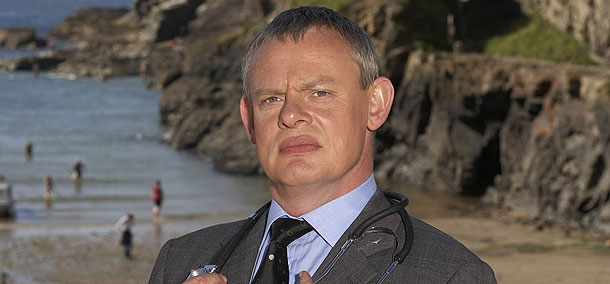
Doc Martin and redemption

As a result of suggestions made by you, Dear Readers, Valerie and I are watching the British TV series Doc Martin on Netflix.  We just finished the third episode of season 4, and don't want spoilers, thank you very much.

The premise of the series is that Dr. Martin Ellingham, accomplished surgeon, is suddenly seized by hematophobia. Accordingly, he leaves surgery (hard to do the slicing without some splashing), and ends up as the GP in a beautiful bayside town called Portwenn. The latter is played by Port Isaac in North Cornwall, England.

The basic format is that of a medical mystery / romantic comedy. Locals persist in calling Ellingham "Doc Martin," against his frequent but now-fading corrections. He is himself a surly, rude man, bereft of the least whiff of tact, and proud of it. He calls tact and sensitivity "rubbish" (which is a modern Britishism for "humbug"), and he'll have none of it.

But Ellingham is medically well-nigh brilliant, and eventually sees through everything sent his way. And while he virtually never shows the least bit of kindness or compassion per se, one of the most recurrent sites is of him running at full speed to some medical emergency.


As you're probably already thinking, it is impossible not to make comparisons to the American series House, MD, which started the same year. Both men are rude and churlish, both men have handicaps that irritate them, both men are medically brilliant, neither man rests until he figures out the medical mystery.

But there are major differences. One dissimilarity is that there's little real malice in Doc Martin. He's guileless. For the most part, Ellingham isn't trying to be mean; he just IS mean because he doesn't care what people think about him or what they make of what he says. Occasionally he effects a puzzled look indicating that doesn't seem to understand what others' problem is — if he even takes note of their reaction.

House, by contrast, was deliberately cruel, setting out to make fools and liars of people and expose their (assumed) hypocrisy. The least flicker of virtue in others constituted a glowing target for House, compelling him to search for a pathology of some sort.

And yet here also is a place where early House was superior to anything we've yet seen in Doc Martin. As I discussed elsewhere, in the early years Dr. House was longing and searching desperately for redemption. He knew he was a broken man, sometimes admitting his need for help; and he hated the horrid place the world was. House longed for something transcendent to cling to, something to give him hope; yet he had the settled conviction that there was no such thing. So House's compulsion to "expose" people who did have hope and transcendent values was driven by a bitter certainty that no real hope existed, a fury at that fact, impelled by a remaining flicker of hope that he'd find something he couldn't deconstruct.

There's nothing of that in Doc Martin. Ellingham's only discomfort is with his hematophobia, and that only because it keeps him in that dreary little village with those dreary little people. He neither longs nor searches for redemption of any sort. When he thinks of it at all, he thinks the rest of the world is off-kilter, addicted as it is to "rubbish" like tact and kindness and compassion. They should all be like him. Or not. He just doesn't care.

One's view of Ellingham is ameliorated a bit by glimpses of his upbringing. He alludes (admiringly) to severe and unloving discipline as a child. More becomes clear when we meet Ellingham's parents. Horrible people, sneering and loveless. Ellingham's father has few or no redeeming traits; and his ice-cold mother tells him, in so many words, that his birth and very existence ruined her life. She was happy before Ellingham as born; then, with his arrival, her life was rubbished. It hurts more to see Ellingham take abuse from both parents with no sign that he thinks them out of line, that he sees what a wretched, inexcusable cruelty it is. This is what has formed him.

Yet the humanist's version of redemption does nibble at Ellingham, in the form of a pretty little teacher named Louisa Glasson. For reasons which baffle and elude any viewer not schooled in abnormal psychology, Louisa is attracted to Ellingham early on, and he to her. Their conversations are really funny, in that every slight encounter turns into an argument. The first time they kiss, he instantly — without a pause — launches into speculation as to the medical causes of her bad breath. The second time they kiss, he speculates that a bad menstrual period explains her being over-emotional. Yes, it's that bad. He's that bad.

SPOILER ALERT ON

Then, in a careening plot line, Louisa finally shows some sense, and breaks up with Ellingham. He is utterly miserable. They happen to encounter each other, and he... proposes marriage. And she accepts! Yes, they literally have not put together two consecutive happy days together, let alone two consecutive happy hours, but they're about to marry.

But even that is doomed. They end up leaving each other at the altar.

In this sequence, both are revealed as selfish people, though Louisa less so. That is, they both primarily want to be made happy by someone. She doesn't want to take Ellingham on as a project, and I daresay anyone who cared a whit for her would agree. He won't make her happy, and she won't make him happy, so they leave each other.


SPOILER ALERT OFF

Valerie and I continued watching because the locations are lovely. The cameraman only seemed to notice that fact with the beginning of the third season, and we started being treated to more artistic views. Also, the people are quaint and quirky, rather like the characters in the All Creatures Great and Small series.


Yet, as my dear wife has observed, it's only rather like. Something keeps the series from being fun. The writers seem to hold all their characters in contempt. The series has a negative attitude towards almost everyone in it. Every last person is unhappy and/or broken in some way. There are no exceptions.

And they're not "quirky-but." Some are insane, most are stupid and self-destructive and mean, none of them really seems to care for anyone other than himself, with the sole exceptions of Ellingham's aunt (who cares for him), a rotund father (who cares for his son), and a "chemist" (who adulterously lusts for Ellingham).

For instance, there's a ranger who's insane and has come close to killing several characters. Funny? Not a lot. Then there was the episode where a 15 year old girl was eager to lose her virginity, and overdosed on drugs because she was stung by her girlfriends' relentless ridicule over the size of her breasts. The happy ending? Ellingham gave her a placebo, and she viciously mocked one of those friends for the shape of her ears. She "won," you see, by getting the last hateful word in.

Like House, there's no redemption for Ellingham thus far. Unlike House, there's no longing for it. You watch a series like this, hoping for some epiphany to hit Ellingham, but so far none has so much as tugged on his sleeve. One religious character had an ongoing presence, yet his religion was shapeless and powerless, and both it and he were ultimately mocked and waved aside dismissively.

Only two even semi-hopes came by. One was a psychologist who immediately diagnosed Ellingham as having Asperger's, which at least would have explained his rudeness pathologically. The other hope of course is Louisa. Ellingham adopts a softer tone around her, and looks rather twitterpated. His voice becomes softer, and he looks like a big puppy, when she's around. Until they start arguing. Which they usually do.

But to date, they've not put themselves together, and in the real world (A) Louisa wouldn't even be available in the first place, and (B) this link-up never would have happened. Barring a sad, sad self-destructive pathology on Louisa's part.

And where does that leave Ellingham? He cared for Louisa as much as he cared for anyone other than himself and, to a lesser degree, his aunt. Nothing else calls to him but a return to his career as a surgeon, if he can just overcome this pesky phobia.

This is where modern screenwriters dip into a dry inkwell. How can they not? They live in a dry inkwell. All mankind is still banished from Eden, still longs for a way back, but still is unwilling to admit either the real cause of the problem or confront the real and only hope for a cure. So we wander on with Cain as strangers in the land of wanderers, complaining about the severity of our punishment but not owning up to our guilt. This is why all long for redemption, and this is why the best storytelling always contains an element of redemption.

But modern Brits, like modern Americans, have no redemption to offer. Amusement, anesthesia, diversion, yes. Mockery and derision of our supposed inferiors, yes.

Redemption, no.

So we watch broken characters like Dr. House and Doc Martin, longing to see them find the redemption we ourselves hope for. But the writers of House ran dry long before the series closed, and gave up all hope of the theme. So they resorted to the formula of House being monstrously cruel and hateful and brilliant. They had nothing more to offer. And so far, while their protagonist isn't the monster House become, neither do the writers of Doc Martin.

Because the only genuine hope for redemption is in the Redeemer... and facing up to that reality would entirely jostle their very world in a way which they are still denying and still fighting with all they've got.

Which is, ultimately, very sad.

ADDENDUM: SPOILERS

Valerie and I have now finished watching the entire series. There is no need to revise anything I wrote above. We enjoyed many things about it. The actors are excellent, the writing is clever, the characters are sad. Bert Large runs his business deep into debt, takes money from a loan-shark, and then won't pay the interest. (Point: the loan-shark didn't specify the interest at the outset; Counterpoint: if Bert is so dim-witted as to think the money was a gift, it's hard to his credit.) His son helps him... by stealing from his aged employer, taking advantage of her trust and affection for him. Nice. All the more so because she's not much more a "people" person than Ellingham, but she likes Al... who takes advantage of her, and barely apologizes. (He had to, you see.)

The poor messed-up constable is fleetingly reconciled to the estranged wife he adores, and loses her, humiliating himself all over again. The poor adulterously love-struck chemist abuses drugs and has a psychotic break. Louisa's long-estranged mother returns, all coos and kisses, only to endanger Louisa's baby and continue the same appalling behavior that shattered her relationship with Louisa in the first place.

Life at Portwenn, in other words, continues as usual.

Meanwhile, Dr. Ellingham and Louisa come to live together, courteously. Martin tries to try to try, Louisa is very patient...in some ways. Ultimately, she has her fill of Ellingham being who he is, and leaves him. Again.

But at the end of the final episode, there's a sweet reunion that does give some horizontal hope to both of them. Ellingham tells Louisa that he loves her, and it looks as if they have a future. More hopefully, Ellingham says he's not going to be a father like his own wretched father, and he doesn't want their son to grow up to be like him. All viewers will cheer both resolutions.

Commenting on this paused story, then, such redemption as we now see serves to glorify God's greater redemption in Christ, by contrast.

Louisa is Martin's only horizontal hope. His aunt Joan, who tried feebly to be an influence, has died. Her death saddened Ellingham, but seemed to provoke no great reflection or introspection. Instead, he used the funeral to blame her for her own death and to lecture everyone about their obesity.

Only Louisa softens him, reaches him, touches him, humanizes him. His voice is always softer in talking to her (until they start arguing, which is usually the case), and his face always takes on a puppylike look.

At the same time, while she shows him a lot of patience, it is limited and aimless — except insofar as it is selfish. Louisa puts up with a lot from Martin... but not so that she can help him grow or change. Nor has he indicated (until the end of the last episode) that he feels the need for any change. Indeed, it is the world that should change. It should become more like him.

Louisa appears to want only to change Martin to make him into someone more suitable for her. And who could blame her? What is more, if he did learn to suit her better, Ellingham would probably become a better person in the bargain.

But Louisa shows no sign of knowing God, so she has no Christ-centered goal for herself or for Martin, and thus doesn't have any idea what either he or she should become. She doesn't have it, so she can't give it.

Christ, by contrast, is hard at work in the lives of His people to conform them to the image of their Creator (Col. 3:10; Titus 2:11-14). To do this, Jesus Christ must be the epitome of long-suffering patience in His dealing with us (1 Tim. 1:16). Unlike Louisa, He will never under any circumstances leave His people (Heb. 13:5-6), and will save us not just part-way, but all the way (Heb. 7:25), and will never, every put us out (Jn. 6:37). His love for His people is unfailing, sovereign, invincible (Rom. 8:35-39).

You see, that's real redemption. That's what it is to know God. It is a redemption that finds us as ruined and with nothing whatever to offer (Eph. 2:1ff.). It finds us not even as "fixer-uppers," but as hopeless wrecks. Yet there is hope for the hopeless, and that only because the Redeemer Himself brings it (Eph. 2:4-10). It is a redemption that begins with us in the very worst condition, and never rests in the good and joy and blessing and recovery that it brings us, not even to the endless ages of eternity.

Now, that is a redemption. Unfortunately, like Louisa, today's authors and screenwriters as a rule do not have that redemption themselves.

And so, like Louisa, they cannot offer what they do not possess.

Saturday, July 23, 2011

Blond-haired, blue-eyed conservative Palin-loving Christian terrorist?

In PR terms, Christmas has come early for the Left/MSM: they have found a terrorist to whom they can attach "far-right" conservatism, fundamentalist Christianity, and the name of Sarah Palin. It's a propaganda trifecta.

Independent thinkers will quickly recall the groundless media swarm over murderer Jared Loughner, and will wonder if this narrative isn't a bit too convenient. However, I have a simple thought to offer, which I believe I'll never be in any danger of having to withdraw or modify.

Let's say the perpetrator of this appalling act is a Christian. In fact, let's say he's a fundamental, orthodox, Calvinistic Christian of impeccable testimony (before this atrocity). Further, let's say he thinks the American Constitution is the embodiment of political wisdom. Let's say he's donated $55 billion to the Tea Party movement in America, and another $55 billion to Sarah Palin's PAC. And let's finally stipulate that he eats and drinks Madison, Jefferson, and Adams, and is appalled at Obama and the Democratic Party in America.

HSAT:
  • There will be no large public celebratory demonstrations of support from fundamental, orthodox, Calvinistic Christians. None. Zero.
  • There will be no large public celebratory demonstrations of support from GOP stalwarts, or any other sorts of American conservatives. None. Zero.
  • There will be no large public celebratory demonstrations of support from Tea Party members. None. Zero.
  • There will be no large public celebratory demonstrations of support from Sarah Palin or her supporters. None. Zero.
  • There will be, instead, universal condemnation of any murderous, terroristic acts from all of the above.
In fact, let me be the first. As a card-carrying CalviDispieBaptoGelical who admires the Constitution, thinks generally well of Sarah Palin, thinks Obama is an appalling man-child wholly unequal to holding the office of American President, and recognizes that the Democratic Party sums up everything that's wrong about America, I unconditionally condemn the Oslo terrorist acts, assuming they're being reported accurately. (Sad that one has to add that qualifier, but one must.)

In this, I'll just be one of many.

That's the difference, and it's all-important. Even if this person holds all the opinions detailed above, his action was in spite of them, and not because of them.

Unlike other monsters and their genuinely monstrous worldviews.

UPDATE: as I anticipated, the story may not be so simple, and some questions need answering.

Wednesday, April 13, 2011

Hollywood and Jesus, part 3248598: "Soul Surfer"

I've often remarked about the scarcity of portrayals of real-live, identifiable, genuine, 3-D Christians in the movies.

Leaving aside even questions of truth — there are, well, let's see: dozens of Christians in America. Hundreds. Thousands. Tens of thousands. Heck, maybe even millions!

But in movies and TV? Not so much. Nary a one. Quick: name one major ongoing TV show with a continuing, positive character who is openly and verbally and consistently a Biblically-faithful Christian. Just one.

On the other hand, name a TV show with a sympathetic homosexual character. Ooh, you could do that one. Now, which is the higher percentage of the American population? In other words, which are you likelier to find in any random lassoing of a group of Americans? Homosexuals, or Christians?

Do the same exercise for TV or movies for a character who is an amoral person, an atheist, an agnostic, a humanist, a Muslim, a Wiccan, a non-practicing Roman Catholic, a political liberal. Easy, isn't it? But Christians? Ah, again, not so much.

One of my favorite creative minds in Hollywood, Joss Whedon, can write credible monsters, murderers, nutcases, humanistic nihilists... but either can't or has no desire to create one identifiably Christian character. (I wrote more fully on that here, in case you're interested.)

If you do see any religion of even distantly-Christian caste, one or more of these will obtain:
  1. It will be Roman Catholic. Or, if not...
  2. If he is a hearty believer, he will be insane, a murderer, a hypocrite, or all three.
  3. If he is a good guy, he will be losing or seriously questioning his faith — or hopelessly vague about it.
  4. If he's a good guy and a sincere believer, he will be unable to give any rationale for his faith, and will lose every argument or debate, no matter how kindergartenish.
  5. If he prays, he will keep his eyes open, as if to signal that he isn't really talking to God.
Why is it so? Obviously, part of it is simply that Hollywood blends well with the world-system, and the world hates the real Jesus and His people, period (cf. John 7:7; 15:18; 17:14; 1 John 2:15-17; 3:13).

More charitably, I've simply wondered whether none of the big wigs and creative minds knows any actual practicing, card-carrying Christians. Maybe there isn't that presence simply because there just isn't that influence. That's my nicest thought.

So with all that, it's interesting to read this back-story about the making of the movie Soul Surfer. Evidently there were a number of fights during the filming, attempts to bar precisely those elements I single out above. Maybe the actors can be allowed to say "God," but they may not say "Jesus"; maybe they may quote from the Bible, but they may not say from where; and so on.

So you can't say Hollywood didn't want the story, and you can't say that Hollywood didn't have any direct, in-person Christian input. It was all there.

Hollywood just didn't want it.

Now, if it had been about some homosexual girl whose arm had been bitten off by a shark, how do you think her perversion would have been treated? It isn't a sure thing, but lesbianism is kind of "hot" today. Or if she'd been an abortion-clinic volunteer? Or Muslim? I think that would all have been different.

Meanwhile, I haven't seen the movie. It will probably be a Burger Night movie; Anna Sophia Robb is an incandescent actress, and the movie is doing well.

Have you seen it?

Michael Medved liked it... but, as Christian-friendly as he is, one of the things he liked about it was that the Christianity wasn't "in your face" (or some such expression).

Sigh.

Thursday, April 07, 2011

Government schools and the erosion of the American vision

I open with several Pre-Rant Disclaimers:
  1. My entire pre-Christian education was in government schools, and most of my educational deficiencies are wholly my fault, not on my teachers'.
  2. My parents were terrific people who did the very best by me that they knew to do, and I am grateful to them. I trusted my kids to state schools, too... at first. This has nothing to do with finding fault with my parents.
  3. I am not about to argue that there are no fine educators in the state education camp system. In fact, probably my best teacher anywhere ever was Earl Livingood at Glendale Community College.
  4. I am not about to argue that Christian parents sin if they send their children to government education schools; that is their decision — though it is my opinion that it should be the distant-last choice, if ever.
So the adults have finally arrived. Democrats have been in charge of legislation and budgetary matters for years, and they have ruined us. Bush, though far better than the current occupant of the WH, was no principled conservative, and the GOP under his leadership was no model of fiscal constraint or constitutional principles.

But the adults are here. Representative Paul Ryan has proposed a budget that would head America in the general direction of the Constitution and the Founding Fathers' vision of a limited government. Calling our current dilemma the "most predictable crisis in the history of our country," Ryan does what the Dem leaders have failed even to attempt: map a path forward that does not depend wholly on confiscatory taxation and deficit spending.

But that isn't really my point.

Dems responded predictably with the usual slanders of the GOP killing people and throwing seniors and The ChildrenTM into the streets to die slow deaths of starvation and disease. Particularly at the present moment, in the wake of President Obama and the Dems' unwillingness to engage seriously and the looming possibility of a (temporary!) Federal government "shutdown," apocalyptic nightmare visions are being invoked.

Now we're near my point. Just stop and think of that. It is the Dem/liberal premise that the government must confiscate the earnings of productive people and control the lives of all citizens. It has that right, and it has that responsibility. If the government does not do those things for us — control, decide, and provide — death and chaos and destruction are inevitable and invariable results.

In a healthier day, the nation would have rebelled in horror at such a suggestion. This is exactly what our forefathers fought and died to prevent. The role outlined above is a proper role — for God primarily, and for our parents in our childhoods secondarily. However, the innate urge of fallen man is not for freedom, as Bush2 imagined, but for power and control and godhood. It started in Genesis 3, and it is still our main problem.

So why don't people rebel today? I have no confidence that the Ryan plan will prevail, or that the principled leaders in Wisconsin will retain their offices, or that tomorrow in America will be any brighter than today. Why not?

Because citizens have been conditioned from childhood to accept statist paternalism.

I see the remnants in my own heart. You will sometimes read that this or that supplement, medicine or technology is "used by the government," or that it is "government-tested and approved." A dwindling part of my consciousness responds positively, as if government-approved means everything. It means that this item/procedure has gone through the most rigorous and omnicompetent testing in gleaming labs run by the very topmost minds in the world. And now it is being offered to my trembling, grateful hands.

Now I know that the precise opposite is likelier the case. But where did I ever get this notion?

I got it where most Americans get it. I started getting it when my mother first left me off (crying, scared) at some government-run institution, trusting me to their care. I started getting it in the kind, benevolent, caring faces of Miss This and Mrs. That and Mr. TheOtherThing, to whom my parents entrusted me for the greater part of every weekday. They told me what and how to think, and how to act. They watched out for me, They cared about my health and nutrition. They were my benevolent caretakers from my early single-digits to my seventeenth year.

So after all: our parents left us there. Our parents loved us. If our parents trusted them to care for us and tell us how and what to think, shouldn't we trust them too?

And so for most Americans, the first face of the State is not a power-mad bureaucrat crushing out all freedom and initiative and individuality. Well, it is, but they don't recognize it, because it is represented by the friendly, caring face of a teacher, assuring them (as state education bureaucrats assured my dear wife and me, in our last meeting with them) that theirs is a "holistic" approach, and that "everything that concerns the child, concerns Us."

That is why there is not an instant national revolution when an Obama or a Reid or a Pelosi rises up and intones dire warnings that, without the government's absolute iron-fisted control of everything, all will be lost, and outlines plans for more and more state control and dictation in yet more and more of our lives, including not only our actions but our thoughts and words.

We have been conditioned, from childhood, to think of the state as our friend and caretaker... basically, not to put too fine a point on it, as our god.


This serves the Dems well. We expect The State to care for us, provide for us, guide us, control us. They're happy to oblige. When conservatives speak of freedom, liberty, and responsibility, those concepts are lost on us. It feels like they are simply abdicating their responsibility. If they don't care for us, people will die. If they don't tell us what to do and how to live, there will be chaos.

And here's the real irony: liberals utterly fail at the more Biblically-rational, Constitutionally/Declaration-defined responsibilities, laid out by men whose worldview was at least framed by a broadly Biblical understanding of man and society. They don't protect the borders, and they don't assure rule-of-law justice in the courts; they don't stand for life, liberty, or the pursuit of (not state-defined-and-provided) happiness.

That's why I'm hopeful and determined, but not entirely optimistic. When I hear leaders and talkers say, as they must, that the American people are smart and all that, I can't agree. If they were that smart, there would have been no Clinton 1, and certainly no Clinton 2, and certainly no Obama; let alone Pelosi, Reid, Frank, Shumer, Snowe, Chaffee, and the like. The fleebaggers in Wisconsin would be on their way out of office. And on and on.

But I don't see signs that Americans at large really get it.

And for that, in part, I blame the state-government conditioning we underwent for the most formative years of our lives. Machen saw it with crystal-clarity, more than 80 years ago:
Place the lives of children in their formative years, despite convictions of their parents, under the intimate control of experts appointed by the state, force them to attend schools where the higher aspirations of humanity are crushed out, and where the mind is filled with the materialism of the day, and it is difficult to see how even the remnants of liberty can subsist. Such a tyrrany, supported as it is by a perverse technique used as the instrument in destroying human souls, is certainly far more dangerous than the crude tyrannies of the past....
Do offer your thoughts, but do me a favor and review the Disclaimers at the top, just one more time.

Tuesday, June 15, 2010

Study says: kids of lesbians "healthy," "fewer behavior problems"

Perhaps you heard about a recent study that announced the Scientific Results of a long-term study: kids of lesbian "parents" are actually better-adjusted than kids of "straight" parents.

Well, that's it, then, right? Science has spoken. You don't want to argue against Science, do you? Be a knuckle-dragging troglodyte, a hater?

No, we don't want to oppose actual science. Is it still OK if we ask questions, though? Like, for instance, who did this survey?

Well, the "researcher" quoted in this article is Nanette Gartrell, MD, the Williams distinguished scholar at the University of California Los Angeles School of Law. Science propels Dr. Gartrell to cut right to the chase:
"Contrary to assertions from people opposed to same-sex parenting, we found that the 17-year-olds scored higher in psychological adjustment in areas of competency and lower in problem behaviors than the normative age-matched sample of kids raised in traditional families with a mom and a dad."
Once again, that sounds pretty weighty. But is that the objective, untainted force of the evidence? Doesn't evidence have to be interpreted by a person? Who is the person doing the interpretation? Is it possible Dr. Gartrell has a dog in this hunt? Is she a member, perhaps, of John Piper's church? Wife of a pastor at John MacArthur's church, maybe — a faithful Christian, forced to this conclusion by the sheer weight of evidence?

Gartrell is a "wife" of sorts, it turns out. She is the "wife" of another female, named Dr. Diane Mosbacher, who did a documentary called "Straight From the Heart," which was "about religious parents coming to terms with the homosexuality of their children." Axe to grind, much?

We learn elsewhere that Dr. Gartrell was "the first out lesbian on the Harvard Medical School faculty," and that she has made the lesbian agenda a focus of her career. This study is in line with her previous activities. So perhaps instead of simply calling her "researcher," as the article does, it might be more informative to say "researcher and lesbian activist"? Isn't that worth factoring in?

It is at least interesting and worth noting. If the "researcher" in a study praising the joys and health benefits of obesity weighed in at 650 pounds, for instance, I think it would be noted. Or if the lead researcher in a study lauding Oreos as a health-food were a major Nabisco stockholder, again, the fact would be noted.

But if that's all we had, we could be reasonably accused of the logical fallacy of "poisoning the well." You know a poison-well argument: it singles out some adverse trait of a person, and tries to invalidate his argument thereby. For instance:
  1. John Calvin was connected to the execution of Michael Servetus
  2. Therefore Calvinism is false.
Is that my argument in this case?

As I said, I think it's worth considering. The study was not done and analyzed by a tire iron or a CPU; it was done by a person, and persons have grids. But more worth considering are the premises of the study. What is "healthy"? What is "normal"? What is "well-adjusted"? Are there other ways of interpreting the data?

For instance, the article specifies that the children of lesbian "parents" (for instance) were less likely to engage in "problem behaviors such as rule-breaking and aggression."

Reading that, I wonder: does that make them more "healthy"? Or more feminine? And is that a good thing, for boys? A number of analyses have suggested that our educational system and culture seem Hell-bent on turning boys into girls. Is it surprising to learn that a boy raised by two women might take on more feminine characteristics? If so, is that good?

Is it legitimate to ask whether the standards of measurement in a test conducted by a woman who rejects her own God-created, God-defined sexuality might be severely skewed, and whose career seems to reflect a focus on normalizing what God calls abnormal?

What are the specifics that define "normalcy" and "health"? Take the term "normal." Now, there's a word capable of a broad array of nuances. If "normal" were used and understood to mean statistical average, I'd have no quarrel. However, the usual nuance is healthy, acceptable, good. But that is misleading. One could say quite accurately, for instance, that it is "normal" for the products of government re-education camps to be lazy-minded, ignorant, and incapable of logical thought. But does that mean it is good? Not at all.

Never forget the statistician who drowned while wading across a river with an "average depth" of four feet.

So what is the standard for normalcy and health in studies such as this one?  What, for instance, if our model were Jesus Christ, instead of the average of our fallen, lost, corrupt culture? What if it were derived from a vertical source rather than a horizontal, or an internal? Suppose these were the standards for measuring health and normalcy:
  1. Faith in the Bible as God's inerrant, binding word.
  2. Faith in the triune God revealed in Scripture alone.
  3. Values derived from the Word.
  4. Heartfelt love for God and passion to be conformed to His will.
  5. Consistent attempt to conform to the Word in thought, aspiration, and behavior.
  6. Moral categories derived from the Word (i.e. identifying immoral behavior such as homosexuality as wrong under any circumstances).
...and the like? If that were the norm, what would the study's results be? Would being raised by couples definitionally devoted to moral anarchy and rebellion against God still turn out looking so rosy?

Bring these thoughts to bear in considering this latest "scientific research" spun as invalidating God's Word — because, don't be deceived, that is the ultimate agenda: to make the world safe for sin.

Here, then, are my points: we should never forget that —

Tuesday, June 08, 2010

Hilary was right

No no, not Hillary; Hilary. That is, Hilary of Poitiers, theological writer from the fourth century, called the "Athanasius of the West" and the "Hammer of the Arians" for his forceful, insightful, Biblical opposition to the Arian heresy.

Were I ever to write a theology (unlikely in the extreme), I think this would make a terrific epigraph:
Since then we are to discourse of the things of God, let us assume that God has full knowledge of Himself, and bow with humble reverence to His words. For He Whom we can only know through His own utterances is the fitting witness concerning Himself. (On the Trinity, book I, section 18; from Philip Schaff, The Nicene and Post-Nicene Fathers Second Series Vol. IX, 45 [Oak Harbor: Logos Research Systems, 1997]).
This strikes at a central truth that led to my conversion. I realized that my idea of God was just that: my idea of God. It had no authority beyond me, my imagination, my reasoning. And what were my qualifications? Zero. In fact, I was disqualified many times over.

So, were I ever to know God (I was led to see) it could only be on His terms, by His taking the initiative to make Himself known.

This is the difference between approaching the knowledge of God in the fear of Yahweh, and doing it any other way. The older I get, the more I see to Solomon's dictum (Proverbs 1:7; 9:10), and the more literally true I realize it to be. Approach God clinging resolutely to personal preconceptions, and we do not approach Him at all, except (I speak as a fool) as His instructors. Only the attitude summed up in Eli's counsel to Samuel ("Speak, Yahweh, for your slave is listening") is a teachable attitude.

Here is Hilary's entire section, for context:
And you, whose warmth of faith and passion for a truth unknown to the world and its philosophers shall prompt to read me, must remember to eschew the feeble and baseless conjectures of earthly minds, and in devout willingness to learn must break down the barriers of prejudice and half-knowledge. The new faculties of the regenerate intellect are needed; each must have his understanding enlightened by the heavenly gift imparted to the soul. First he must take his stand upon the sure ground [substantia = ὐποστάσει] of God, as holy Jeremiah says [23:22, Septuagint (which has ἐν τῇ ὑποστάσει μου)], that since he is to hear about that nature [substantia] he may expand his thoughts till they are worthy of the theme, not fixing some arbitrary standard for himself, but judging as of infinity. And again, though he be aware that he is partaker of the Divine nature, as the holy apostle Peter says in his second Epistle [2 Peter 1:4], yet he must not measure the Divine nature by the limitations of his own, but gauge God’s assertions concerning Himself by the scale of His own glorious self-revelation. For he is the best student who does not read his thoughts into the book, but lets it reveal its own; who draws from it its sense, and does not import his own into it, nor force upon its words a meaning which he had determined was the right one before he opened its pages. Since then we are to discourse of the things of God, let us assume that God has full knowledge of Himself, and bow with humble reverence to His words. For He Whom we can only know through His own utterances is the fitting witness concerning Himself.
Amen. Good counsel.

Tuesday, May 18, 2010

Scientists are baffled!

My friend and brother, Missionary to Honduras Mike Pettengill, sent me a series of articles with a single theme: Scientists Baffled! I've added a few of my own. Here you go:
  1. Voyager 2 is now sending back signals in an unknown data format. What is it saying to us? Scientists are baffled!
  2. The fakir is not a fakir! An Indian religious-type guy went 10 days without eating, drinking, or eliminating, in a tightly-controlled environment. How did he do it? Scientists are baffled!
  3. How did the statues on Easter Island get moved around? Nobody knowsScientists are baffled! (Money-quotation: " like many other archaeologists, he was so swayed by his cast iron belief that the roads were for transportation – he completely ignored them.”)
  4. A grey whale off the coast of Israel, when they are only known to roam the Pacific Ocean? How did that happen? Nobody knows! Scientists are baffled! (Money-quotation: "The best guess from Scheinin is global warming played a role.")
  5. A rooster named Gianni used to wake up his owners with his crowing. Then a fox killed all the hens. Then Gianni started laying eggs. Huh? Yep. He'd become a hen. How'd that happen Nobody knows! Scientists are baffled!
  6. The planet Jupiter has all these stripes, right? These bands? Yeah, well now it suddenly has one less! Huh? How'd that happen? Nobody knows. Scientists are baffled! (Oh, and btw: it wasn't a professional scientist who noticed it. It was an amateur astronomer.)
Golly, there's so much scientists don't know, don't understand!


Well, except evolution, of course. Stung by years of folks pointing out that evolution is a theory incapable of demonstration or falsification, they have officially elevated it to a Fact. Not just a Fact, but a Fact without which absolutely no science of any sort can be done. So there! They're sure about thatAnd that the Bible's wrong about... well, about whatever. And that God is irrelevant to the most important areas of thought. About those things, they're dead-sure.


For instance: brand-new study "finds" (not guesses, speculates, or hypothesizes) that all life came from a single-celled organism. Well, not only that... but creationism is an "absolutely horrible hypothesis." And creationists are weenies who won't respond when given a chance. So... so there! Will you religious people please go back into hiding and cede us the floor?


Same time I saw that article, I saw another listing six more things scientists can't explain. (Not linking, because that site contains too many offensive images and invitations.)


All very interesting, isn't it? When they're off-guard, you see a constant flow of stories about scientists being "baffled," or divided, or revising their long-held certain and sure theories.

But here's the thing. Without admitting it, many scientists commit to a religious philosophy called Materialism, which assumes God out of existence. So assuming, they lose the claim to speak with authority on anything.

Was that a leap? Not at all. Scientists cannot claim to be omniscient. They cannot claim access to an authority in complete command of all facts without exception. They just hypothesize, guess, speculate, from atom to atom.

Therefore they cannot (with credibility) make a unified theory of anything. How do they know that one of these "baffling" phenomena does not contain a fact that will undo everything they think? They don't. How do they know that such a fact does not exist in the thousands of acres of Earth not yet explored, let alone in the universe? They don't.

But you say, they proceed empirically, by experimentation. Correct — experiments resting on mountains of unproven and unprovable assumptions. The whole notion of "experimentation" assumes a continuity to the universe that they have no right to assume, on their premises. Do a test, and X occurs. What have you proven? That X occurred once. Repeat the test 300 times, and X occurs each time. What have you proven? That X occurred 300 times. Nothing more, nothing less.

Further, you don't really know what caused X to occur. The whole notion of causation is itself an assumption, unproven and unprovable.

So next time you read, "Scientists baffled," just think to yourself, "More than you know, buddy. A whole lot more."

The Christian's stance is identical, and different. Natively, he does not possess one grain, one atom more information. He's not a tick smarter nor brighter.

However, the Biblically-faithful Christian (A) admits the fact at the outset, (B) has recourse to a Source who actually is in command not only of all conceivable facts, ever, but also of the significance of all conceivable facts, ever. That is because He created them. And (C) He has taken the initiative to reveal everything we need to know to have a relationship with Him.

And that is the Christian's stance.


30:1 The words of Agur son of Jakeh. The oracle.
The man declares, I am weary, O God;
I am weary, O God, and worn out.
Surely I am too stupid to be a man.
I have not the understanding of a man.
I have not learned wisdom,
nor have I knowledge of the Holy One.
Who has ascended to heaven and come down?
Who has gathered the wind in his fists?
Who has wrapped up the waters in a garment?
Who has established all the ends of the earth?
What is his name, and what is his son's name?
Surely you know!
Every word of God proves true;
he is a shield to those who take refuge in him.
Do not add to his words,
lest he rebuke you and you be found a liar.
(Proverbs 30:1-6)

UPDATE: M'man Frank tag-teams, which is always a good thing in my book.