
I've been Purgatoricized.
That is going to leave a stain!
(I thought nobody could top the first caption, but some of the others have been pretty hysterical. Still, sadly, I'm afraid it's going to lose me this guy for good.)
Friday, September 29, 2006


Thursday, September 28, 2006
Questions about the Sola's
Googling and my previous reading hasn't helped me here. Without meaning to give anyone a research assignment, I wonder whether any of my erudite readers have links or book-citations to answer the following questions:
1. History. Who first used the Sola's? What was the earliest documented use?
2. Latin -- that is, the Latin form and meaning of the Sola's. I know some Latin words and phrases, but have not studied Latin per se. You see (for instance) both solus Christus and solo Christo. What is the grammatical difference, and why are there two? Is it "Grace alone," as subject, or (as some say), "by grace alone"? That is, are some of the phrases grammatically equivalent to Greek instrumentals? Are they all nominative, do they vary?
This is background work for a sermon I have been invited and plan to preach on the Sunday before Reformation Day. Thanks in advance.
1. History. Who first used the Sola's? What was the earliest documented use?
2. Latin -- that is, the Latin form and meaning of the Sola's. I know some Latin words and phrases, but have not studied Latin per se. You see (for instance) both solus Christus and solo Christo. What is the grammatical difference, and why are there two? Is it "Grace alone," as subject, or (as some say), "by grace alone"? That is, are some of the phrases grammatically equivalent to Greek instrumentals? Are they all nominative, do they vary?
This is background work for a sermon I have been invited and plan to preach on the Sunday before Reformation Day. Thanks in advance.
Tuesday, September 26, 2006
Is horror, as a genre, redeemable?
Interesting essay here (h-t m'mate Craig). Discuss. (I may update with my own reflections later; just back from birthday weekend, playing catch-up.)
UPDATE (as promised/threatened): I'm very much appreciating the comments.
As Lee says, horror has a strength in depicting the ugly; it also busts open the universe, in depending for its metaphor on the premise that what we see isn't all there is. I totally agree with Libbie that the slasher-type films have little or nothing to say for them, at best.
I've long noted this, however: horror is long on depicting the dark, but virtually never even tries to depict The Other Side. That is, the devil (and his homies) are vivid, active, present, and powerful -- but they're either countered just by people, or "good" monsters (Hellboy), or ex opere operato religious icons (the more Roman Catholic tellings of Dracula, Buffy). In fact, a vampire asks Buffy about God, and she says "The jury's still out." In fact, her creator, the brilliant Joss Whedon, is a self-described "angry atheist," but he finds himself in need of religious icons to have something to fight evil. The "something" is amorphous and non-specific, and arguably often immoral itself, but it's something.
Only a few such as Constantine and Bram Stoker's (F. F. Coppola's) Dracula do much more than hint at God. It has taken Christian writers such as Frank Peretti and the vastly superior Ted Dekker to bring Him into the story.
Is it possible that there is a C. S. Lewis out there to do for horror what he did for allegorical fantasy (Narnia) and science fiction (Perelandra)?
Resources: Christian horror writer Maurice Broaddus has written about the field, including A Theology of Horror, and some additional thoughts. (I've not yet read any of his fiction; has any of my readers?)
Ted Dekker also has a web site.
UPDATE (as promised/threatened): I'm very much appreciating the comments.
As Lee says, horror has a strength in depicting the ugly; it also busts open the universe, in depending for its metaphor on the premise that what we see isn't all there is. I totally agree with Libbie that the slasher-type films have little or nothing to say for them, at best.
I've long noted this, however: horror is long on depicting the dark, but virtually never even tries to depict The Other Side. That is, the devil (and his homies) are vivid, active, present, and powerful -- but they're either countered just by people, or "good" monsters (Hellboy), or ex opere operato religious icons (the more Roman Catholic tellings of Dracula, Buffy). In fact, a vampire asks Buffy about God, and she says "The jury's still out." In fact, her creator, the brilliant Joss Whedon, is a self-described "angry atheist," but he finds himself in need of religious icons to have something to fight evil. The "something" is amorphous and non-specific, and arguably often immoral itself, but it's something.
Only a few such as Constantine and Bram Stoker's (F. F. Coppola's) Dracula do much more than hint at God. It has taken Christian writers such as Frank Peretti and the vastly superior Ted Dekker to bring Him into the story.
Is it possible that there is a C. S. Lewis out there to do for horror what he did for allegorical fantasy (Narnia) and science fiction (Perelandra)?
Resources: Christian horror writer Maurice Broaddus has written about the field, including A Theology of Horror, and some additional thoughts. (I've not yet read any of his fiction; has any of my readers?)
Ted Dekker also has a web site.
Tuesday, September 19, 2006
Oh! those creative geniuses in Hollywood!
Here's the exciting and novel plotline of a planned movie. It's titled "God, the Devil, and Lucy," and goes Something Like This:
She chooses "neither." Gospel of Humanism.
We'll see how I do.
The story follows God and the Devil who, tired of eternally fighting for human souls, decide to settle things once and for all by coming down to Earth as mortal men and competing for the love of one woman that they mutually choose.It is well-known that I don't believe in live prophets today, but I'm going to make a prediction.
She chooses "neither." Gospel of Humanism.
We'll see how I do.
Saturday, September 16, 2006
The Pope and (some) Muslims crack me up
This will offend folks like "Squish" Hewitt, but I just don't have much respect for the Pope. To me, he's on a level with any other cult leader. Plain enough? He's probably an authority on Roman Catholicism. If that's important to you, then he's your man.
That having been said, I thought his remarks on Islam were worth making. I might even have said, "Good point."
But now he's apologized. Well, sort of. Okay, it wasn't him, and it wasn't an apology... but it was apologetic, and in his name.
That's sort of funny. Here are two funnier things:
1. Freshen my memory: has The One and Only Seamless and True Holy Roman Catholic Church, Now With Magisterial Teaching for Extra-Infallibility{tm} ever officially and formally apologized for the violence done by it to my spiritual ancestors? Or are they still fishing in that big river over in Egypt?
2. How do Muslims (the loud, visible, public ones, anyway) respond when the Pope associates violence with their religion? Yeppers, you guessed it. Violence. Wellsir, now there's a convincing response! Nobody will dare to associate them with violence anymore or... or... well, they'll kill him! (Isn't this like a husband telling his wife to go to Hell when she says he doesn't love her, or a wife tearing her husband apart when he hints she might not be very respectful? Not much of a rebuttal.)
Reminds me of this deathless exchange in Raising Arizona:
That having been said, I thought his remarks on Islam were worth making. I might even have said, "Good point."
But now he's apologized. Well, sort of. Okay, it wasn't him, and it wasn't an apology... but it was apologetic, and in his name.
That's sort of funny. Here are two funnier things:
1. Freshen my memory: has The One and Only Seamless and True Holy Roman Catholic Church, Now With Magisterial Teaching for Extra-Infallibility{tm} ever officially and formally apologized for the violence done by it to my spiritual ancestors? Or are they still fishing in that big river over in Egypt?
2. How do Muslims (the loud, visible, public ones, anyway) respond when the Pope associates violence with their religion? Yeppers, you guessed it. Violence. Wellsir, now there's a convincing response! Nobody will dare to associate them with violence anymore or... or... well, they'll kill him! (Isn't this like a husband telling his wife to go to Hell when she says he doesn't love her, or a wife tearing her husband apart when he hints she might not be very respectful? Not much of a rebuttal.)
Reminds me of this deathless exchange in Raising Arizona:
Glen: It's a crazy world.
H.I. : Someone oughta sell tickets.
Glen: Sure, I'd buy one.
Thursday, September 14, 2006
The Mosaic Law and the Christian
I've gone back and forth in what I think of Justin Taylor and Between Two Worlds. But this post on the Mosaic Law, and the Christian's relation thereto, provides a couple of the most concise and thoughtful summaries I've seen in some time. Plus, it's very close to my own position.
The comments are being interesting, too. It took longer than I'd've guessed for the inevitable "but this clashes with my preconceived template about the church and Israel!" comment.
The comments are being interesting, too. It took longer than I'd've guessed for the inevitable "but this clashes with my preconceived template about the church and Israel!" comment.
Wednesday, September 13, 2006
Does ANY false teaching EVER die?
I just learned that someone of whom I think very well holds a position which, in my opinion, has been well, often, and thoroughly discredited, and which I thought had long-since been left by the roadside.
Who it is doesn't matter, what it is doesn't matter, for my purposes here and now. And of course it might be that I'm wrong. My friend might be right. But for the purposes of this one single question, assume that I'm not. So here's my question:
Has ANY false teaching EVER been just simply, roundly, and universally been rejected and left for dead, for good?
Seriously: can you name one? Modalism, Socinianism, universalism, Docetism; KJV-only, Pelagianism... I could go on and on. They've all been staked right through the heart. They've all been dusted. And they're all still parading around as if they were gems of truth that had just been discovered.
Am I missing anything? And I'm talking about teaching, not persons. Well, actually, I could even expand that to persons, on reflection. I was going to write, "For instance, Montanism. Nobody says Montanus is a prophet anymore, but there are still people trying to prop up prophetism." But then I remembered that that Charismatic "historians" have tried to claim Montanus as proof that prophecy never died out.
So you could perhaps even add people. Has any false teacher ever been completely rejected for all time -- or do all the discredited still teach on, whether living (Hinn, Camping) or dead (Pelagius, Wellhausen, Hagin)?
Anyone?
Bueller?
Who it is doesn't matter, what it is doesn't matter, for my purposes here and now. And of course it might be that I'm wrong. My friend might be right. But for the purposes of this one single question, assume that I'm not. So here's my question:
Has ANY false teaching EVER been just simply, roundly, and universally been rejected and left for dead, for good?
Seriously: can you name one? Modalism, Socinianism, universalism, Docetism; KJV-only, Pelagianism... I could go on and on. They've all been staked right through the heart. They've all been dusted. And they're all still parading around as if they were gems of truth that had just been discovered.
Am I missing anything? And I'm talking about teaching, not persons. Well, actually, I could even expand that to persons, on reflection. I was going to write, "For instance, Montanism. Nobody says Montanus is a prophet anymore, but there are still people trying to prop up prophetism." But then I remembered that that Charismatic "historians" have tried to claim Montanus as proof that prophecy never died out.
So you could perhaps even add people. Has any false teacher ever been completely rejected for all time -- or do all the discredited still teach on, whether living (Hinn, Camping) or dead (Pelagius, Wellhausen, Hagin)?
Anyone?
Bueller?
Tuesday, September 12, 2006
"It's alive!! It's al... oh, wait. Never mind."
William Dicks creates a sweet little parabolic analogy in The Arminian Monster. Check it out.
Thursday, September 07, 2006
Just STOP "it's" !!
Okay, I've had it. Now listen up:
I've just read my 4,957th otherwise-intelligent and articulate Christian blogger misusing the word "it's," when he should have used "its."
It's not that hard.
If you want to use a pronoun, use "its." "Its" means "belonging to it." As in, "I put the TNIV back in its place, and left the bookstore, shaking my head in disgust."
ONLY use "it's" when you mean "it is." It's a contraction; it's short for "it is." As in, "All Christians should reject the TNIV roundly, since it's such an illegitimate monstrosity."
You don't write "hi's" when you mean "belonging to him," and you don't use "her's" when you mean "belonging to her." (Or I dearly hope you don't.)
So stop using "it's" when you mean "belonging to it."
Okay? Got that?
Just stop it!
That is all.
PS -- don't even get me started on the use of "their" (plural possessive pronoun) as a gutless, unthinking, PC-substitute for "he" (singular possessive pronoun) -- as in, "Everyone [get that -- "every one -- every single one] should read their [belonging to more than one] Bible."
I've just read my 4,957th otherwise-intelligent and articulate Christian blogger misusing the word "it's," when he should have used "its."
It's not that hard.
If you want to use a pronoun, use "its." "Its" means "belonging to it." As in, "I put the TNIV back in its place, and left the bookstore, shaking my head in disgust."
ONLY use "it's" when you mean "it is." It's a contraction; it's short for "it is." As in, "All Christians should reject the TNIV roundly, since it's such an illegitimate monstrosity."
You don't write "hi's" when you mean "belonging to him," and you don't use "her's" when you mean "belonging to her." (Or I dearly hope you don't.)
So stop using "it's" when you mean "belonging to it."
Okay? Got that?
Just stop it!
That is all.
PS -- don't even get me started on the use of "their" (plural possessive pronoun) as a gutless, unthinking, PC-substitute for "he" (singular possessive pronoun) -- as in, "Everyone [get that -- "every one -- every single one] should read their [belonging to more than one] Bible."
Monday, September 04, 2006
"Evangelical" means less and less (Jack Rogers, Randall Balmer, Clark Pinnock)
Sadly, a fine old word is becoming wholly useless. The main perps are people insisting, wrongly, that it apply to them. The collaborators are those who, though otherwise entitled to the word, are gutless and useless in drawing lines.
The word, of course, is evangelical. Was a day when it described someone who affirmed the Gospel of Christ, along with such fundamentals as His deity and virgin conception, along with the full authority of Scripture.
Now? Who knows?
The media never got the word. It could not get straight the distinction between evangelical and evangelist. I always tried to correct folks who misused the word, nicely. Now I'm thinking I won't bother. The term may not be salvageable.
For a rarity, an AP article is well-titled Definition of evangelical in dispute, and pretty much delivers. It cites a poll that has evangelical Protestants outnumbering Roman Catholics in Ameria -- but then notes (correctly) that "the definition of 'evangelical' is open to dispute."
It cites Randall Balmer, who fancies himself an evangelical, yet has written a book bashing socially/politically active Biblical Christians. Abortion is one area where Balmer thinks is "fellow" evangelicals are 'way off, since the choice of whether to have babies killed for being imperfect or inconvenient is “properly left to a woman and her conscience.”
I heard Balmer on Michael Medved's radio show, and he could equally have been James Carville, Barry Lynn, or any other ignorant leftist. In fact Medved, who is a practicing Jew, was defending evangelicals -- against this "evangelical"!
And then there's Jack Rogers, formerly of Fooler... sorry, Fuller Theological Seminary. He wrote a book years ago attacking the fact of Biblical inerrancy. At that time, many of us were warning of the slippery slope onto which one leaps when one abandons a robust affirmation of the inerrancy (i.e. truth) of Scripture. Rogers was among those tut-tutting and assuring everyone that it was a recent invention, and a doctrine we'd all be well rid of.
And now the article mentions that Rogers "advocates full acceptance of same-sex couples and gay clergy."
You who join me in heartily detesting Christianity Today (an "evangelical" magazine) will love this:
I'm minded as well of Clark Pinnock. I'm having to labor through Four Views of Salvation in a Pluralistic World. It's a book where guys from four different perspectives on the finality of Jesus and how that works out soteriologically have at it. On the distant left is apostate John Hicks; then barely to his right is Clark Pinnock, then other more conservative writers.
To focus on Pinnock, he keeps insisting that he is an "evangelical" -- over, and over, and over, and over -- while bashing Calvinism, saying God doesn't always get His way through He tries His best, praising Mohammed and the Buddha, saying that God works in other religions as well, and that we should listen and learn from other faiths, and a ton of other billowy blah, blah, blah.
But he's an "evangelical."
And, among his other false teachings, Pinnock is an "evangelical" who denies that God inerrantly knows the future. That's right, he's an open theist. Now, you may or may not know this, but -- and this is classic modern "evangelicalism," the Evangelical Theological Society has given attention to his declension, miserably.
"Miserably"? Well, chart this. In 2001, the ETS "voted ...overwhelmingly to affirm what almost every Christian in the history of the church has always believed -- that God knows everything, including the future decisions of his creatures." In other words, they condemned open theism, and called scholars affirming it to repent.
Repent, or what?
Well, they then took the next step, when those false teachers refused to resign, of entertaining charges against Clark Pinnock and others, which would result in their being ejected from the "Evangelical" organization.
And then, after study and debate, the organization hugely failed to eject the two against whom charges had been made. This, of course, vindicated them and all "open theist" false teachers as real, live, card-carrying "evangelicals."
Then we could add "evangelical" Richard Mouw, of "evangelical" Fuller seminary, apologizing for past Christian attempts to evangelize Mormons. Mouw further said that the true gospel (i.e. evangel) could be found in Mormon teaching, if one picks and chooses correctly.
And then there was Richard Cizik, Vice President for Governmental Affairs with the National Association of Evangelicals (NAE), who said "Most evangelicals still regard Mormonism as a cult" (emphases added; i.e. some don't regard Mormonism as a cult, but are still evangelical).
So what does "evangelical" mean, anyway?
More and more, it looks like "whatever" is the best answer. Leaving us with what? "Fundamentalist" has been rendered almost useless, "Reformed" is good but problematic, and doesn't emphasize what I'd most like emphasized. "Biblical Christian," or "Bible-believing Christian" may be better, though all sorts of rabid loons would say the same.
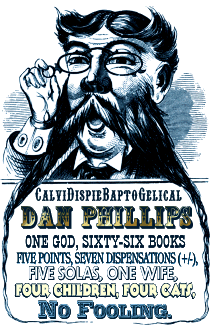
Hm. Back to "Calvidispiebaptogelical" for me, I guess, then just explain it. Or FundaCalvidispiebaptogelical?
Ay, yi yi.
The word, of course, is evangelical. Was a day when it described someone who affirmed the Gospel of Christ, along with such fundamentals as His deity and virgin conception, along with the full authority of Scripture.
Now? Who knows?
The media never got the word. It could not get straight the distinction between evangelical and evangelist. I always tried to correct folks who misused the word, nicely. Now I'm thinking I won't bother. The term may not be salvageable.
For a rarity, an AP article is well-titled Definition of evangelical in dispute, and pretty much delivers. It cites a poll that has evangelical Protestants outnumbering Roman Catholics in Ameria -- but then notes (correctly) that "the definition of 'evangelical' is open to dispute."
It cites Randall Balmer, who fancies himself an evangelical, yet has written a book bashing socially/politically active Biblical Christians. Abortion is one area where Balmer thinks is "fellow" evangelicals are 'way off, since the choice of whether to have babies killed for being imperfect or inconvenient is “properly left to a woman and her conscience.”
I heard Balmer on Michael Medved's radio show, and he could equally have been James Carville, Barry Lynn, or any other ignorant leftist. In fact Medved, who is a practicing Jew, was defending evangelicals -- against this "evangelical"!
And then there's Jack Rogers, formerly of Fooler... sorry, Fuller Theological Seminary. He wrote a book years ago attacking the fact of Biblical inerrancy. At that time, many of us were warning of the slippery slope onto which one leaps when one abandons a robust affirmation of the inerrancy (i.e. truth) of Scripture. Rogers was among those tut-tutting and assuring everyone that it was a recent invention, and a doctrine we'd all be well rid of.
And now the article mentions that Rogers "advocates full acceptance of same-sex couples and gay clergy."
You who join me in heartily detesting Christianity Today (an "evangelical" magazine) will love this:
Asked whether Balmer and Rogers are evangelicals, Christianity Today editor David Neff (another lay Episcopalian) says they’re “in a very small minority” on issues like gays and abortion. He’d consider them still within the fold “if they employ evangelical discourse and display evangelical piety,” basing conclusions on the Bible rather than on current social science.Well now; isn't that special?
I'm minded as well of Clark Pinnock. I'm having to labor through Four Views of Salvation in a Pluralistic World. It's a book where guys from four different perspectives on the finality of Jesus and how that works out soteriologically have at it. On the distant left is apostate John Hicks; then barely to his right is Clark Pinnock, then other more conservative writers.
To focus on Pinnock, he keeps insisting that he is an "evangelical" -- over, and over, and over, and over -- while bashing Calvinism, saying God doesn't always get His way through He tries His best, praising Mohammed and the Buddha, saying that God works in other religions as well, and that we should listen and learn from other faiths, and a ton of other billowy blah, blah, blah.
But he's an "evangelical."
And, among his other false teachings, Pinnock is an "evangelical" who denies that God inerrantly knows the future. That's right, he's an open theist. Now, you may or may not know this, but -- and this is classic modern "evangelicalism," the Evangelical Theological Society has given attention to his declension, miserably.
"Miserably"? Well, chart this. In 2001, the ETS "voted ...overwhelmingly to affirm what almost every Christian in the history of the church has always believed -- that God knows everything, including the future decisions of his creatures." In other words, they condemned open theism, and called scholars affirming it to repent.
Repent, or what?
Well, they then took the next step, when those false teachers refused to resign, of entertaining charges against Clark Pinnock and others, which would result in their being ejected from the "Evangelical" organization.
And then, after study and debate, the organization hugely failed to eject the two against whom charges had been made. This, of course, vindicated them and all "open theist" false teachers as real, live, card-carrying "evangelicals."
Then we could add "evangelical" Richard Mouw, of "evangelical" Fuller seminary, apologizing for past Christian attempts to evangelize Mormons. Mouw further said that the true gospel (i.e. evangel) could be found in Mormon teaching, if one picks and chooses correctly.
And then there was Richard Cizik, Vice President for Governmental Affairs with the National Association of Evangelicals (NAE), who said "Most evangelicals still regard Mormonism as a cult" (emphases added; i.e. some don't regard Mormonism as a cult, but are still evangelical).
So what does "evangelical" mean, anyway?
More and more, it looks like "whatever" is the best answer. Leaving us with what? "Fundamentalist" has been rendered almost useless, "Reformed" is good but problematic, and doesn't emphasize what I'd most like emphasized. "Biblical Christian," or "Bible-believing Christian" may be better, though all sorts of rabid loons would say the same.
Hm. Back to "Calvidispiebaptogelical" for me, I guess, then just explain it. Or FundaCalvidispiebaptogelical?
Ay, yi yi.
Subscribe to:
Posts (Atom)


 Posts
Posts


