I have heard for years that
Oliver Stone was a skilled film-maker, and a
rabid nutcase. Until Friday night, I had only known the latter to be true; now I can attest to the former.
In fact, here's my highest praise: if I hadn't been told that the movie was done by Oliver Stone, I'd
never have guessed it.
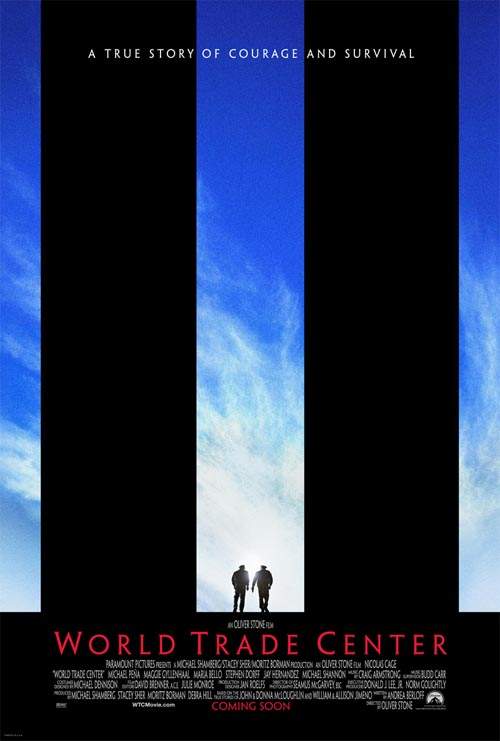
World Trade Center, which I saw with my eldest son Matthew, is a fine picture. I'd categorize it with the World War II-era films with which Hollywood focused, encouraged, and united America -- the sort of films that the new
Hollywood has miserably failed to produce during the current war against terrorism. I discussed that in
this post, and posed this challenge:
Name the ten best movies produced since 9/11 depicting that event, or positively featuring some aspect of the Global War on Terror.
At the time, I knew of none. Now I can name two:
United 93, and World Trade Center.
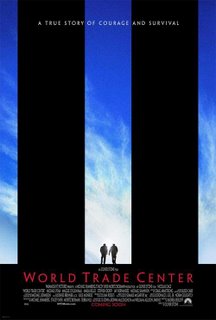
Like many, I groaned when I'd heard that Stone was helming this movie. He's with the nutcase crowd, living in the bubble (or DNC headquarters) that still chant "Bush lied, people died," that still actually believes that the war in Iraq was based on deliberate lies, that says it is unrelated to the war against terrorism, and so on. How would Stone screw up the narrative of this day?
I was surprised when conservative after conservative praised the movie, before and after its release. So I decided I'd go, and form my own opinion.
I meant to see it opening weekend, but that didn't work out. If I want to see a movie, I always try to see it that way, so that I can go in expecting
nothing. I was one of relatively few, I guess, who saw
Alien with no idea of what was coming up -- and I was up the back of my chair from the titles on! Then I went with someone whose brother-in-law had told her everything about it, and she just sat there, her experience spoiled.
So inevitably and in spite of my best efforts, I went in knowing more than I'd rather have known, and I think that made it less emotional for me. So I'll warn you when I am about to get specific, in case you've yet to (A) hear spoilers and (B) see the movie.
My son Matthew had not heard any spoilers. What was more, he was actually
in the World Trade Center less than two months before 9/11, as part of the Boy Scouts' jubilee. He recognized not just the exterior, but the interior. So the movie resonated for him on a very emotional level.
WTC starts early the morning of 9/11/2001, focuses on just one particular aspect of that day and the next: what happened with several policemen who went in to rescue survivors from the rubble of the WTC.
Try as hard as I might to look for something to criticise, I cannot but say that the movie's tone and message is pro-America, pro-family, pro-Christian, pro-military, pro-cop, pro-bravery, pro-sacrifice, pro-friendship, and even arguably pro-war-on-Terror --
including the Iraq phase of that war.
It is absolutely gut-wrenching, and at the same time has heart-warming elements -- yet seldom (I can't say "never") approaches schmaltz. You leave both sobered, moved, and uplifted. I think WTC succeeds in achieving what it set out to do.
There is some bad language, but probably toned down from reality; there is also blood and death, but it is never Saving-Private-Ryan-gruesome.
Now,
read no further if you've yet to see it and want to avoid details.As I reflected on the movie with Matthew and my wife Valerie, I was struck by just how much Stone got into this movie.
He has been faulted by conservatives for minimizing the outrage of what was done. Some have said that Stone trivialized 9/11 by making a feel-good, uplifting, inspirational story out of it. They've also said he didn't highlight the terrorists enough, he didn't make the connection to the war on terrorism, he just tried to turn it into a small-scale human-interest Hallmark movie.
I went, perfectly willing to find these criticisms true; and left, appalled at the conservative critics.
First, this only covers 9/11 itself, and the next day.
We knew hardly anything at the time about the larger picture. There were suspicions and rumors, and information began to trickle out. But the attack itself was a complete blind-side.
Second, the criticism simply isn't true. The focus is indeed on the men who went in, and on the two who were rescued. But additionally, Stone does show the collapse of the towers, and that from numerous angles. He captures some of the horror it caused at home and abroad. He also features people whose loved ones and coworkers
did not come out. One vivid moment features a mother whose son was in the elevator when the tower fell, who wept because she had yelled at him the last time she spoke with him. You'd have to be made of stone not to share her anguish -- and that anguish was multiplied many-fold on that day.
Further, Stone shows what we vividly remember -- the walls full of picture after picture of the lost and missing who did not come out of the tower, the comment of Giuliani that the loss of life would be "unbearable." At the end of the movie, Stone enumerates the killed and wounded. He
names dozens of port authorities and others who lost their lives.
But beyond that, what are we conservatives always griping and carping about, if it isn't the negative portrayal of faith, marriage, and the military, in modern movies? But this is precisely what WTC does. Stone features two men who deeply love (and are loved by) their wives, and are both men of some faith.
The third leading character is a Marine, Dave Karnes, deeply moved by his identifiably Christian faith to answer what he thinks is God's call to go and help rescue those trapped. He is depicted as a man of faith, courage, and unstinting self-sacrifice. He doggedly passes the restraining lines to get into the rubble where few are going, given its instability. He is clearly and unhesitatingly risking his life, and he is joined by another Marine. It is by doing this that they find, and enable the rescue of, our heroes.
But there's more.
The Marine's last words are something like, "They're going to need some good men to avenge this."
And Stone puts up the information at the movie's end that Karnes signed up for two tours of duty
in Iraq. So, whether or not
Stone has
personally made the connection, the
viewer is led to believe that this hero
Karnes made the connection between 9/11, the larger fight against terrorism, and Iraq.
Other details go in the same direction. In fact, though a critical, conservative, Christian viewer, I'd have to say I didn't see the faintest hint of any anti-American, anti-Bush, anti-war agenda in this movie. Quite the contrary.
So what to make of the conservative critics?
If they didn't like the movie, they didn't like it. Tastes differ. No problem.
But conservatives have a reputation of being absolutely unpleasable, carping critics. That sort of griping about this movie will only underscore and validate this criticism, and render them irrelevant.
You may work hard to please someone with high standards. But if you find out that someone won't be pleased no matter what you do, you just give up. These hyper-critical conservatives are running the risk of taking the whole movement into that pit with them.
Stone made a good movie, a necessary movie, an
overdue movie. Two and a half weeks after its release, the theater I was in was packed. I hope it does good business, and that a dozen others step up and start giving that event and this war the treatment that Hollywood's deadly liberalism has stifled thus far, the treatment that unified and encouraged our parents and grandparents during the dark days of World War II.







 Posts
Posts


