The Presbyterian Church in America's magazine
By Faith is now featuring an
article by Carolyn Custis James who, we're told, has an M.A. in biblical studies, and "is an international conference speaker, and ...author ...." I found the article very troubling. It certainly gave me a nasty case of
deja vu.
(Something odd is happening with that link, even though I've repeatedly confirmed it. If it doesn't work, go to the magazine's web site, click on
IN THE CHURCH, and you'll see the link to the article.)
Here's what James lays down pretty much at the outset, emphases added:
Currently, PCA churches offer few vocational ministries to women. At a conference recently, a Westminster Theological Seminary graduate told me her heart was in the local church, but because she was unable to find an opportunity to support herself in ministry there, she was reluctantly returning to the business career she had set aside earlier to pursue her seminary degree. Another young woman, graduating in biblical studies this year from Reformed Theological Seminary, asked me pointedly, “What can I do with my seminary degree?” Women in the pews are asking questions too: “How do I fulfill my responsibility to minister to the whole Body of Christ?” “Does the church really value and need my spiritual gifts?”
With the educational and professional advancement of women today, many women come to our churches and wonder why the secular workplace values what they bring to the table, but the church shows so little interest. One young professional remarked, “At work, my male colleagues value and seek out my expertise and involvement. I’d like to think I could make a serious contribution in the church too. But my gifts go virtually unnoticed here.” An attorney with years of experience practicing law and a deep commitment to the church was bewildered that no one ever accepted her offer to assist with expensive legal issues her church was facing. Instead, she was drafted to decorate tables for the church dinner.
I'll launch here. This fires up an array of red lights for me.
When I attended Talbot in the early eighties, the issue of women in the ministry was red-hot. Talbot had recently begun admitting women into the Master of Divinity program, a program traditionally thought of as culminating in a "pastoral degree."
A professor remarked, off the record, that allowing women to take that program was like giving someone a gun, and saying "Now you must never, ever actually shoot this."
It was argued, of course, that women just wanted and deserved the best education, this would make them better pastor's wives, better Sunday School teachers, better servants in women's ministries, etc. Many of us felt that those arguments had real merit... yet were troubled. Ms. James validates every fear we had when she complains that women have nothing to
do with these degrees, that they can't
get full-time jobs with these degrees, and that because they can't their "gifts" are being undervalued.
Don't miss that: if they can't support themselves full-time in the local church with their seminary training, their God-given gifts are being wasted.
So much for "just" being a great pastor's wife, "just" being an excellent Sunday School teacher, "just" being a women's ministry servant, or "just" being better-educated for personal enrichment.
Then she goes on to give examples
precisely like the ones I heard in the early eighties, meant to make the point that women should do exactly what men do in the church. Two ironies whack me over the head:
Irony one: in what is probably supposed to convince us all of the great loss we all are suffering (and our great offense against God), she makes a Biblical case that
does not Biblically make her case. That is,
none of her
Biblical examples makes the case that the church sins by not employing women as full-time theologians. If this is an example of what we're missing... well, you draw your own conclusion.
Irony two: after denigrating the horror of asking this high-powered female lawyer to decorate tables, her
very first signal example of a "woman theologian" is Mary, anointing Jesus for burial. Decorating tables is demeaning for an attorney; but pouring oil on a guy isn't. Decorating tables is not serving Jesus; only holding a full-time religious job is. (Wait -- isn't that a step
backward from the Reformation she claims so to value?)
(And while I'm being parenthetical, I'll observe that I can't understand why a church would turn down this woman's legal expertise. As the author tells it, it makes no sense. And has nothing to do with employing women fulltime as theologians.)
She does doff her hat, in passing, to the real hot-button issue: "The PCA’s position on the matter of women’s ordination is firm, clear, and defended by Scripture." Then she hurries on to say,
But this position still leaves plenty of room for the PCA to build a reputation as a denomination where women’s gifts are embraced, fully utilized, and publicly affirmed as vital to the health of the Body of Christ. There is still opportunity for us to think of substantial ways to incorporate women into the full life of the church and to brainstorm new ministry vocations for women in our congregations. An encouraging precedent has already been set by the fact that some of the brightest lights in the PCA galaxy are female theologians.
Think over that last one. Most of the folks I've heard
lament when women do most of the work in the church. It is taken as an indication that men aren't doing their jobs, and that they are falling to women is thought to be a symptom of male failure. James, by contrast, seemingly thinks it's cool that "some of the brightest lights in the PCA galaxy are female theologians." Is it true? If true, is it really cool?
Then we read this: "The wife of a leading PCA pastor told me, 'PCA men need to unleash our gifts.'" The message here is: Bad men!
Bad men -- holding back all those women's God-given gifts!
I attended a little seminar at Biola in the early eighties, where a female Princeton graduate was making the case for woman pastors. She had no in-context Scripture, of course -- so she made
exactly the case that James makes (except for the final conclusion): women were taught and did things in the Gospel, the Holy Spirit gives women gifts,
ergo women should be pastors. QED.
Well, children were taught and did things, too. Should children be pastors? As to the Holy Spirit, I take it as a given that the Holy Spirit never gives a gift to do something that He forbids. He doesn't men the "gift" of lying glibly, and he doesn't give women the "gift" of teaching or exercizing authority over men (2 Timothy 2:8-15).
Is there some large Bible-believing contingency who believes that women can't be taught, or do things? Is there someone who believes that women aren't gifted and crucially valuable? I've not heard that this is much of a pandemic, let alone an epidemic -- or even a microdemic.
Only if the problem is defined as being unwilling to "let" women do what Scripture forbids them to do, is this much of a problem among Bible-believers, as far as I know.
She also says this:
One of the serious side-effects of roping off women’s gifts within the confines of women’s or children’s ministries, is that men have effectively cut themselves off from vital ministry that they need and God intended for them to receive. It is still “not good for the man to be alone.”
Since I'm tiring of hearing myself using the word "irony," I assume you're tiring of it too. But I have to use it one more time... maybe two. Yeah, two. No, three. Here goes.
First, it is an
irony that the passage she quotes (“not good for the man to be alone”) is where God explains why he made for Adam a
wife. Yet the message of the article clearly is that being a helpful wife
is not enough.Second, it is an
irony to have James denigrate "roping off women's gifts" to the "confines" of women's or children's ministries. Wow, I guess those ministries must really be wastes of time for women. I guess when we talk up how essential they are, we're -- what, lying?
I honestly need this cleared up: Ms. James scoffs at "roping off" women to the "confines" of "women's or children's ministries." Now, help me out here. She doesn't want to teach children, she doesn't want to teach women. Scripture forbids her to teach or exercise authority over men, at least in the context of the local church. But she's explicitly raised the issue of fulltime employment in the local church.
So what is it that she wants to do, that she can't do?
Third and final irony: James has
no Biblical precedent for what she
seems to want to do. In fact, the two
explicit Biblical examples I can
immediately think of for women actually teaching are: women teaching their
children (Proverbs 1:8-9; 6:20-23; 31:26), and women teaching
younger women to be great and godly wives and mothers (Titus 2:3-5).
Note this well:- Neither of these is presented as fulltime local-church-salaried employment; and...
- None of these scriptures is mentioned even once in Ms. James' article!
FINAL DISCLAIMER: there are real, legitimate, hard questions to be asked about what women should and should not do, and be employed to do, in the context of the local church. I do not even pretend to be able to answer those questions.
For that matter, I'll go one better: I don't see a direct precedent, offhand, for fulltime salaried
male professional theologians anyway.
Except pastors.
But that's a subject for another post.
(
POSTSCRIPT: After writing my thoughts, I read
this essay by "Little Phil." I commend it to you.)
UPDATE: Some sisters in Christ blessed me with insightful email and conversation after this.
Libbie just blogged some thoughts, from a different perspective, that I find very insightful, and commend to you. This in particular is wonderfully put:
"...they claim to be wanting to lift women up. Yet they go about this by denigrating the clear mandates given to women in scripture, exalting the mandates given to men, and then saying that women should be doing the men's tasks because the women's tasks are rubbish."

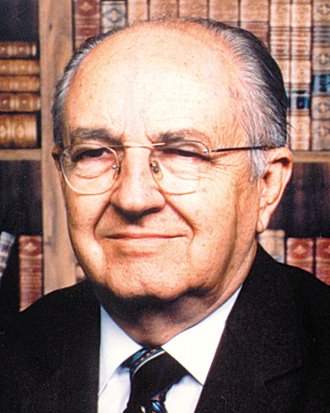 Henry Morris passed away at the age of 87, after a series of strokes. His name alone will equally bring fond smiles, or hateful sneers, to the faces of those who recognize it. He was a scientifically educated Christian who challenged the very foundations of Darwinism, from the perspective of a plain-sense reading of the Bible. Morris co-authored The Genesis Flood with John C. Whitcomb, Jr., as well as a host of other books, and founded the Institute for Creation Research.
 You may or may not agree with Morris' reading of Genesis, nor with his catastrophic reading of the geological record. (I do agree.) But I think you have to grant that he, by single-mindedly holding to the inerrancy and plenary authority of the Word, had a pioneering and revealing ministry.










 Posts
Posts


