Tuesday, February 28, 2006

A great man passes, unnoticed by the glitterati

They say it happens in threes. Don Knotts, Darren McGavin, and Dennis Weaver all passed away. These beloved actors' deaths were noted, their careers lauded, their best screen moments replayed.

But I just learned to my surprise that another person died last Saturday. Not an actor, not a celebrity. In fact, if the circles in which the deceased actors heard of how this man spent his life, they'd doubtless reply with sneering, scornful wit -- or an indifferent shrug.

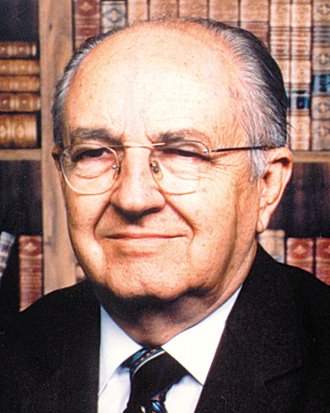
Henry Morris passed away at the age of 87, after a series of strokes. His name alone will equally bring fond smiles, or hateful sneers, to the faces of those who recognize it. He was a scientifically educated Christian who challenged the very foundations of Darwinism, from the perspective of a plain-sense reading of the Bible. Morris co-authored The Genesis Flood with John C. Whitcomb, Jr., as well as a host of other books, and founded the Institute for Creation Research.

Morris revived the meaning of plenary in the phrase "verbal, plenary inspiration." That is, he did not believe that the Bible's inspiration and authority was confined to "spiritual" matters, but that it was authoritative in every area on which it made pronouncement. He believed that too many had adapted their reading of Genesis from the most natural sense of the words, to a sense twisted to fit the current evolutionary establishment's consensus vote. He didn't think that Christians should hand over their worldview to white-coated "experts" who held their Lord's all-inclusive authority in contempt.

You may or may not agree with Morris' reading of Genesis, nor with his catastrophic reading of the geological record. (I do agree.) But I think you have to grant that he, by single-mindedly holding to the inerrancy and plenary authority of the Word, had a pioneering and revealing ministry.

His insistence on accepting the full authority of the Word revealed the heart of liberalism, quailing before the cultured despisers, eager to please and be friends with the world, accepting the dictums of a white-coated priesthood over God's Word, willing to sell their birthright just to escape the contempt of the elite.

At the same time, he revealed the charade of objective openmindedness behind which the scientific establishment hides. From the PR the Darwinian priesthood was putting out, one would expect that they would welcome alternate approaches and theories with great enthusiasm and open arms. Instead they were revealed to be narrow minded, arrogant, doctrinnaire oppressors driven by a particular philosophy.

It seems to me that if one reaches the end of his life loved for the reasons Dr. Morris was loved, and hated for the reasons he was hated, he has probably done well.

ALSO: read Doug Phillips' (no relation) warm tribute to Dr. Morris, as well as Ray Pritchard's.

Sunday, February 26, 2006

Ooh! I did a "best Godblog"!

Sometimes I feel a little like the fifth Beatle over at Pyromaniacs.

Frank called me "David," Steve Camp called me "Don," a poster called me "Phil."

Then, when one of my posts caught the eye of the legendary Tim Challies... he called me "James"! (That's kind of okay, because he thinks "James" doesn't have much of an IT background, as opposed to my six years or so.)

So it's truly nice to have my post 26 ways in which doing IT Support is better than being a pastor made one of the Best of the GodBlogs. He found it funny and encouraging to him as a pastor, and that's dead-on what I was aiming at. Praise God.

(Though he doesn't mention my name. That's probably good; who knows what he might have called me?!)

Saturday, February 25, 2006

Eschatology quiz site

Well, this is fun. There's a site called What's your eschatology?, where you can find out where you stand eschatologically. I have some real arguments with forms of the questions; I think I answered in a sense not meant by the designer. But I did say "fun," not "inerrant analytical tool, right? (H-T PietyHill Press.)

So, this (they say) is me:

You scored as Premillenialist. Premillenialism believes that there will be a rapture and tribulation before Jesus returns and overthrows the antichrist and establishes his Kingdom. Current events are spoken of in scripture.

Premillenialist

100%

Left Behind

75%

Dispensationalist

75%

Amillenialist

65%

Moltmannian Eschatology

60%

Preterist

40%

Postmillenialist

35%

What's your eschatology?
created with QuizFarm.com


(Mmm... really have to work on bringing down those Amill, Moltmannian, Preterist, and Postmill scores!)

NOTE: I had to adjust the width of the display, or it torqued out this page. If you do it, be warned to change width from 600 to 300.

Wednesday, February 22, 2006

My admiration for James White rises; for Ergun Caner? Not so much

In the world of public Christianity, some of my greatest admiration is reserved for folks like James White.

I've no doubt that White and I don't dot all our i's, nor accent all our alpha's, nor vowel-point all our 'aleph's identically. But this is the sort of man who, as far as I can tell, talks the same "game" with friendly audiences as unfriendly. Not only that, he seeks out unfriendly audiences, to make the case for Christ and the teaching of the Word.

So White doesn't just hold lectures by himself, or speak only in situations he tightly controls. He actively seeks out the best in the opposition, and challenges them to debate the central issues fairly and openly.

When a very accomplished scholar like Dr. Norman Geisler takes off after Calvinism, White challenges him to a debate. I never would have figured Geisler to lack courage -- but you can find The Calvinist Gadfly's Norman Geisler Clock here. (So far, it's been over 2100 days since White issued the challenge -- and counting.)

Likewise, White has taken on Dr. John Dominic Crossan, and a host of Mormon and Roman Catholic apologists.

So now I read that he's challenged Dr. Ergun Caner of Liberty University. I'd known Caner by name only, and thought of him as a "good guy," very frontally taking on Islam and other issues. But then lately his name crossed my radar screen again, through his and his brother's stunningly immature, ignorant, and almost drunkenly pugnacious posts over on the Founder's blog. Here the brothers sneeringly and angrily attack Calvinism and Calvinists (h-t Jason at Fide-o).

So what does White do? Corresponds with Caner, and invites him to debate. Not just any debate anywhere, but at "Liberty University ...before an audience of his own students"; that is, on ground friendly to Caner, and hostile to White.

So far, Caner -- so bold and aggressive on a blog -- has not seized what one would think would be a golden opportunity, if Calvinism is such a ridiculous absurdity.

So what is it that White has, and others lack? Courage? Could be. I think further, though, that it's faith. He has the conviction that God's Word is unassailable, and can stand up to attack. White seems unwilling to let truth fall by default.

That, I admire greatly.

The running and the hiding?

Not so much.

ADDENDA: first, on a serious note, I expect everyone to read the Caner's posts and judge for themselves whether or not I describe their spirit and behavior accurately. But in the course of it, Emir Caner in four words took my breath away.

He signed one of his posts, "Elected because I selected."

I like to think I can put words together fairly well, but this one has me next to speechless. There it all is, in four words. That's where you go when you have contempt for the Biblical doctrines of grace. I just have seldom seen it laid out so baldly, in one who (presumably) should know better. There goes soli Deo gloria. There goes monergistic salvation. There goes Jonah 2:9, Ephesians 2:8-10, John 6:44 and 15:16. There goes Romans 9:16. Turns out dead people (Ephesians 2:1ff.) can actually do a lot of good stuff -- why, they can affect (and effect!) the very counsels of God!

Stunning.

This, I suppose, is the sort of person who can sing "Arminian Grace" and not find a thing wrong with it. What would an Emil Caner do before the throne, if he manages to keep himself saved? Would he see the others casting their crowns... would he say, "You know, really, at bottom, if it wasn't for me, I wouldn't be saved. I think I'll keep it. Thanks. Thanks for playing along, that is"?

Then, on a far lighter note, Purgatorio and his posters has some great fun with James White's "when in Scotland" garb, over here.

UPDATE: James updates this story, and adds his email correspondence with Dr. Caner. Not being a "profile in courage," from where I sit. Not on the Caner side.

It's nice to see other blogs taking up this story, almost this very post. It'd be nicer still if they'd hat-tip, if warranted.

Monday, February 20, 2006

What Dispensationalism Isn't

[I was inspired to this by Jason Robertson's What Calvinism Is Not. Jason, of course, bears no responsibility for this essay.]

Growing up, one learns reluctantly that what seems perfectly clear to you may well prove to be equally perfectly opaque to others. Much danger, weeping, gnashing of teeth and pounding of keyboards lies in the way of ignoring this principle. So when I say I am a dispensationalist, I find that even the best-informed may think something totally different from what I mean.

"Reformed" folks bristle, rightly, at how Arminians (some of whom are dispensationalists) misrepresent and shallowly interact with their beliefs. Then they attack dispensationalism -- unaware that they often are returning the misfavor.

I get it both ways. I tell dispensationalists that I'm Reformed in most areas of theology, and run a real risk of getting a sort of Church-Lady-voice, "Oh, reeeeealllly?"

But the same thing happens when I tell Reformed friends that I'm a dispensationalist. I even had the late William Hendriksen blast me in a letter decades ago, thundering that I couldn't be "100% Reformed" and a dispensationalist. (I hadn't written about dispensationalism, just mentioned it in passing.)

Though there are substantial and real areas of (what should be) brotherly disagreement, I think both are often reacting to a misunderstanding, rather than to the actuality.

So what do I mean when I say I'm a dispensationalist, and what don't I mean? I can put it very, very briefly, believe it or not. Charles Ryrie identifies as three items as the irreducible sine qua non's of dispensationalism, in the first -- and, to my mind, better -- edition of Dispensationalism Today (Moody, 1965, pp. 43-47). In my own words and order, they are:

  • Grammatico-historical hermeneutics applied to all Scripture
  • The Christian church and Israel distinguished from each other
  • The glory of God seen as the center of history
I think that the second and third grow out of the first, which really is the pivotal point. (This is deliberately oversimplified. Michael Vlach gives an admirably brief but more nuanced discussion here.)

Now, that is what I mean by dispensationalism. Sadly, some dispensationalists have gotten attention by teaching other doctrines which may or may not be true, but are not in any way integral to dispensationalism -- any more than Harold Camping's nuttinesses are integral to Calvinism or amillennialism.

So, without further eloquence, here is my partial, exploratory list of What Dispensationalism Isn't.

  1. It isn't belief in any particular number of dispensations (all Christians believe in dispensations).
  2. It isn't any particular position on the "Lordship"/"grace" controversy.
  3. It isn't any particular position on the "continuationism"/"cessationism" controversy.
  4. It isn't any particular position on the KJV-only issue.
  5. It isn't about multiple ways of salvation.
  6. It isn't any particular position on Calvinism/Arminianism/Amyraldianism or any other soteriological "-ism."
  7. It isn't any particular position on baptism.
  8. It isn't any particular position on church government.
  9. It isn't any particular position on the age of the earth, or meaning of the days of Genesis.
  10. It isn't about huge, complicated charts. (Any theological position can be turned into a huge, complicated chart.)
  11. It isn't contrary to any of the "five Sola's."
  12. It isn't anything that any Reformed person shouldn't be able to embrace -- unless his definition of "Reformed" means "non-dispensational," or even "amillennial."
  13. It isn't any particular position on the use of alcohol, movie-attendance, dancing, nylons, lipstick, tattoo's, or tobacco.
  14. It isn't any particular position on the significance of the current nation of Israel.
  15. It isn't inherently divisive -- any more than any other distinctive doctrine (i.e. the five sola's) divides one position from its contraries.
Now, it is true that one can find some or many dispensationalists who occupy particular positions under these categories. One might even find majorities on various positions. What one has to ask is, "Is this integral to the position? Does one of the three core-beliefs necessarily lead to that position?"

For instance, some date-setters have been dispensationalists. But there have been amillennial date-setters, too. If all dispensationalists are to be blamed for Edgar Whisenant, then surely all amillennialists are equally to be blamed for Harold Camping. Which is to say, not -- in either case.

Likewise, it could be argued that the same principles that incline one towards dispensationalism might incline one towards certain truths and certain errors. But if they're not inherent to the system, then they neither credit nor discredit the system. For instance, I think a consistent application of the grammatico-historical hermeneutic will lead one to the poorly-named "cessationist" view, or to affirm that holiness is a necessary fruit of salvation, and that obedience is integral to the Christian life. But those positions aren't necessary to dispensationalism, nor are they confined to dispensationalism.

For instance, it has been said that all dispensationalists are also inerrantists, and all liberals are amillennialists. There is some truth in this. But does one position necessarily and exclusively give rise to the other? Not at all. There might be room for fruitful discussion as to whether affirming the verbal, plenary inspiration of Scripture most naturally lends itself to a grammatico-historical hermeneutic (it does); and whether a grammatico-historical hermeneutic most naturally lends itself to a dispensational approach to Scripture (it does). Further, it might be discussed whether a person with a low view of Scripture is not likelier to be dismissive of the details of prophecy (he will), and whether that dismissiveness is likelier to yield something more like amillennialism than dispensationalism (you decide!).

The first distinctive led me to be basically "Reformed" on theology, Christology, anthropology, Bibliology, soteriology -- but equally to a distinct position on ecclesiology and eschatology.

But it also cannot be denied that some of the very best, most convinced and convincing stalwart defenders of the authority of the Word have also been convinced amillennialists -- such as Edward J. Young, to name only one of scores.

It would be nice if the two camps ("Reformed" and "dispensationalist") would stop lobbing grenades at each other. It would be nice if they'd recognize each other as co-combatants under a common flag and against a common enemy, would sweep aside straw men, non-sequiturs and old grudges, and would confine the discussion to the only thing we all should care about: what does Scripture teach?

Hey -- a man can dream, can't he?

UPDATE: looking for something else, I stumbled across Revealing The [sic] Dispensational Straw Man, which does a good job of making the specific case that nothing in being a 5-point Calvinist precludes being a dispensationalist, nor vice-versa. Check it out.

Saturday, February 18, 2006

Experimental policy change

All right all right. If girls (like La Shawn [although sometimes it's driven her just next to crazy], and Libbie, and Kim, and the Under the Sky lady) allow comments, maybe I should at least try it. Yes, they've unintentionally shamed me into trying it. Shame does sometimes work with me.

I have never allowed comments, and it's been a really good thing. My post on "Jeff Gannon" was linked on liberal sites, and got me hundreds of hate emails; the site would have been swamped with only one viewpoint. I never would have had the time to respond. One of my posts on Chad Allen and "The End of the Spear" (I forget which one) was linked at, I think, a homosexual site. The comments there were just astonishing, even getting at my family. It would have been ugly.

It isn't that I'm against your occasional fly-by drooling idiot, or your occasional stubborn pinhead. They can make life fun, and funny. It's that I've been afraid my readership was such that there'd be no response unless it was by me, and I simply haven't the time.

But that's changed, and I'm hopeful that there could be an evenhanded give and take. "Hopeful" is, you'll note, not a synonym for certain.

Posting at Pyromaniacs has shown me how fun comments can be when you've got a good spread of really great readers and contributors.

So, all that to say, I will try it here. If it doesn't work, it's gone, no tears.

Kind of up to you, Gentle Reader.

Friday, February 17, 2006

Hugh "Squish" Hewitt?

I like listening to Hugh; it's a daily thing as I drive home. He knows an awful lot, he's very interesting, and he is on balance by far the best radio interviewer I have ever heard. He has great guests, and gets the best out of them, he's generally very polite but takes no prisoners and no guff. He also probably most influenced me to get blogging. He also is on my very-select list of links, as you'll see.

All that having been said.....

I called Hugh's show probably a couple of years ago, to talk about something. But Hugh was flogging one of his books at the time (I think it was In, But Not Of : A Guide to Christian Ambition), and he asked me what he was asking every caller. "Have you ordered my book yet?" I said, maybe a bit too emphatically, "No!" He was taken a bit aback, I think, and asked why. It wasn't what I'd called about, so I semi-punted. I've since wished I had been prepared with a better response.

Here's why. I just have no respect for Hewitt as a spokesman when it comes to Biblical essentials. If he wants to have coffee and talk about spiritual things, terrific. But I don't need to buy one of his books on the subject. I accept him as a Christian, but I can't accept him as an authority or spokesman in any sense -- which is unfortunate, given his position and influence.

Starting with the most minor anecdote: he moderated a debate on some aspect of eschatology at Biola, and openly joked about having no clue about the very topic he'd be moderating. First, that's interesting, given that a great deal of the Bible was prophetic/predictive when first written, and it is a subject of some moment. What's more, it isn't as if teaching isn't available. You want to write books about Christianity that other people should pay money for, it seems to me you should have some knowledge in the main areas.

But here's the one that bothered me the most. Hewitt used to have columnist Michael Kelly in what is now the Mark Steyn spot. Kelly was a great guest, knowledgeable and affable. Kelly went to Iraq to do some on-site journalism and, tragically was killed in an accident. It was shocking and sad, and Hewitt paid due tribute to him.

But Hewitt pretty well declared that Kelly was in a better place, or Heaven, or something to that effect. How did he know that? In this essay, Kelly said that he is (Roman) Catholic and his wife is Jewish, so his kids get both Christmas and Hanukah -- and he says this in passing, emphases added:
People sometimes ask me if it is hard to raise children in respect and love for two great faiths that have a slight doctrinal disagreement between them, and I say: Not if you give them presents every day for eight days of Hanukah and for Christmas. The more Gods, the merrier is Tom and Jack's strong belief.
The identity of Jesus the Messiah -- a "slight doctrinal disagreement"?

Since making that stunningly ignorant and misleading statement, did something change within Kelly? Is that the sort of thing a saved man says, to Hewitt? How did Hewitt know Kelly was in Heaven?

Now, I can hear Hewitt demanding of me, as he does to guests when he's in hectoring-mode, "So is Michael Kelly in Hell? Is he in Hell? Did you want me to say he was in Hell? No, I won't let you talk about anything else until you tell me: is Michael Kelly in Hell? Why won't you just answer that simple question: is Michael Kelly in Hell?" And of course I don't know, so I wouldn't have said.

But Hewitt doesn't know, either, so he shouldn't have said anything.

But what I do know, and what self-proclaimed evangelical Hewitt also should know -- unless he didn't learn about soteriology when he wasn't learning about eschatology -- is that Jesus is the only way to God (John 14:6), and that those who don't affirm His Messiahship and Deity will die in their sins (John 8:24). I know that false Gospels damn, they don't save (Galatians 1:6-9). And I know Rome preaches a false Gospel. Does Hugh know that? (More on that later.)

But then something saddened me even more. On that same show, he had a regular caller, a Jewish man named Yoni. Since Yoni was running for political office in Israel, I take it he is unsaved, an unbeliever, rejects Jesus. In the course of talking with Yoni, Hewitt asked Yoni to pray for Michael Kelly.

Wait. What?

Where do you start? This evangelical leader, big-name "God-blogger," author of Christian books, is asking (A) an unsaved man to (B) pray (C) for a dead man? What was that about? Is Proverbs 28:9 in Hugh's Bible? To say nothing of... hello? Praying for a dead man?

Now, I've done a funeral for a person who'd given no evidence of Christian faith. It was tough. But I didn't try to preach him into, or out of, Heaven. Not my business, thank God. But what I did do was preach Christ to the living, and laid down the Gospel as crisp and plain as I could.

Many other things have been niggling concerns over the months. Hewitt has pastors and/or theologians on the show to talk things over and goes on about how deep and wonderful they are -- but the conversations are anything but, as a rule. If I were to say that I could have dug deeper, my point would not be that I'm anything special, but that his "experts" aren't.

Then there was the whole mess around the death and replacement of the Pope. At that time, I began to wonder anew how far Hewitt really had escaped Rome. One perspective alone (friendly to Rome) was given respectful consideration and air-time. I remember Hewitt registering no concern (as I did at the time) about the fact that Rome preaches a damning Gospel, nor that the late pope was a great leader of Mariolatry. The edges of the Gospel just don't seem to loom too large to Hewitt.

And now my fellow-Pyro Frank Turk has weighed in. His post, Hugh Hewitt, Mere Religionist, is what actually finally edged me over to expressing my concerns. Frank's a terrific writer, and I won't try to reproduce what you should read for yourself. Hewitt slaps down all sorts of stuff -- but damning doctrinal insanities? Not so much.

So no, I really probably won't be buying anything Hewitt writes about how to be a Christian witness.

UPDATE: Unlike me, Frank did read In, But Not Of. Looks like I did well in saving my money.

UPDATE II: FRESH SQUISH? I wouldn't have assumed Hewitt knew who John Piper was. But yesterday Hewitt wrote, "If you have cancer, have battled it successfully, or have lost a loved one to the disease, you will want to read this post, and this one, and especially this one." The first is Piper's very challenging essay, "Don’t Waste Your Cancer," written on the eve of his own surgery for prostate cancer. The other two are by some guy who attacks him and his theology. The one that Presbyterian Hewitt says we should "especially" read is a sarcastic, blistering attack on Piper as a pastor, written from equal helpings of emotion and ignorance. There is a lot of venting, and not much Bible. Why does Hewitt think we should "especially" read that one?

UPDATE III: A HISTORY OF SQUISHINESS: m'man Frank Turk looks back into Hugh's deceased books and finds a squishy trail.

UPDATE IV: CENTRAL LOCATION FOR SQUISHLINKS: here.

Wednesday, February 15, 2006

Woman theologians in the PCA: my half-baked and fully-baked thoughts

The Presbyterian Church in America's magazine By Faith is now featuring an article by Carolyn Custis James who, we're told, has an M.A. in biblical studies, and "is an international conference speaker, and ...author ...." I found the article very troubling. It certainly gave me a nasty case of deja vu.

(Something odd is happening with that link, even though I've repeatedly confirmed it. If it doesn't work, go to the magazine's web site, click on IN THE CHURCH, and you'll see the link to the article.)

Here's what James lays down pretty much at the outset, emphases added:
Currently, PCA churches offer few vocational ministries to women. At a conference recently, a Westminster Theological Seminary graduate told me her heart was in the local church, but because she was unable to find an opportunity to support herself in ministry there, she was reluctantly returning to the business career she had set aside earlier to pursue her seminary degree. Another young woman, graduating in biblical studies this year from Reformed Theological Seminary, asked me pointedly, “What can I do with my seminary degree?” Women in the pews are asking questions too: “How do I fulfill my responsibility to minister to the whole Body of Christ?” “Does the church really value and need my spiritual gifts?”

With the educational and professional advancement of women today, many women come to our churches and wonder why the secular workplace values what they bring to the table, but the church shows so little interest. One young professional remarked, “At work, my male colleagues value and seek out my expertise and involvement. I’d like to think I could make a serious contribution in the church too. But my gifts go virtually unnoticed here.” An attorney with years of experience practicing law and a deep commitment to the church was bewildered that no one ever accepted her offer to assist with expensive legal issues her church was facing. Instead, she was drafted to decorate tables for the church dinner.
I'll launch here. This fires up an array of red lights for me.

When I attended Talbot in the early eighties, the issue of women in the ministry was red-hot. Talbot had recently begun admitting women into the Master of Divinity program, a program traditionally thought of as culminating in a "pastoral degree."

A professor remarked, off the record, that allowing women to take that program was like giving someone a gun, and saying "Now you must never, ever actually shoot this."

It was argued, of course, that women just wanted and deserved the best education, this would make them better pastor's wives, better Sunday School teachers, better servants in women's ministries, etc. Many of us felt that those arguments had real merit... yet were troubled. Ms. James validates every fear we had when she complains that women have nothing to do with these degrees, that they can't get full-time jobs with these degrees, and that because they can't their "gifts" are being undervalued.

Don't miss that: if they can't support themselves full-time in the local church with their seminary training, their God-given gifts are being wasted.

So much for "just" being a great pastor's wife, "just" being an excellent Sunday School teacher, "just" being a women's ministry servant, or "just" being better-educated for personal enrichment.

Then she goes on to give examples precisely like the ones I heard in the early eighties, meant to make the point that women should do exactly what men do in the church. Two ironies whack me over the head:

Irony one: in what is probably supposed to convince us all of the great loss we all are suffering (and our great offense against God), she makes a Biblical case that does not Biblically make her case. That is, none of her Biblical examples makes the case that the church sins by not employing women as full-time theologians. If this is an example of what we're missing... well, you draw your own conclusion.

Irony two: after denigrating the horror of asking this high-powered female lawyer to decorate tables, her very first signal example of a "woman theologian" is Mary, anointing Jesus for burial. Decorating tables is demeaning for an attorney; but pouring oil on a guy isn't. Decorating tables is not serving Jesus; only holding a full-time religious job is. (Wait -- isn't that a step backward from the Reformation she claims so to value?)

(And while I'm being parenthetical, I'll observe that I can't understand why a church would turn down this woman's legal expertise. As the author tells it, it makes no sense. And has nothing to do with employing women fulltime as theologians.)

She does doff her hat, in passing, to the real hot-button issue: "The PCA’s position on the matter of women’s ordination is firm, clear, and defended by Scripture." Then she hurries on to say,
But this position still leaves plenty of room for the PCA to build a reputation as a denomination where women’s gifts are embraced, fully utilized, and publicly affirmed as vital to the health of the Body of Christ. There is still opportunity for us to think of substantial ways to incorporate women into the full life of the church and to brainstorm new ministry vocations for women in our congregations. An encouraging precedent has already been set by the fact that some of the brightest lights in the PCA galaxy are female theologians.
Think over that last one. Most of the folks I've heard lament when women do most of the work in the church. It is taken as an indication that men aren't doing their jobs, and that they are falling to women is thought to be a symptom of male failure. James, by contrast, seemingly thinks it's cool that "some of the brightest lights in the PCA galaxy are female theologians." Is it true? If true, is it really cool?

Then we read this: "The wife of a leading PCA pastor told me, 'PCA men need to unleash our gifts.'" The message here is: Bad men! Bad men -- holding back all those women's God-given gifts!

I attended a little seminar at Biola in the early eighties, where a female Princeton graduate was making the case for woman pastors. She had no in-context Scripture, of course -- so she made exactly the case that James makes (except for the final conclusion): women were taught and did things in the Gospel, the Holy Spirit gives women gifts, ergo women should be pastors. QED.

Well, children were taught and did things, too. Should children be pastors? As to the Holy Spirit, I take it as a given that the Holy Spirit never gives a gift to do something that He forbids. He doesn't men the "gift" of lying glibly, and he doesn't give women the "gift" of teaching or exercizing authority over men (2 Timothy 2:8-15).

Is there some large Bible-believing contingency who believes that women can't be taught, or do things? Is there someone who believes that women aren't gifted and crucially valuable? I've not heard that this is much of a pandemic, let alone an epidemic -- or even a microdemic. Only if the problem is defined as being unwilling to "let" women do what Scripture forbids them to do, is this much of a problem among Bible-believers, as far as I know.

She also says this:

One of the serious side-effects of roping off women’s gifts within the confines of women’s or children’s ministries, is that men have effectively cut themselves off from vital ministry that they need and God intended for them to receive. It is still “not good for the man to be alone.”
Since I'm tiring of hearing myself using the word "irony," I assume you're tiring of it too. But I have to use it one more time... maybe two. Yeah, two. No, three. Here goes.

First, it is an irony that the passage she quotes (“not good for the man to be alone”) is where God explains why he made for Adam a wife. Yet the message of the article clearly is that being a helpful wife is not enough.

Second, it is an irony to have James denigrate "roping off women's gifts" to the "confines" of women's or children's ministries. Wow, I guess those ministries must really be wastes of time for women. I guess when we talk up how essential they are, we're -- what, lying?

I honestly need this cleared up: Ms. James scoffs at "roping off" women to the "confines" of "women's or children's ministries." Now, help me out here. She doesn't want to teach children, she doesn't want to teach women. Scripture forbids her to teach or exercise authority over men, at least in the context of the local church. But she's explicitly raised the issue of fulltime employment in the local church.

So what is it that she wants to do, that she can't do?

Third and final irony: James has no Biblical precedent for what she seems to want to do. In fact, the two explicit Biblical examples I can immediately think of for women actually teaching are: women teaching their children (Proverbs 1:8-9; 6:20-23; 31:26), and women teaching younger women to be great and godly wives and mothers (Titus 2:3-5). Note this well:

  1. Neither of these is presented as fulltime local-church-salaried employment; and...
  2. None of these scriptures is mentioned even once in Ms. James' article!
FINAL DISCLAIMER: there are real, legitimate, hard questions to be asked about what women should and should not do, and be employed to do, in the context of the local church. I do not even pretend to be able to answer those questions.

For that matter, I'll go one better: I don't see a direct precedent, offhand, for fulltime salaried male professional theologians anyway. Except pastors.

But that's a subject for another post.

(POSTSCRIPT: After writing my thoughts, I read this essay by "Little Phil." I commend it to you.)

UPDATE: Some sisters in Christ blessed me with insightful email and conversation after this. Libbie just blogged some thoughts, from a different perspective, that I find very insightful, and commend to you. This in particular is wonderfully put: "...they claim to be wanting to lift women up. Yet they go about this by denigrating the clear mandates given to women in scripture, exalting the mandates given to men, and then saying that women should be doing the men's tasks because the women's tasks are rubbish."

Thursday, February 09, 2006

"Arminian Grace"

Ouch, and LOL, at the same time:
Arminian Grace
(To the tune of Amazing Grace)

Arminian "grace!"
How strange the sound,
Salvation hinged on me.
I once was lost
then turned around,
Was blind then chose to see.

What "grace" is it
that calls for choice,
Made from some good within?
That part that wills
to heed God's voice,
Proved stronger than my sin.

Thru many ardent gospel pleas,
I sat with heart of stone.
But then some hidden good in me,
Propelled me toward my home.

My poor, dead neighbor,
Such a fool!
Didn't choose from sin to flee
I had the sense
to change my heart
But he's not smart -- like me!

When we've been there
ten thousand years,
Because of what we've done,
We've no less days
to sing our praise,
Than when we first begun.

(With apologies to John Newton)

(From Timmy at Provocations and Pantings; the bolded verse is my addition.)

Tuesday, February 07, 2006

C. J. Mahaney is wrong -- >:^(

I'll admit from the outset that I know next to nothing about C. J. Mahaney. He's supposed to be a good guy. He's supposed to be Reformed and Charismatic, which... no comment. MacArthur invited him to preach. That last one really proves he's a good guy, to many. And that, really, is about all I know.

Well, that, and this: he has ruled that Real Men don't use smileys. His dictum:
Real men do not use smiley faces on e-mails! This is fine for the ladies, but not the men. Real men communicate humor effectively without having to use a smiley face and real men can discern the presence of genuine humor without seeing a smiley face. So let our blog be free from all wimp-like communication!
Perhaps he is some-kind-of joking, although his thought is echoed here and there -- the latter of which featuring some very, ah, lively interaction.

Maybe C. J.'s joking. If so, no one's sure. Of course, he could have removed all doubt by ending his post with a (c; -- but that would have made him a wimp.

It is passing ironic to have a Charismatic objecting to men expressing emotions. My objection is simply that it has no Scriptural basis. Well that, and that it's silly. To me, it would make as much sense to call emoticons "wimpy" as it would to stigmatize people who use certain letters of the alphabet, or compound verbs or predicate adjectives, as being a bit light in the loafers.

"Say, Dirk -- do you notice that Francoise over there says 'down-size' an awful lot?"

"You know, Crusher, you're right. And the letter 'q' seems to keep cropping up."

"Yeah. D'you think maybe...?"
Silly. If we're going to judge by such trivia, what about people who go by their initials, instead of their given name? Pretentious, much?

In other words, it makes no sense.

Is the goal communication, or isn't it? I say it is. Even John felt the limitations of mere pen and ink, powerful as his writing was (2 John 12; 3 John 13). How often have you written something in a light mood, or meant to be taken lightly and chattily, and had it received as if it were a thunderous denunciation? If an emoticon better communicates the tone of a note, where's the bad?

And by the way, Mahaney wrote, "Real men communicate humor effectively without having to use a smiley face and real men can discern the presence of genuine humor without seeing a smiley face." But many of us don't know whether he's serious. So... does that mean he isn't a real man, since he didn't "communicate humor effectively"? Or that we aren't, since we didn't "discern the presence of genuine humor without seeing a smiley face"?

Hmm.

:^/

Monday, February 06, 2006

Jason Janz on the Gospel in The End of the Spear

Once again well-phrased, thoughtful and incisive, Jason Janz has produced When We Say “Gospel”: My Primary Concern with End of the Spear. It's a worthwhile read on many levels, as Janz says that (and explains how) this was his greater concern about the movie.

Here is perhaps the most arresting sentence in the long, worthwhile essay: "We are coming to an age where we are going to have to fight for the Gospel even within evangelicalism."

Reflect that "evangelical" comes from "evangel," which is simply a transliteration of the Greek euaggelion -- good news, Gospel. In other words, historically, the central defining point of evangelicalism is fidelity to the Gospel. "Evangelical" should mean, at bare minimum, "Gospel-holder." Yet Janz says we will have to fight for the Gospel among Gospel-holders.

Sad. Ironic. True.

Sunday, February 05, 2006

Friday, February 03, 2006

Various Spear-points

M'man Phil Johnson weighs in and it is, as always, a must-read. He links to other good discussions -- again, as always.

Chris Anderson writes an excellent, sharp-minded, extremely-well-phrased response to Randy Alcorn's gush of mush.

Recap of mine own:
Here is where I encounter the issue. If more evanjellybeans would read this (or something like it), some of the continuing misfires could be avoided. In it, I also give some predictions, basically all of which have come true. Give it a read.

Here is where I discuss Allen's appearance on Larry King, and score my predictions.

Here is where I wrap it up -- and, again, I wish some of the "c-c-can't we all just get along?" folks would read this and give it a thought. And, finally --

Here is where I discuss at length , and with some, er, warmth, how Mart Green and Steve Saint bring out the "Because-God-told-me-to" defense.